
How to become an effective English tutor: planning lessons with e-future

An effective English tutor starts with the learner's needs, plans a clear language goal and checks whether the learner can use that language with less help. Good materials make the work easier to organise, but it is your choice of tasks, feedback and follow-up that turns a coursebook into a useful individual lesson.
If you teach children learning English as a foreign language in Poland or elsewhere in Europe, e-future courses and teacher resources can provide a sequence to work from. This guide explains how to choose materials, adapt classroom activities for one-to-one teaching and show parents what their child is learning.
Build teaching skills alongside your knowledge of English
Tutoring offers the opportunity to work closely with a learner and adjust the lesson as you go. It also asks you to make decisions that a page of exercises cannot make for you: when to model, when to wait, what to correct and when to revisit an earlier skill.
You need sufficiently strong English to provide accurate models and respond to questions, together with an understanding of how children learn. No single CEFR level is a universal teaching qualification. Check any local requirements that apply to your work, including those for working with children, and seek training or mentoring where you need it.
Practise giving short instructions, explaining an activity through a demonstration and identifying why a learner is stuck. A child who cannot complete a reading task may need help decoding words rather than another explanation of the grammar.
Find out what the learner needs before choosing a course
At the first meeting, ask the parent and child what they want help with. Is the priority understanding school lessons, building confidence in speaking, learning to read or preparing for a particular assessment?
Then collect a small sample of what the learner can do. Depending on their stage, ask them to describe a picture, follow an instruction, listen and choose an image, read a short passage or write a few sentences. Keep the atmosphere supportive and notice how much prompting they need.
The e-future placement test and material-selection guide can inform a starting level for primary learners. Combine its recommendation with your own observation. A test result should not replace a conversation with the learner or a review of their work.
Write the next goal in observable terms. “Use English more confidently” is a useful ambition; “ask and answer three questions about a favourite animal with picture support” gives you something to plan and check.
Choose a course for the learner, not just their school year
Look at the level, lesson organisation, topics and supporting resources. A learner may need consolidation at an earlier level without needing you to repeat every activity. Another may complete written exercises easily but still need extensive speaking practice.
Hand in Hand: a structured course with cultural and subject links
Hand in Hand coursebooks and teacher resources combine vocabulary and grammar progression with cultural content, CLIL and projects across seven levels. The series lists lesson plans, flashcards, worksheets and tests among its supporting materials.
For tutoring, these resources give you a starting sequence and options for practice. A picture task can become a conversation. A project can become a short presentation to you, followed by questions that encourage the learner to use the language again.
The Hand in Hand 1 Teacher's Manual and series overview show the course approach and resource types. Match the manual to the level you teach and check how the supplementary resources are supplied.
Let's Smile: stories, songs, games and repeated language
Let's Smile for primary EFL learners uses animated stories, songs, chants and communicative games. Its seven-level programme includes CLIL lessons and World Link lessons that connect unit language with children's lives.
This offers several ways to revisit a target phrase without giving the learner another identical worksheet. After listening to a story exchange, take a role each. Later, keep the sentence pattern but change the object, character or setting.
Review the Let's Smile 1 Teacher's Manual and available course resources when planning how to combine audio, flashcards, worksheets and review work. Choose the appropriate level rather than assuming the first book fits every primary beginner.
Smart English: a basis for short conversational exchanges
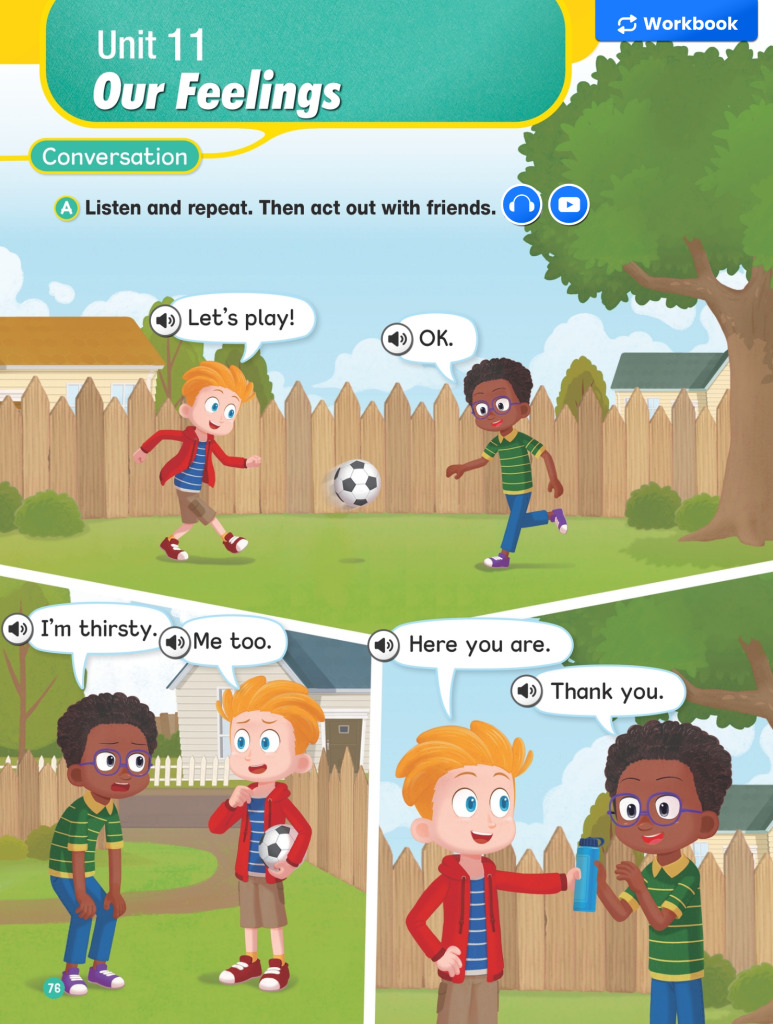
Smart English uses comics and characters to introduce everyday expressions, with review activities that bring earlier language back. If a learner already uses this series, make the dialogue a starting point for interaction rather than an exercise in memorising both parts.
For example, model one exchange, let the learner choose their response, then change a detail and swap roles. Check the edition before selecting companion materials or an app; resources from different editions should not be treated as interchangeable.
Use a teacher's manual as a plan you can adapt
Read the lesson aim before selecting the activities. Prepare the audio, pictures and any materials you need, then decide how each task contributes to that aim. You do not have to use every optional activity.
A useful planning note answers four questions:
- What should the learner be able to do by the end?
- What model or example will help them start?
- How will they practise with support?
- What will show whether they can use the language more independently?
Adapt group tasks deliberately. In a pair activity, you can be the partner, but avoid answering your own questions. In an information-gap task, give each person different information and a reason to ask. In a team game, use the learner's own earlier attempt as a point of comparison rather than creating a competition they cannot win.
Keep one easier version and one extension ready. The easier version might use two picture choices or a sentence starter. The extension might ask for a reason, an extra detail or a question back.
A one-to-one lesson example: from food words to a real request
Suppose the learner can name some foods but rarely speaks beyond single words. Your aim is for them to ask for an item using a familiar request such as “Can I have…?” and respond when roles change.
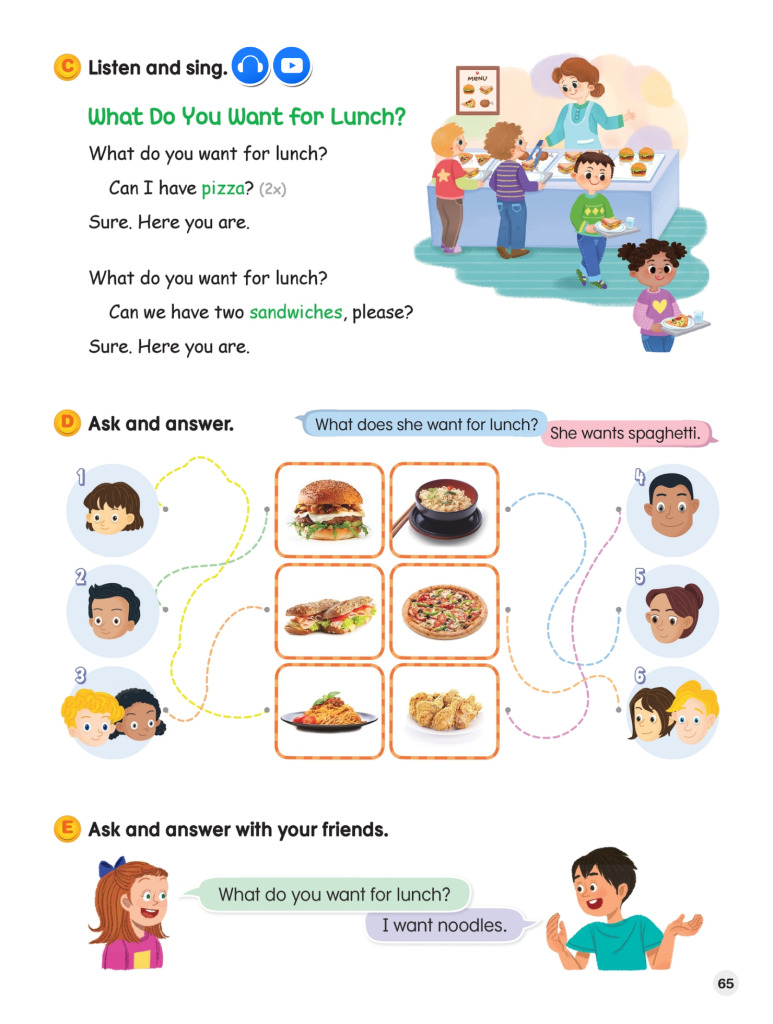
The following is a suggested 45-minute lesson, not a fixed coursebook script. Shorten it or add breaks to suit the child.
- Reconnect — 5 minutes. Use a few familiar food pictures to recall words. Include something from the previous lesson.
- Listen and notice — 5 minutes. Play a suitable course dialogue or model a brief exchange. Ask the learner to identify what is requested.
- Practise with support — 10 minutes. Use pictures and a sentence starter. Take turns asking and responding, with several different items.
- Use the language — 10 minutes. Make a small shop with picture cards. Keep some items hidden so the learner needs to ask for them. Change roles.
- Revisit a difficulty — 5 minutes. Work on one phrase or sound that caused a problem, then return to the exchange.
- Check and close — 10 minutes. Repeat the task with a new selection of pictures and less prompting. Agree on one manageable activity before the next lesson.
A learner who needs more support could point to a sentence strip. A learner ready for more could ask for two items or respond when something is unavailable. The goal stays meaningful while the support changes.
Use digital resources for a specific teaching purpose
eSmartClass learning management and course resources include class e-books, downloadable materials, online practice and tests. The teacher tools allow you to review learning history and results.
Check the supported course, edition and access arrangements first. Class e-books are teacher-facing resources; student accounts should not be assumed to have identical access. Resource availability and permissions matter when planning both online and face-to-face lessons.
Use the platform to answer a teaching question. Which task did the learner find difficult? Did they complete the agreed practice? What should you revisit next? Completion records are useful evidence of activity, but you still need to hear the learner use the language.
Add reading when it serves the learner's goal
A short reader can provide a shared topic for listening, vocabulary and conversation. Before reading, use the cover or pictures to invite a prediction. During reading, keep interruptions manageable. Afterwards, ask for a response that fits the learner's level: choose a favourite character, order pictures or explain a decision in the story.
Browse graded English readers and comic books for print options. Our guide to active English reading with children offers further activity ideas; check current product pages for library access details.
If you teach through a school or language school, e-Library's reading and teacher tools may support reading between lessons. The current offer requires at least 10 student accesses and is not sold individually. MetaLibrary's missions, rewards and teacher dashboard are another school-organised option, also with a minimum of 10 students. These are separate library services, not automatic features of an eSmartClass account.
For a single private learner, choose suitable print materials or work with access already organised by their school. Do not build a lesson plan around an individual library subscription that is not offered.
Build confidence through achievable tasks and useful feedback
Let the learner rehearse before asking for a performance. Give them a choice of a familiar object to describe or a character to play. Praise a specific action: asking a question without reading it, trying a new word or noticing their own mistake.
Correction should support the task. If the learner is trying to communicate, note a recurring error and return to it afterwards rather than interrupting every sentence. During focused practice, give a clear model and let them try again.
For grammar work, connect the form to something the learner wants to say. After practising a sentence pattern, change the picture or ask about the child's own routine. Our practical guide to English grammar teaching introduces further approaches and grammar resources.
Show parents evidence, not just completed pages
Keep a brief record of the lesson aim, the support used and the next step. Save selected work or, with appropriate permission, a short speaking sample. Compare similar tasks over time.
A useful parent update might say:
“Today we practised asking for food. Your child made requests using pictures and managed the final exchange without the sentence strip. Next time we will revisit the phrase and practise responding when an item is unavailable.”
This is an example of feedback, not a promised outcome. It shows parents what happened and gives the next lesson a clear starting point.
Keep developing your teaching practice
After each lesson, note where the learner spoke independently, where you gave too much help and which activity you would change. Use teacher guides, training and feedback from an experienced colleague to address a specific question in your practice.
When you attend a webinar or observe a lesson, choose one idea to try and review its usefulness afterwards. A new game is valuable when it helps the learner do something you have identified, not simply because it fills the time.
Frequently asked questions
Should I follow the child's schoolbook or use another course?
Start with the purpose of the tutoring. If the learner needs help with school content, use that material to identify gaps. A separate course can provide a more consistent sequence where broader development is needed. Avoid setting two competing workloads without a clear reason.
Do I need a teacher's manual for individual lessons?
A manual can help with lesson sequence, preparation and ways to practise the language. You still need to adapt the activities to one learner and check understanding. Use the manual for the correct course and level.
How much homework should I set?
Choose an amount the learner and family can realistically manage. One short audio-supported task or a familiar reading activity with a clear purpose can be a better starting point than several unrelated worksheets. Review it in the next lesson.
How do I choose my first e-future materials?
Begin with a sample of the learner's English and a clear goal. Compare the level and lesson style of Hand in Hand and Let's Smile, then check the matching student materials and teacher's manual. Confirm any digital access before relying on it.
Plan the next lesson around one clear goal
Choose what the learner needs to do, prepare a model and supported practice, and leave time to see what they can do with less help. Record the next step while the lesson is still fresh.
To choose your course resources, compare Hand in Hand and Let's Smile. Review the manual for your learner's level and use it to plan a sequence you can adapt as their English develops.
Recommended

Hand in Hand Starter Teacher's Manual

Hand in Hand 1 Teacher's Manual

Hand in Hand 2 Teacher's Manual

Hand in Hand 3 Teacher's Manual
Hand in Hand 4 Teacher's Manual

Hand in Hand 5 Teacher's Manual

Hand in Hand 6 Teacher's Manual
Let's Smile Starter Teacher's Manual

Let's Smile 1 Teacher's Manual
Let's Smile 2 Teacher's Manual

Let's Smile 3 Teacher's Manual
Let's Smile 4 Teacher's Manual
Let's Smile 5 Teacher's Manual

Let's Smile 6 Teacher's Manual

Smart English 6 Teacher's Manual

Smart English 5 Teacher's Manual

Smart English 4 Teacher's Manual

Smart English 3 Teacher's Manual
Smart English 2 Teacher's Manual

Smart English 1 Teacher's Manual
