
About e-Library
A library that makes regular English reading easier to run
1,204 readers, audio, activities and teacher reports. Main range: Pre-A1 to B2.
Recommended device: computer. Minimum 10 students. No individual sales.
 Read · listen · practise
See how e-Library works
The short film shows the catalogue, reading view and student journey.
Reading that teachers can guide and review
Students
Choose a book, listen to audio, follow highlighted text and complete activities or a read-aloud recording.
Teachers
Create classes, recommend books and review reading, recordings and activity results.
Parents
Talk about completed stories and see the work students have done.
Schools
Use one catalogue across lessons, the school library and home reading.
From phonics to longer B2 reading
A short test helps recommend a level, while students can still browse the complete catalogue of 1,204 titles.

Little Sprout Readers
Rhyming beginner books connected with songs and animated stories.

Phonics Fun Readers
Controlled vocabulary, phonics work, picture glossaries and songs.

Smart Phonics Readers
Accessible stories practise target sounds and words.

Classic Readers — Elementary
Retold classics with controlled grammar and vocabulary.
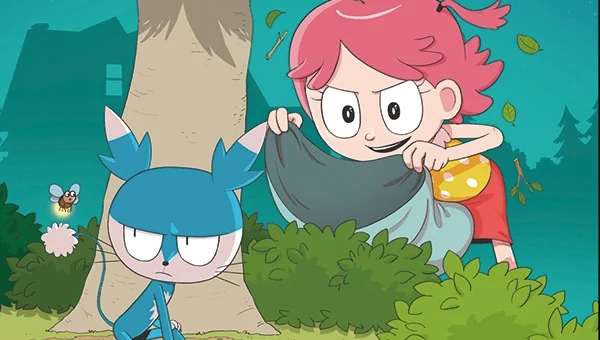
Vera the Alien Hunter
A comic series connecting reading with speaking, listening and grammar.

Magic Adventures
Comic adventures present words and structures in context.

Art Classic Stories
Classic stories connect language, narrative and art.

PYP Readers
Six levels of inquiry-based reading.
Read, listen and check understanding

Audio, highlighted text and dictionary
Students listen, follow the text, check unfamiliar words and return to saved progress.

Quizzes, games and reading aloud
After reading, students complete activities, record themselves and can write a review.

Classes, recommendations and results
Teachers manage access, recommend books and review activity, recordings and results.
Open books and activities before you choose
Test the reading interface and see what the games and post-reading quizzes look like in the free sample.
Open free sampleLots of accessible books. Fluency built step by step.
Dr Rob Waring has presented and published widely on Extensive Reading and second language vocabulary acquisition. In eFuture’s material, he explains the purpose, scale and reported benefits of Extensive Reading.

Repeated encounters require a large amount of text
A simple rule of thumb is that a typical word needs 10-20 meetings before it stays in your head. To meet all the 1,000 most frequent words in English at least 20 times, students need to meet about 160,000 words. To master 5,000 words they need to meet about 3,000,000 words.
Source: e-future e-Library, “Extensive Reading”, material featuring Dr Rob Waring.
Gross price per student access
Minimum order: 10 students. EUR pricing for European schools.
e-Library
| Students | 6 months | 12 months (2 months free) |
|---|---|---|
| 10–49 | €27 | €45 |
| 50–99 | €23 | €38 |
| 100–199 | €20 | €34 |
| 200+ | €18 | €30 |
When e-Library is the right choice
Choose e-Library when you want to open a large reading catalogue quickly and give teachers a clear set of class tools.
Compare with MetaLibrary
Planning e-Library for your school
- Decide who will read. Choose the classes or groups and count the student accesses you need. The minimum order is 10 students. No personal data is needed: a first name and an initial are enough for each student account.
- Check the starting level. The main range runs from Pre-A1 to B2. A short test helps recommend a level, and students can still browse the whole catalogue.
- Plan regular reading time. Use the library in lessons, in the school library and for home reading. We recommend a computer.
- Agree how you will follow progress. Teachers create classes, recommend books and review reading, recordings and activity results.
- See it first. Request teacher trial access and tell us your school type, the number of accesses you need and the library you would like to see.
See the library as a teacher and as a student
Choose MetaLibrary or e-Library. We will email you access to a teacher account and a student account straight away.
Good to know
- Trial access is free and lasts until the end of the current month. If you sign up in the last week of a month, we will send you new access on the 1st of the next month, valid until the end of that month.
- Student access is ordered by the school, as a group subscription for at least 10 students.
The form opens in a new tab.
FAQ
Must students read only recommended books?
No. The test supports a suitable starting point, but students can browse the whole catalogue.
Which device is recommended?
We recommend a computer.
What can teachers see?
Class and student activity, reading, recordings, activity results, levels and reports.
Do e-Library and MetaLibrary have the same catalogue?
Yes. Both versions use the same 1,204 readers.
Can we start with one class?
Yes, if the group has at least 10 students.
How long does access last?
6 or 12 months from activation, depending on the option your school chooses. See the subscription options.
Recommended

e-future Online Library: Group Subscription 12 months
