
Phonics: how children learn to read in English
A child knows the word sun from listening, but meets it in a book for the first time. Instead of waiting for someone to read it aloud, they connect the spelling with its sounds: /s/ /ʌ/ /n/ → sun. Phonics helps children make that connection and begin reading words for themselves. The next task matters just as much: understanding what those words mean in a sentence and in the story as a whole.
For an English as a foreign language teacher, this means developing word reading alongside the language children understand. This guide explains the main approaches to phonics, offers seven activities and shows how a structured programme can lead from individual sounds to meaningful reading.
At a glance
- Phonics connects letters and groups of letters with speech sounds. Children blend sounds to read words and segment spoken words to help spell them.
- A systematic programme provides a planned sequence, review and reading practice matched to the spelling–sound relationships already taught.
- Synthetic phonics has the largest evidence base in the EEF overview. Choose the pace and activities to suit learners' skills and language experience, combining sound work with vocabulary and comprehension.
- In EFL, oral vocabulary, listening and comprehension need attention alongside decoding.
- Flashcards can support the first steps, but sentences, stories and discussion give children a reason to use what they learn.
Contents
- What phonics teaches
- Synthetic, analytic, analogy and embedded phonics
- From listening to fluent reading
- Phonics in the EFL classroom
- Seven activities to try
- How families can help
- Decoding is not the whole of reading
- Using e-future materials
- Frequently asked questions
- Sources
What phonics teaches
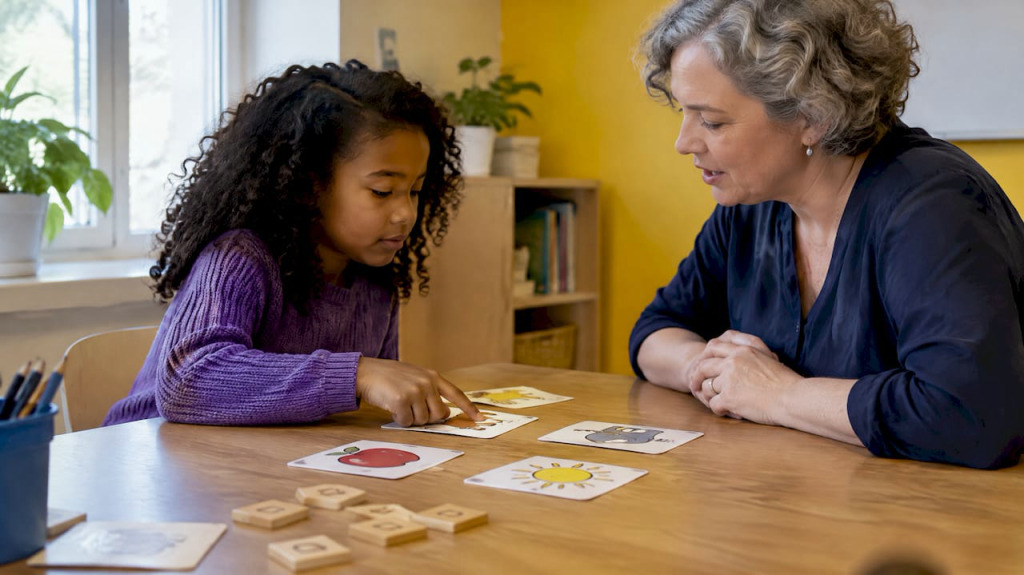
Phonics teaches the relationship between written symbols and speech sounds. As the National Literacy Trust explains, children match sounds to individual letters or groups of letters, then use that knowledge to read and spell.
In cat, three letters represent three sounds: /k/ /æ/ /t/. In fish, four letters represent three sounds: /f/ /ɪ/ /ʃ/. The final sh is a digraph: two letters representing one sound in that word. Learning phonics is therefore more than learning the alphabet.
A note on pronunciation: examples between slashes use the International Phonetic Alphabet, or IPA. The examples in this article follow British dictionary transcriptions: sun /sʌn/, pig /pɪɡ/, dog /dɒɡ/ and fish /fɪʃ/. Letters and spellings such as sh appear in italics without slashes. Use your course recordings as the classroom model; other varieties of English also have valid pronunciations. Children do not need to learn IPA to take part in phonics lessons.
A child who can already read in another language may understand the idea of blending sounds, but still needs to learn English spelling–sound relationships. The sound /k/, for example, can be written as c, k, ck or ch: cat, kite, duck, school. A familiar-looking letter does not always behave as it does in the child's first language.
Patterns help children move beyond learning each word separately. A child who knows big and pig can draw on the shared -ig pattern when reading dig. British Council authors Susan Russak and Richard Wong explain how comparing words in this way supports predictions about unfamiliar spellings. The new word still needs to contain relationships the learner knows or is being taught.
Synthetic, analytic, analogy and embedded phonics
The National Literacy Trust describes four approaches. The terms refer to different ways of organising instruction, rather than four names for the same activity.
- Synthetic phonics: children learn the sounds associated with letters or groups of letters and blend them into a word, for example /p/ /ɪ/ /ɡ/ → pig. Here, “synthetic” means putting sounds together.
- Analytic phonics: children examine familiar words for a shared spelling–sound relationship, such as the beginning of ball, bat and bed, without pronouncing the target sound in isolation.
- Analogy phonics: children use known word parts to help read new words, for example moving from cake to make and bake. This approach draws on word families.
- Embedded phonics: the teacher introduces spelling–sound relationships as they arise in a text. The teaching opportunities come from the reading rather than a separate, planned sequence.
The Education Endowment Foundation reports that the largest evidence base concerns synthetic phonics. Its overview describes higher average impacts for synthetic and analytic approaches than for analogy and embedded approaches, which have fewer studies. Use these findings to inform programme choice in EFL, taking learners' English knowledge and reading skills into account.
Keep the classroom core systematic: decide what to teach, provide practice and return to earlier learning. Listening, comparing words and reading stories can reinforce that work. Fit stories into the planned sequence, choosing an approach that serves the activity's purpose.
From listening to fluent reading
These six areas show what children are learning. Let the course sequence and learners' progress guide the order and pace: programmes introduce some spellings in different orders. Develop vocabulary, comprehension and knowledge of common words throughout the process.
1. Listening and playing with sounds
Rhymes, syllable clapping and finding words with the same beginning develop phonological awareness. These activities focus on spoken language and can take place without print. Children also learn to identify and blend individual speech sounds.
Listening work can continue alongside early letter–sound teaching. Introduce the first written correspondences while children continue practising rhymes and sound play.
2. The first letter–sound relationships
The letter name for a is different from /æ/, the first sound in apple. Children need both kinds of knowledge, but they use sounds rather than letter names when blending a word.
Some programmes begin with a small set of letters that can quickly form words. The letters s, a, t, p, i, n, for example, allow children to build sat, pin, tap and nap. Let the pace reflect what learners can actually read and spell, rather than the number of pages completed.
3. Short CVC words
CVC stands for consonant–vowel–consonant. Straightforward examples include cat, dog, sun and bed. Children practise blending, putting sounds together to read, and segmenting, identifying the sounds in a spoken word.
English vowel sounds may differ from those in a learner's first language. Give children opportunities to hear, compare and say them with a clear model, rather than relying on an approximate spelling in another language.
4. Consonant blends and digraphs
In a consonant blend such as st, bl or fr, both consonant sounds remain. A digraph has two letters representing a single sound in a particular word: sh in ship or ck in duck. So ship contains four letters but three sounds: /ʃ/ /ɪ/ /p/.
A digraph does not necessarily have only one pronunciation in every word. For example, th represents /θ/ in thin and /ð/ in this. Introduce the examples and contrasts in line with the programme you use.
5. Further vowel patterns
Children compare cap with cape and kit with kite, then meet spellings such as ai, ay, ee and oa. The classroom label “long vowel” does not simply mean stretching a previously learned short sound: compare /æ/ in cap with /eɪ/ in cape.
The same spelling can also represent different sounds, as ea does in sea and head. Examples, review and meaningful sentences help children build their knowledge of these patterns.
6. Common words and fluency
“High-frequency” does not mean “irregular”. Some common words can be read using relationships already taught; others contain a part that needs particular attention. In said, children can identify the familiar /s/ and /d/, then learn the unusual pronunciation of ai in that word.
Introduce these words as they become useful in reading. Returning to a short, understood story gives children a chance to work on fluency and expression without having to solve a new decoding problem in every sentence.
Phonics in the EFL classroom
Children learning English as a foreign language may recognise a word in print without knowing what it means. Others know the spoken word but cannot yet read it. Notice which kind of support is needed before choosing an activity.
With preschool learners, start from understood words, stories and sound play. Add initial letter–sound relationships when the group is ready. Activities need not all involve writing. For the wider course choice, our preschool English books guide considers the materials a teacher needs around the Student Book.
With early primary learners, find out what children can already do in spoken English and in reading. Some may transfer an understanding of blending from another language; others will need more modelling. A regular phonics slot can sit within the lesson, followed by games and stories that reuse the target words.
In a language school, plan reading and spelling alongside the main English course. In a mixed group, assess decoding separately from vocabulary and comprehension. Reading dog aloud accurately and understanding dog are related but different achievements.
Melanie Ellis's paper on early reading materials argues for more explicit attention to alphabetic principles and decoding in Polish early years EFL education. Her theoretical discussion draws partly on classroom observations in that setting. For teachers elsewhere, it offers a useful starting point: give children explicit help with the English written code alongside work with familiar words and their meanings.
Slow, effortful blending is a normal part of beginning to read. Look at the support a child needs and the progress they make, rather than comparing reading speed alone.
Seven activities to try
Choose words and spellings already introduced in your programme. Make sure children understand the target vocabulary before the decoding task.
- Guess the word from its sounds. Say /d/ /ɒ/ /ɡ/. Children blend the sounds into dog and choose the matching picture. Without print, this is oral blending. Then show the word and connect each sound to its letter.
- Move a counter for each sound. Say fish. Children segment /f/ /ɪ/ /ʃ/ and move three counters. Next, match the sounds to f–i–sh. The two final letters share one position because they represent one sound.
- Hunt for a sound and its spelling. First, children listen for words containing /ʃ/. Then they look for the taught digraph sh in a short, suitable text. Ask them to read the word they find, not simply circle the letters.
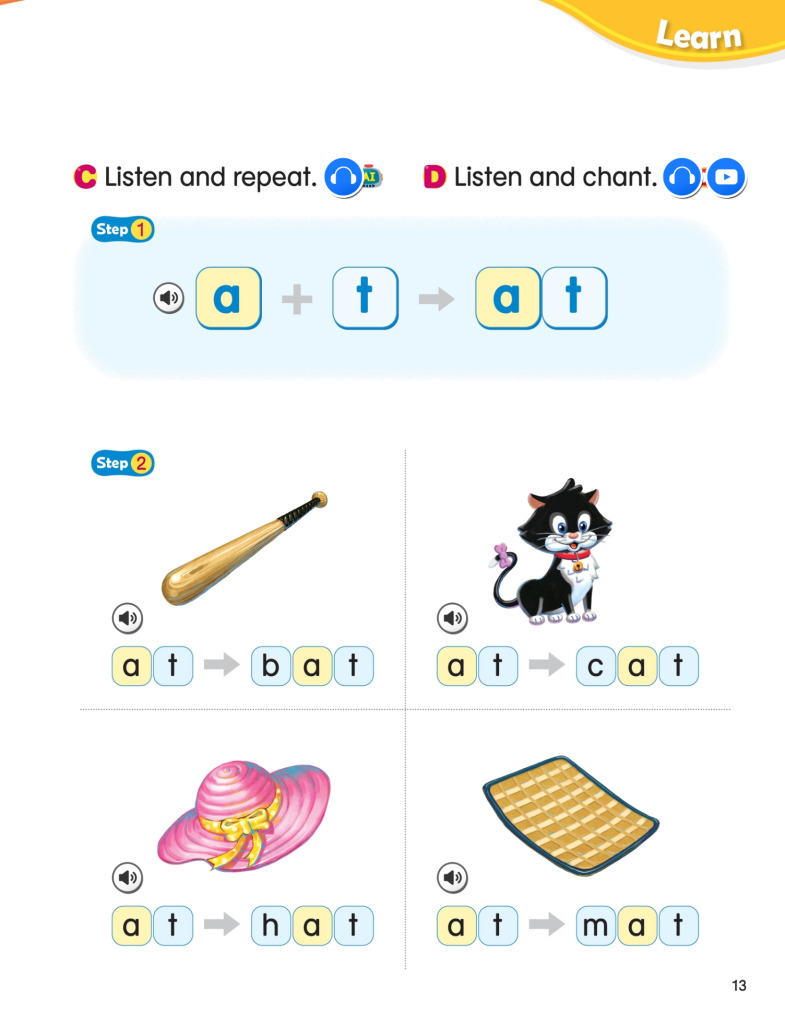
- Build a word family. Write cat, hat, mat, bat, sat. Compare the changing beginning and shared -at part. Finish by choosing a word for a picture or a short sentence, keeping the activity connected to meaning.
- Change one letter. Build cat → cot → cut → hut. At each step, children say the new word and identify the changed letter and sound. Use the chain after the relevant vowels and words have been introduced.
- Sound-by-sound spelling. Say a familiar word such as fish. Children identify three sounds and choose the letters or letter groups to represent them: f–i–sh. Work sound by sound rather than insisting on one letter for each sound.
- Read a story within reach. Choose a short text matched to the spelling–sound relationships and exception words children have learned. This is what makes a text decodable for a particular learner. After reading, ask children to point out a funny moment or explain what happened. Guidance from Spain's Ministry of Education and the British Council recommends such a match so children can experience achievement from the beginning.
When modelling consonants, avoid adding an extra vowel: say /b/, not “buh”, and /t/, not “tuh”. Keep stop consonants brief and clear. Other sounds, such as /s/ and /m/, can be sustained briefly to support smooth blending; there is no need to cut every sound equally short.
How families can help
Home practice works best when it reinforces classroom learning rather than introducing a competing sequence.
- Start small. A few minutes with familiar words can provide useful review. Adjust the length to the child's attention and what they can do independently.
- Recall the meaning first. Show a picture, use the word in a sentence or revisit a familiar story. Children should know what they are trying to read.
- Coordinate with the teacher. Find out which spelling–sound relationships have been introduced. Extra materials can help when they practise the same learning.
- Use recordings. If a pronunciation is uncertain, listen to the course audio or a dictionary recording. Avoid relying on a written approximation in the family's first language.
- Read for enjoyment too. An adult can read a more demanding book aloud while the child listens and talks about the pictures. Choose easier passages for independent decoding. Our guide to active reading with children offers further ideas for shared reading.
If difficulties persist despite suitable support, speak to the teacher. Consider vocabulary, sound awareness and spelling–sound knowledge separately. Seek specialist advice as soon as the need arises.
Decoding is not the whole of reading
A child can read a sentence aloud accurately without understanding it. The Hong Kong Education Bureau's phonics resource explains that phonics supports word reading and spelling, while teaching also needs to develop reading for meaning. British Council authors highlight oral vocabulary as a particular consideration for children learning English as an additional language.
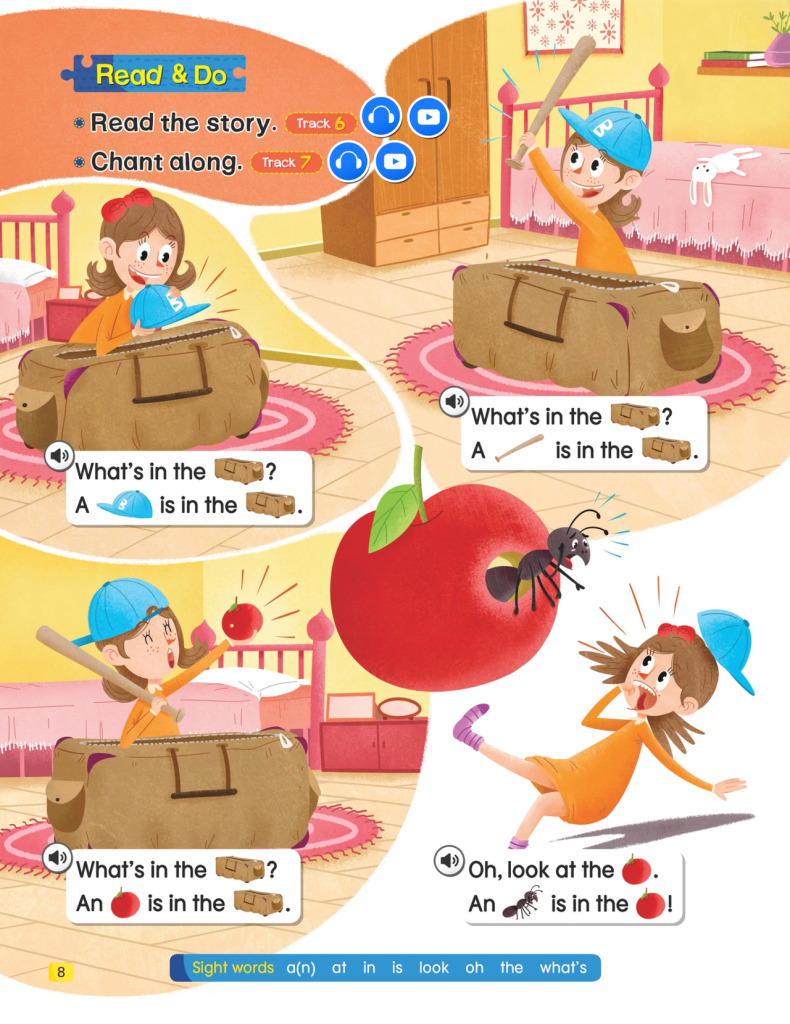
Alongside decoding, talk about what children understand. Ask why a character hid behind a tree or which illustration matches a sentence. Let learners respond by pointing, using a gesture or giving a short spoken answer according to their language level.
Children can enjoy stories from the beginning of phonics learning. Distinguish the text a learner can decode independently from a richer book the teacher reads aloud and discusses with the class. Our guide to choosing English reading texts and checking understanding explores that next step.
Using e-future materials
A complete programme helps organise the sequence, review and transition from isolated words to stories. The eFuture range includes four phonics series:
- School Phonics — four levels. The Student Book includes practice activities, stickers and three readers. The series also has a separate Workbook.
- Smart Phonics, 3rd Edition — five levels. The Student Book and Workbook are separate, allowing teachers to organise new learning and additional practice independently.
- EFL Phonics, 3rd Edition — five levels. The Student Book offered here includes an integrated workbook.
- Speed Phonics — three levels. Each level combines the Student Book and Workbook in one volume. The material is arranged more compactly; adjust the pace to the group's progress.
All four programmes combine flashcards, games, stories and animations with eSmartClass resources. This gives children different ways to return to a pattern: hearing it, reading it, spelling it and finding it in a story. Compare the teaching sequence, number of levels and organisation of components when choosing for a group.
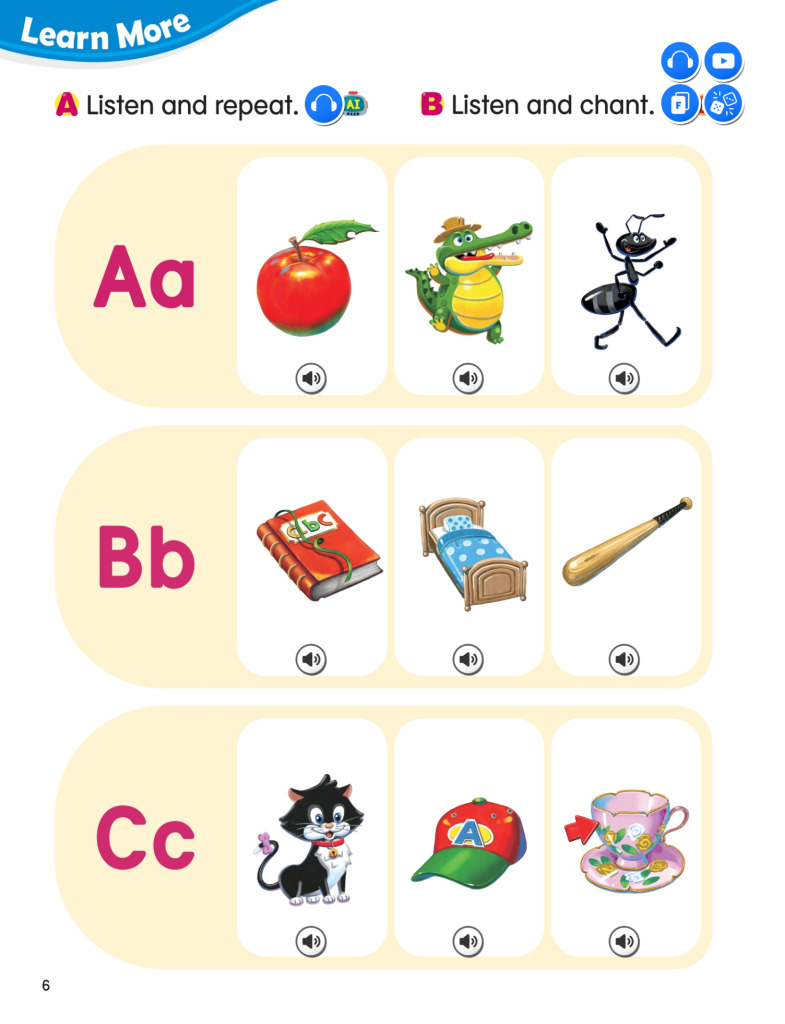
In class, start with the picture side of a flashcard and the spoken word. Turn the card over so children can connect its pronunciation and spelling, then find the familiar pattern in a short story. The card supports reading the word; the story gives children a reason to use it and understand it in context.
Compare the phonics series in the eFuture catalogue. Our reading-text guide also gives a fuller comparison of the four programmes and an example of a story in use. As learners develop comprehension across further texts, you can choose a suitable level of Smart Reading.
For a wider school reading programme, e-Library or MetaLibrary can provide further reading choices. When choosing a decodable text for a beginner from an online library, check the individual title against the learner's knowledge. See the current group subscription options for access terms. eSmartClass is a separate platform for course materials; e-Library and MetaLibrary serve as reading libraries.
Frequently asked questions
At what age can children begin phonics?
Sound play and nursery rhymes can begin in preschool. Introduce letter–sound relationships according to children's readiness, English experience and the programme. English reading can develop alongside reading in another language; choose the starting point for systematic work to suit the group.
Will English phonics interfere with reading in another language?
Children may initially apply familiar letter–sound relationships from one language to another. Clear language contexts, recordings and practice with specific differences can help. Transfer depends partly on the languages involved and the differences between their reading systems. Support reading in both languages and discuss persistent difficulties with the teacher.
How is synthetic phonics different from whole-word teaching?
Synthetic phonics teaches children to blend sounds represented by letters and letter groups, helping them read new words with familiar patterns. Whole-word teaching begins with recognition of a word's complete written form. Do not confuse this with automatic word recognition developed through decoding practice: reading familiar words fluently is a desirable outcome.
How much time should phonics take?
Plan short, regular sessions. The Spanish Ministry of Education and British Council guidance gives 10–15 minutes daily as an example in its bilingual programme. In EFL, use this as a reference point and adapt the time to the group and lesson plan. For home review, start with a few minutes and notice the child's attention and independence.
What about words such as the, said and was?
Introduce them when they are needed, highlighting both familiar spelling–sound relationships and parts that need particular explanation. Not all high-frequency words are irregular. Revisit the words in meaningful sentences rather than relying only on memorised lists.
Sources
- National Literacy Trust: What is phonics?
- British Council, Susan Russak and Richard Wong: How phonics can give children a head start with reading English
- Education Endowment Foundation: Phonics
- Melanie Ellis: Supporting young L2 English learners with word recognition: design of early reading materials
- Ministerio de Educación and British Council: Orientaciones para la enseñanza del inglés (Literacy) en el marco del Programa Educativo Bilingüe en Educación Primaria, Annex 2
- Education Bureau, Hong Kong: Teaching Phonics at Primary Level
- Cambridge Dictionary, British pronunciation examples: sun, pig, dog, fish.