

An eraser goes missing, Tango feels sad, and later he smiles again. Children follow the pictures, recognise feelings and hear a familiar question in a new situation. A song, a story and a short conversation can work together without becoming another vocabulary list.
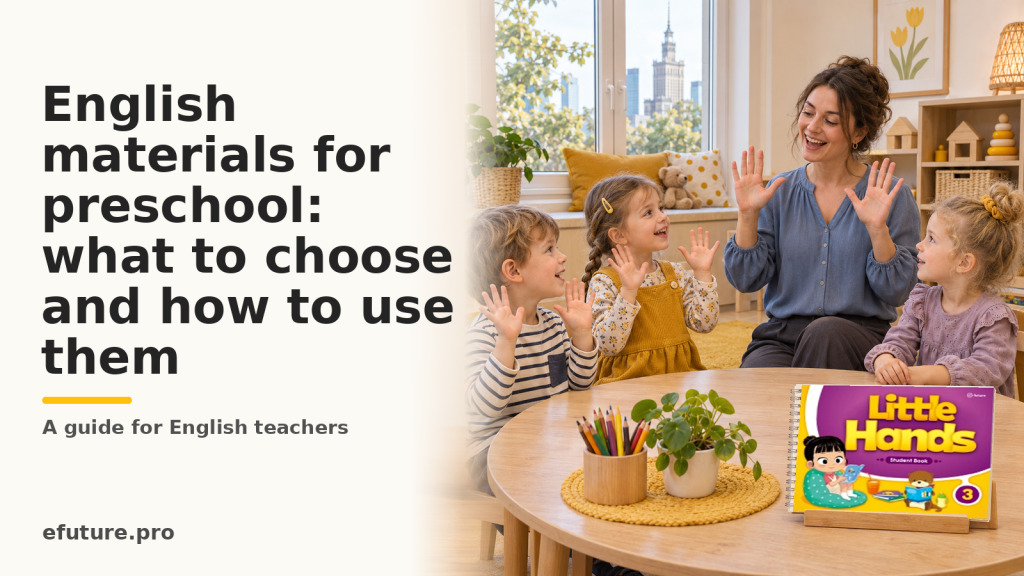
Preschool English resources are most useful when they give children something to do: point, move, choose, respond or help someone find an object. Using Little Hands, this guide shows how to bring recordings, picture cards, books and craft activities together around a clear communication goal. It includes eight videos from e-future ELT, practical ways to use them and a sample short lesson.
The essentials
- Start with what children will understand and do in English, rather than how many pages they will complete.
- Match the level to previous learning and readiness for the activities. Catalogue ages help you find resources; they do not replace observing your class.
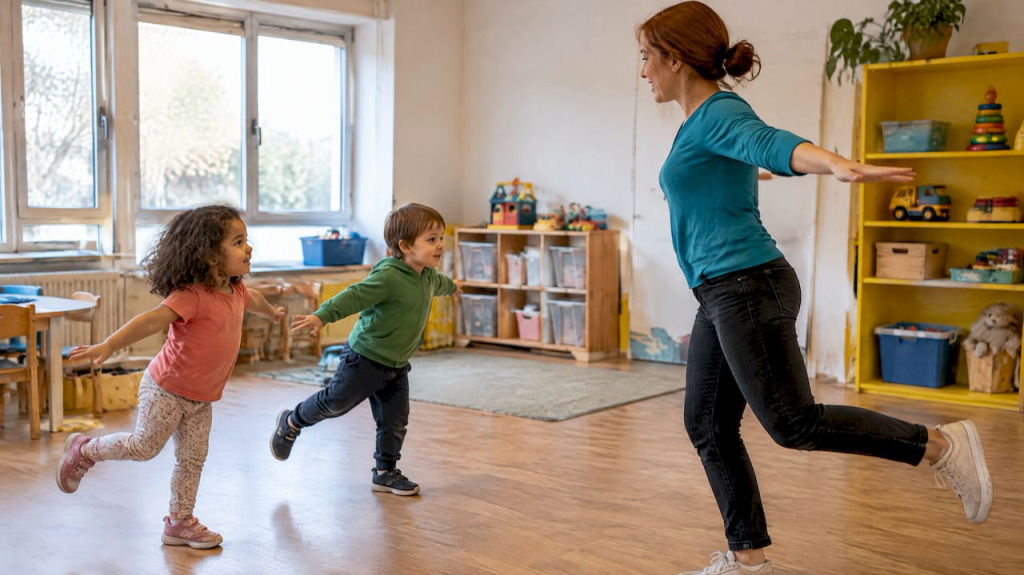
- Children can join a song through actions before they are ready to sing. Not everyone needs to start speaking at the same time.
- Revisit a useful phrase in different situations: in a recording, with a puppet, at a table and while tidying up.
- Use a video to support a shared activity. Once the screen is off, bring the language back into the room.
Contents
- Lesson goals and Poland’s 2026/27 curriculum
- Putting the Little Hands components to work
- Three songs: feelings, questions and actions
- Tango’s Eraser: a story that brings language back
- Two activities: folding and story sequencing
- A sample 25-minute lesson
- Two videos for the teacher
- Moving from preschool into Grade 1
- A short activity at home
- Extra resources and your next step
- Questions from teachers and parents
Lesson goals and Poland’s 2026/27 curriculum
Instead of recording only a topic such as “school supplies”, decide what children will do with the language. For example, they might recognise “Is this your eraser?” and respond with a word, an action or a short “Yes, it is”. Choose an object, a picture and a situation that make that exchange meaningful. The eraser becomes something to ask about, rather than just a word to repeat.
In Poland, a new preschool core curriculum applies from the 2026/2027 school year. It is set out in the Minister of Education’s regulation of 11 March 2026, Journal of Laws item 378. Annex 1 includes naming selected objects in the immediate environment in a modern foreign language, responding to simple instructions, taking part in a simple communication situation, and repeating rhymes and singing songs. The implementation guidance places language learning within play, everyday situations and different areas of children’s development.
For lesson planning, that means creating opportunities to use language as well as recognise pictures. A child might pass a crayon, point to a missing object, respond to a puppet or join a refrain. The achievements described for the end of preschool are not entry requirements for the youngest class.
The primary-school change is being phased in. In 2026/27, the new curriculum applies to Grades 1 and 4; Grades 2 and 3 continue with the previous curriculum, as amended. Sections 2 and 4 of the regulation establish this timetable. The 2017 wording should therefore not be presented as the single current framework for all Polish preschools and Grades 1–3. These legal details concern Poland, not preschool requirements in other countries.
Putting the Little Hands components to work
Little Hands is a four-level e-future course: Nursery and Levels 1, 2 and 3. It combines everyday vocabulary and useful expressions with songs, stories, illustrations and art projects. The age guidance in the Polish catalogue starts with Nursery for age 2, Level 1 for age 3, Level 2 for age 4 and Level 3 for age 5. These are starting points for choosing materials, not a rule that every child of a particular age belongs at the same level.
Look at a sample before deciding. Can the children follow the instructions, find their way around the picture and carry out the activity comfortably? An older class beginning English may need a simpler introduction. Children who already know the phrases may need more independent turns, rather than a faster version of the same repetition.
Each component has a different job:
- Student Book. The main learner’s book provides shared pictures and contexts for listening, pointing and talking. You do not need to work through a page without pausing. Find one detail together, then return to the recording.
- Activity Book. Practice activities connect pictures with colouring, matching and other tasks. Link what children do with their hands to a short exchange. Choose the point in the lesson that serves your purpose; the Activity Book does not always have to come last.
- Nursery ABC Book and phonics materials in the range. These support exploration of letters and sound–print relationships. Check the component for the level you are using, rather than assuming every package contains the same items.
- Teacher’s Manual, flashcards, posters and the Chip puppet. These help you plan, show meaning and introduce someone to talk to. Check the contents of the specific teacher’s set before ordering.
- Recordings and Teacher’s E-Kit. These support work with the printed materials. Check digital resources, access arrangements and any codes for the edition and purchase concerned. Buying any single component should not be taken to mean access to every resource.
If you are still deciding what to order for a class, use the separate guide to choosing preschool English books and components. Here, the focus is on using those resources in the classroom.
Three songs: feelings, questions and actions
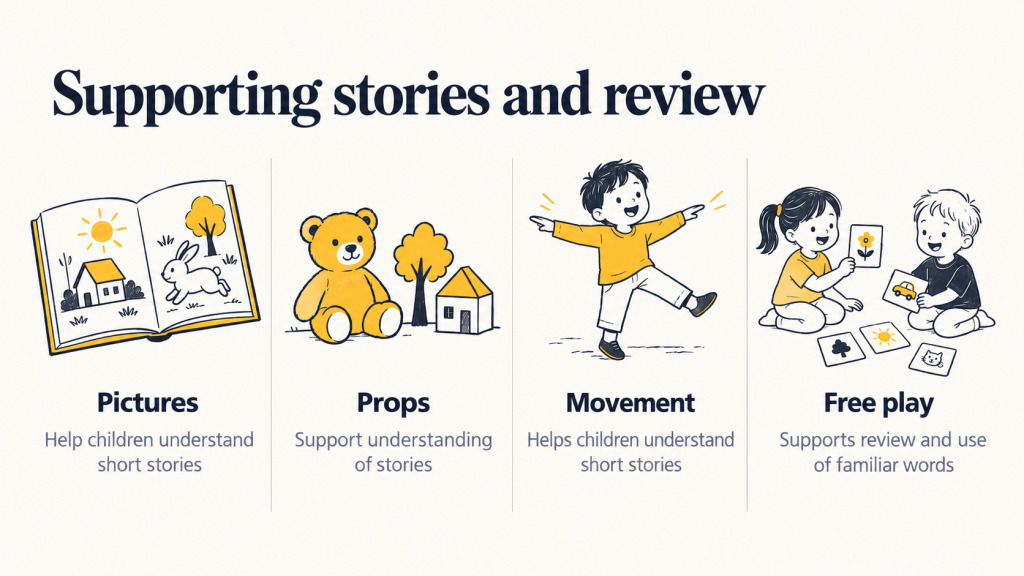
Choose one song that fits your lesson goal. Establish meaning first, invite listening and actions next, and then offer opportunities to join in with the words. A short song does not need a lengthy explanation or a compulsory performance.
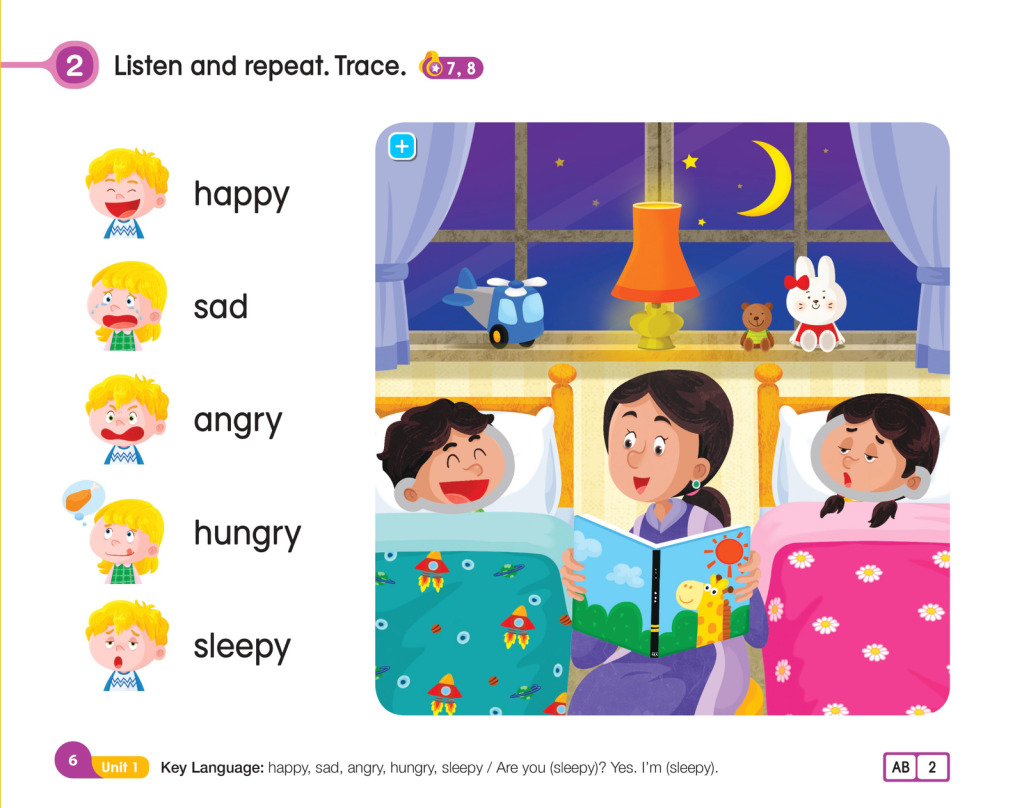
Little Hands 3, Unit 1: My Feelings
The song pairs questions about feelings and states with short answers. It includes hungry, happy, angry, sad and sleepy. Its repeated pattern lets children recognise a familiar way of responding without learning a different structure each time.
Before: show selected feelings and states with expressions or cards. During: children point to a card or make an agreed action; singing is an invitation, not a condition of taking part. After: the puppet asks about one feeling or state, and children choose a response. There is no need to ask anyone to disclose personal feelings in front of the class: they can speak for a character instead.
Watch “Little Hands 3 Unit 1 Song - My Feelings” on YouTube
Little Hands 3, Unit 2: Here it is.
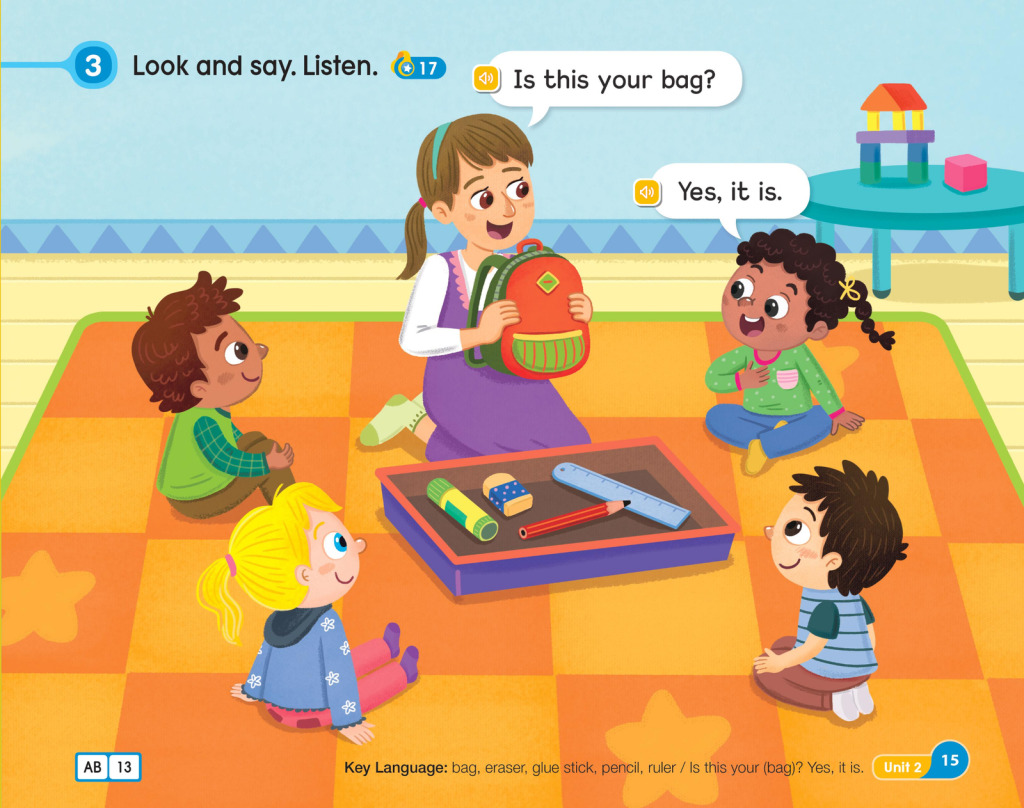
This song uses questions about classroom items and the response “Yes, it is”. The recording includes ruler, glue stick, pencil and bag. Use it to connect recognising an object with a complete question, rather than practising the object’s name alone.
Before: prepare safe classroom objects or pictures and show children how to point to the right one. During: they hold up a card when they recognise its object. After: model a short exchange about one item with the puppet, then invite volunteers to ask. You do not need to introduce every object at once.
Watch “Little Hands 3 Unit 2 Song - Here it is.” on YouTube
Little Hands 3, Review 1: Is this your eraser?
The song returns to an eraser, a question about who it belongs to, and a change from sadness to happiness. It brings classroom-item language together with feelings. This is a useful way to revisit learning: a familiar phrase gains another context instead of disappearing when the unit ends.
Before: show an eraser and recall “Is this your eraser?”. During: children can point to the eraser and change their expressions to match the recording. After: pair the song with the story below. Ask children to notice one phrase they hear in both, rather than testing them on the entire song.
Watch “Little Hands 3 Review 1 Song - Is this your eraser?” on YouTube
Tango’s Eraser: a story that brings language back
Little Hands 3, Review 1: Tango’s Eraser
Tango looks for his eraser. The story includes “Where is my eraser?”, sadness and the happiness of finding the object again. It connects the events in the story with language heard in the songs. Children do not have to understand every word to follow the change in the situation.
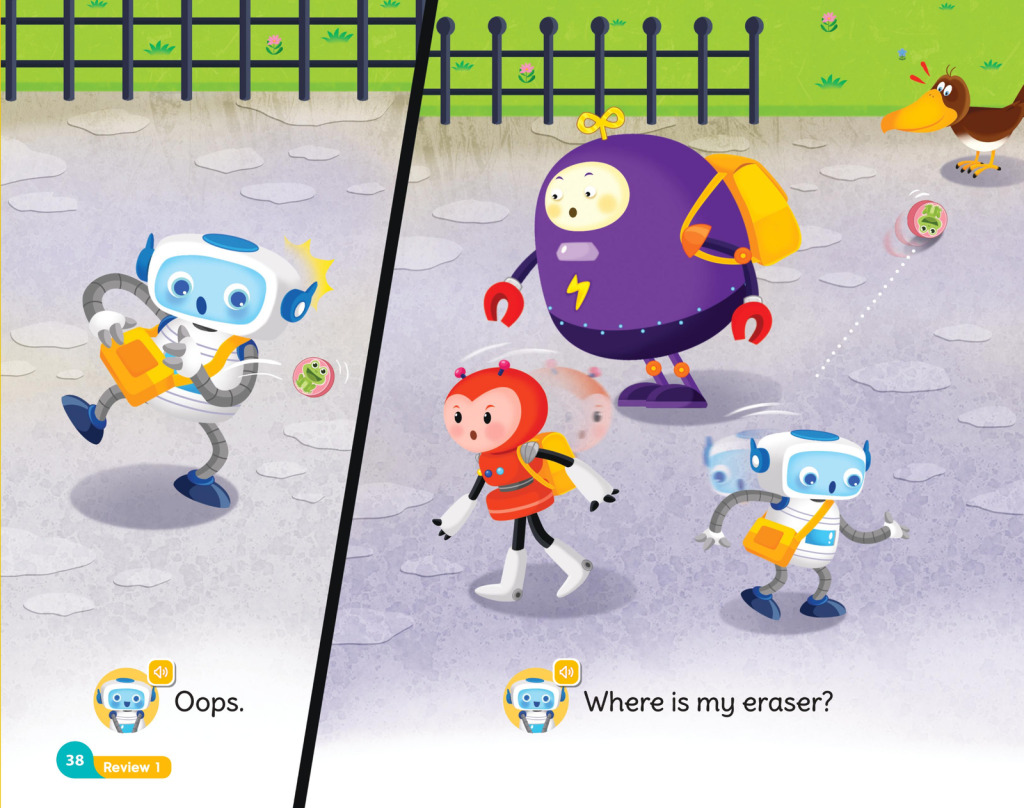
Before: show an eraser and two feeling cards: sad and happy. Set one listening task: find out how Tango’s feelings change. During: watch once without repeatedly stopping. On a later viewing, pause at a chosen moment and let children point to a feeling or an object. After: hide an eraser somewhere easy to find. The puppet asks “Where is my eraser?” and the class helps look. This is a suggested follow-up game, not an extra event from the video.
Watch “Little Hands 3 Review 1 Story - Tango’s Eraser” on YouTube
Bring the language back the following day in a shorter form: just a picture, an eraser and the familiar question. Later, change the object or let a child ask. This creates a spiral of revisiting language: recognising it, responding together and using it in a new game. It does not mean playing the same video in every lesson.
Two activities: folding and story sequencing
Hands-on work has a language purpose when children listen, choose, ask or show something. Silent colouring alone does not replace interaction in English. Equally, you do not need to comment on every mark: leave time for children to carry out the task.
Little Hands Activity: Color and fold!
In this demonstration, colouring and folding lead into a conversation about pictures. The questions include “What’s this?” and “What color is it?”, with items such as table, chair, book and crayon. This is an activity demonstration for the teacher, not another sing-along.
Before: the teacher watches the demonstration and prepares an appropriate worksheet and crayons. During the classroom activity: show one folding step and give children time to try it, offering physical help where needed. After: a child shows a chosen picture and the adult asks about the object or colour. A response might be pointing, a word or a sentence, depending on readiness. Folding speed is not a measure of English ability.
Watch “Little Hands Activity - Color and fold!” on YouTube
Little Hands Activity: Story sequencing
The presenter and the Chip puppet put story cards in order and revisit what they show. The demonstration includes greetings, introductions and family language. It is a separate example of working with cards, not a continuation of Tango’s Eraser.
Before: watch the example and choose cards for a story your class already knows. During: children find the first scene and then the next. If that is difficult, offer a choice between two cards. After: follow the sequence with a finger and recall one short phrase from each selected scene. Retelling the whole story independently does not have to be the final task.
Watch “Little Hands Activity - Story sequencing” on YouTube
A sample 25-minute lesson
This plan uses a question about an eraser and feelings from Little Hands 3. It is an example for a class ready for this material, not a standard lesson length for every age. Choose one song: do not try to fit all eight videos into a single session.
- Greeting — 2 minutes. The puppet greets children with a familiar phrase. They can answer or wave.
- An object and a question — 4 minutes. Show an eraser. Model “Is this your eraser?” and a short answer with the puppet. Children help point to the object.
- A song with a response — 3 minutes. Use “Is this your eraser?”. Introduce only as many actions as the class can comfortably follow.
- Story and picture talk — 5 minutes. Watch Tango’s Eraser. Return to a chosen scene and identify the character’s feeling.
- A search with the puppet — 4 minutes. The eraser disappears from an agreed place. Children help find it while hearing the familiar question.
- A short book or card activity — 5 minutes. Choose a task that fits the language. Children show the result and the adult responds in English.
- Return to the goal and say goodbye — 2 minutes. The puppet asks about the eraser again. Notice who recognises the question, who points and who now answers.
Total: 25 minutes. Shorten or leave out a stage if the class needs a break. Revisit the familiar question in the next session before adding new language. Rather than counting remembered words alone, note an observable action: recognises an object, responds to a question, answers with support or answers independently.
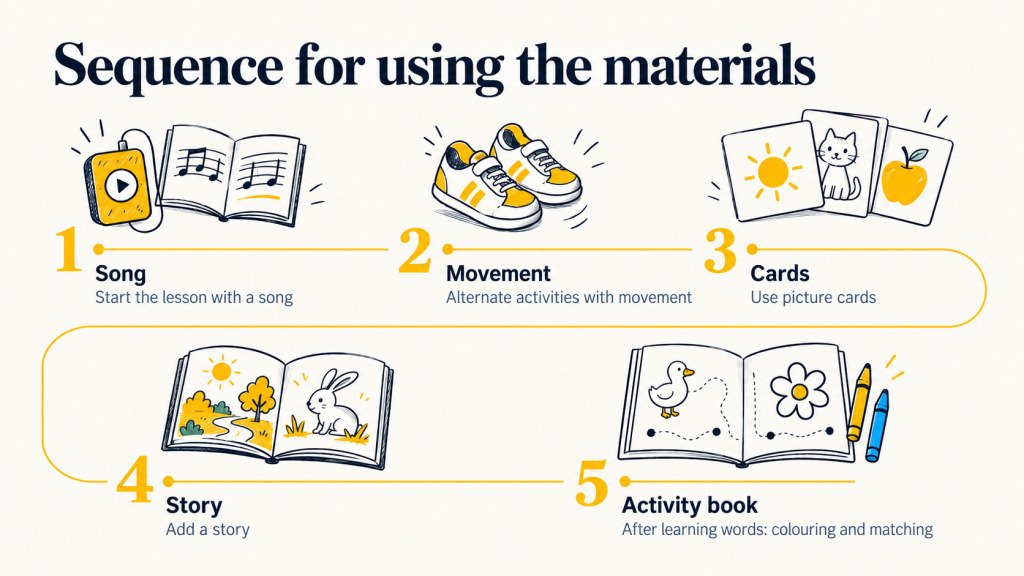
Two videos for the teacher
These recordings support the teacher’s preparation. They are not videos to play in full to a preschool class, or a pace every class should be expected to maintain.
Tips and Strategies for Kindergarten Classrooms
This training session covers topics including language and literacy development, the whole-child approach, lesson planning and games. In its discussion of safety and support, the presenter considers a classroom climate in which children do not fear other people’s reactions when they try to speak. This broader kindergarten teacher-development session can support planning your own lessons.
Before watching: choose a classroom problem, such as children being reluctant to answer in front of others. During: note one possible change to your questions or organisation of an activity. After: try it and observe whether more children can participate comfortably. There is no need to introduce every suggestion at once.
Watch “Tips and Strategies for Kindergarten Classrooms” on YouTube
Little Hands Model Lesson
The model lesson includes a greeting with Chip, fruit and a shopping basket, “What do you see?”, stickers, a missing-item game, counting, sharing and an art activity. The same topic returns through different kinds of participation. Notice how the presenter connects a demonstration, a question and the puppet’s response.
Before: write down two questions: what is the teacher doing, and what can a child do at this point? During: compare the introduction of fruit, the sticker task and “What’s missing?”. After: choose one section to adapt. Rather than showing the whole lesson on a screen, lead the activity with your own class at its own pace.
Watch “Little Hands Model Lesson” on YouTube
Moving from preschool into Grade 1
Starting school does not mean leaving songs, cards and movement behind. The tasks change and written language gradually plays a larger part, but the starting point is still what the child understands and can do.
In Poland’s 2026 curriculum, foreign-language education across Grades 1–3 includes very simple spoken and written texts, communication in everyday situations and language awareness. These are expectations for an educational stage, not a list of compulsory skills for the first day of Grade 1. They do not justify requiring every seven-year-old to read English sentences independently on entry.
When a child is ready to explore sound–print relationships, compare samples from Smart Phonics, School Phonics or Speed Phonics. These are alternatives to consider, not three courses that must be completed in sequence. Match the sample to the child’s recognition of sounds, letter knowledge and ability to blend a word.
The next resource should meet a particular need. Consider Smart Reading for work with texts and understanding, or Smart Listening for focused listening practice. Age alone, or finishing one book, does not establish the right level for the next. The guide to how children learn to read through phonics explains more about connecting sounds and letters.
A short activity at home
Parents do not need to recreate the teacher’s lesson. The easiest starting point is one resource the child already knows from preschool.
Choose a song recommended by the teacher. Watch together and try a familiar action. Then turn off the screen. A soft toy can take the puppet’s place, and a real object can replace a picture card. Ask the toy about an eraser or show it a happy and a sad expression. The child can point, answer or simply watch for a while.
If you are unsure of pronunciation, the recording provides a shared model. There is no need to translate every line or correct every sound. Stop when the activity no longer feels relaxed and shared. Ask the teacher for the next phrase or a suitable card, rather than adding increasingly difficult videos on your own.
Extra resources and your next step
A free video can support a course, but a collection of unrelated recordings does not provide a learning sequence. Before using an online worksheet, check its language, its fit with the lesson goal and the terms for printing and sharing. A publicly accessible file is not automatically available for unrestricted copying across a setting.
Start with the Little Hands levels and components. Match the learner’s material and teacher support to your class. To discuss a preschool’s needs, contact e-future and prepare a short account of the children’s previous English and how lessons are organised.
For additional books, see e-Library, MetaLibrary and “I Read in English”: from book choice to classroom ideas. Treat a library as support for a particular goal. Choosing a book and checking access terms are separate steps from buying a Little Hands course component.
Questions from teachers and parents
Does every child need to speak and sing straight away?
No. When introducing a resource, accept an action, pointing or shared participation too. Model a short phrase and offer further opportunities to use it without calling on children to perform. Watch each child’s development, not only the loudest responses in the room.
How many new words should I plan?
Choose an amount the class can use in the activity. There is no universal six-word limit. If children lose the meaning of a question or instruction, reduce the scope and return to familiar language. Plan useful expressions alongside object names.
Should the Activity Book always come last?
No. It can consolidate familiar language, focus attention on a picture or help make something for a later game. What matters is that children understand the task and can connect it with English. Choose the timing and length to suit the group.
Can I start with Little Hands 3 videos in a younger class?
Check the language and demands of the specific resource first. Do not choose a level solely by age or an appealing thumbnail. If the questions and situation are too difficult, use a simpler resource rather than expecting children to memorise the entire recording.
Do children need to watch all the videos?
No. Choose a short resource that serves the lesson goal. The two activity demonstrations and two teacher-development videos can primarily help adults prepare their own work. What children do with the language after the screen goes off matters most.
Does buying a book include every online resource?
Do not assume so. Check the particular component, edition and activation arrangements for teacher and learner resources. A Student Book, an Activity Book, a teacher’s set and a digital library are different purchases.