
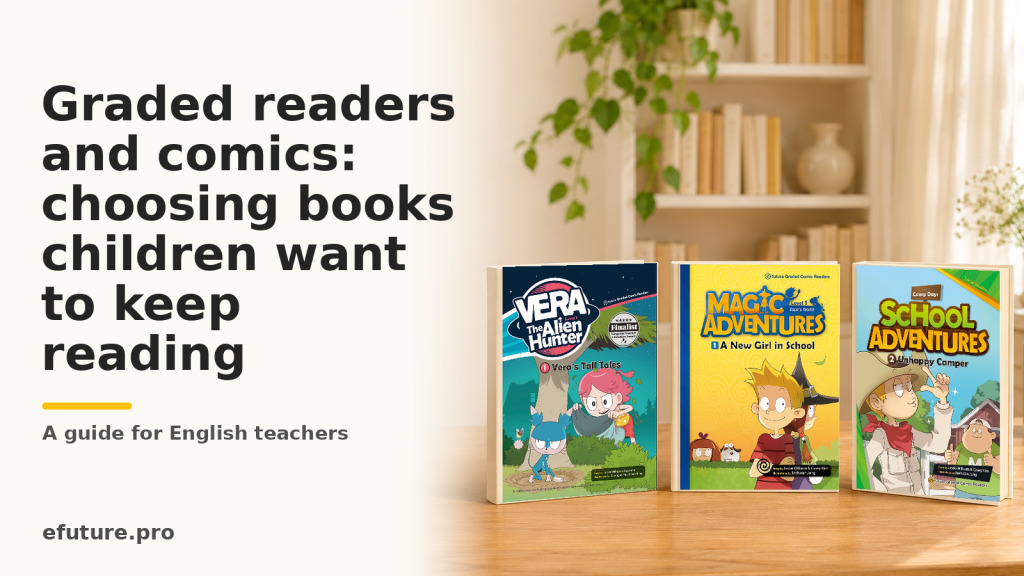

A well-chosen English book lets a child follow a story and want to find out what happens next. It does not have to be harder than the last one. In extensive reading, easy, interesting books create room for fluency, understanding and repeated encounters with familiar language.
For teachers, this means helping learners find an accessible level while leaving them a meaningful choice. Graded readers, including e-future comic readers, bring those aims together in lessons, school libraries and holiday programmes.
At a glance
- Graded readers use controlled vocabulary and language structures. They include original stories, retellings and factual texts.
- For independent reading, choose a text the learner can understand comfortably. Easy reading is valuable: it makes more reading and smoother processing possible.
- A series level, a CEFR label, headwords and text length describe different things. A short reading sample helps you make the final choice.
- Comics combine illustrations and dialogue to make situations, emotions and events easier to follow.
- Schools can choose between e-Library and MetaLibrary. Start with teacher trial access and explore both the learner experience and the teacher tools.
Contents
- What graded readers are
- Why easy reading matters
- Understanding levels and choosing a book
- Stories, audio and phonics from the start
- Three comic series for different interests
- Practical activities with comics
- Developing oral reading fluency
- Making reading part of the school week
- e-Library and MetaLibrary for schools
- Questions from teachers and parents
What graded readers are
Graded readers are books developed for people learning another language. Their vocabulary and language structures are controlled so that readers can focus on meaning. A graded reader might be a retelling of a familiar tale, an original adventure or a factual text. “Graded” describes how the language is managed, rather than a single genre or format.
The Extensive Reading Foundation describes these books as literature for a particular readership: language learners. Accessible language can still tell an engaging story. Illustrations, characters and a strong premise matter just as much as the level printed on the cover.
Video: e-future Graded Readers Library. Notice the range of material in this short introduction: phonics-focused stories, the Magic Adventures, School Adventures and Vera the Alien Hunter comics, and classic tales. Use the variety to start a conversation about what your learners would like to read.
Browse the available books in readers and comic books.
Why easy reading matters
Extensive reading means regularly reading plenty of accessible, interesting material for pleasure and general understanding. Learners choose what to read, follow the content and do not need to stop continually to use a dictionary. They can also put down a book that does not interest them and choose another.
In his introduction to extensive reading, Dr Rob Waring emphasises easy, enjoyable books. They provide repeated encounters with words, grammar and phrases that learners have already met. Instead of decoding every word separately, readers have space to process meaningful groups of words and follow the writer’s ideas.
An easy book is useful reading practice. It gives learners more time with English, a reason to revisit a favourite story and the experience of using the language for something beyond completing an exercise. Progress includes becoming more comfortable with language they already know.
Keep the purpose of each reading activity clear:
- Independent extensive reading: learners mainly read silently, at their own pace, for meaning and enjoyment.
- Shared reading and listening: a teacher or recording helps learners enter the story and connect written language with sound.
- Intensive reading: the class examines a selected passage, explores language or practises a particular skill.
- Reading aloud and role-play: learners work on phrasing, expression and how dialogue sounds.
The same book can serve different purposes at different times. Also leave room for books where the next step is simply choosing another story. A quiz, drawing or performance can extend a reading experience without becoming a requirement after every title. Choice, accessible texts and enjoyment are also central to Richard Day and Julian Bamford’s principles for extensive reading.
Understanding levels and choosing a book
CEFR describes language proficiency. Level 1 identifies a place within a particular series. There is no universal conversion in which every Level 1 book is A1 and every Level 2 book is A2. The number and size of the steps depend on the material.
For example, the printed School Adventures, Magic Adventures and Vera the Alien Hunter collections in the eFuture shop are labelled Levels 1, 2 and 3. Smart Phonics Readers has five levels and 20 stories, with four stories per level. Do not transfer those numbers between series or treat them as levels for the whole online library.
When reading a book description, distinguish between:
- Headwords: the vocabulary entries used as the basis for a level’s language control, not the total number of words printed in a book.
- Word count: the length of a text, including repeated words.
- Word families: groups of related forms defined according to particular criteria; not automatically equivalent to headwords.
- Lexile: a measure of text complexity, shown with an L; not a quiz score or a count of words a learner knows.
- CEFR: a reference to language proficiency that should be considered alongside the actual text and the learner’s reading ability.
For learners working around A1 or A2, start with a few short, appealing samples with clear illustrations. Match themes to age and interests: simple language need not mean content intended for a younger child. Look at sentence length, the amount of text on the page and audio support too.
Use a short reading sample, not a rigid formula
- Offer a small selection of topics. Choose material that looks accessible, then let the learner select an appealing cover or description.
- Give them time with a passage. Independent readers can read silently; shared reading can show you what support an emerging reader needs.
- Talk about meaning. Ask what is happening, who a character is or how an illustration relates to the story. Learners can respond in English or another shared language, depending on your aim.
- Notice how comfortably they read. Are they following the story, or using most of their attention to decode words and work out meanings?
- Ask whether they want to continue. Interest and understanding should work together.
Comfortable understanding and a wish to continue are encouraging signs. If frequent help is needed, offer an easier book for independent reading and enjoy the chosen story together. Avoid a fixed allowance of pauses per page: page lengths and layouts vary.
Video: Young Learners and Graded Readers. Look for the relationship between interest and understanding, the comparison of plain text with illustrated versions, and the role of learner choice. Later, the presenter demonstrates reading with different emotions: a way to revisit a familiar passage without memorising it.
For more ways to discuss meaning, read choosing short English reading texts and checking understanding.
When to offer a more demanding book
When learners understand their current reading comfortably and want to try something new, show them a sample from the next level. Keep easier books available as well. Reading widely at one level, rereading favourites and exploring new topics are all worthwhile. Finishing a title does not have to mean moving up a level.
Stories, audio and phonics from the start
Children can enjoy stories, explore illustrations, listen and join in shared reading from the beginning of their English learning. Alongside this, phonics helps them connect print with sound. These experiences can support one another: completing a whole phonics course is not a prerequisite for meeting a first reader.
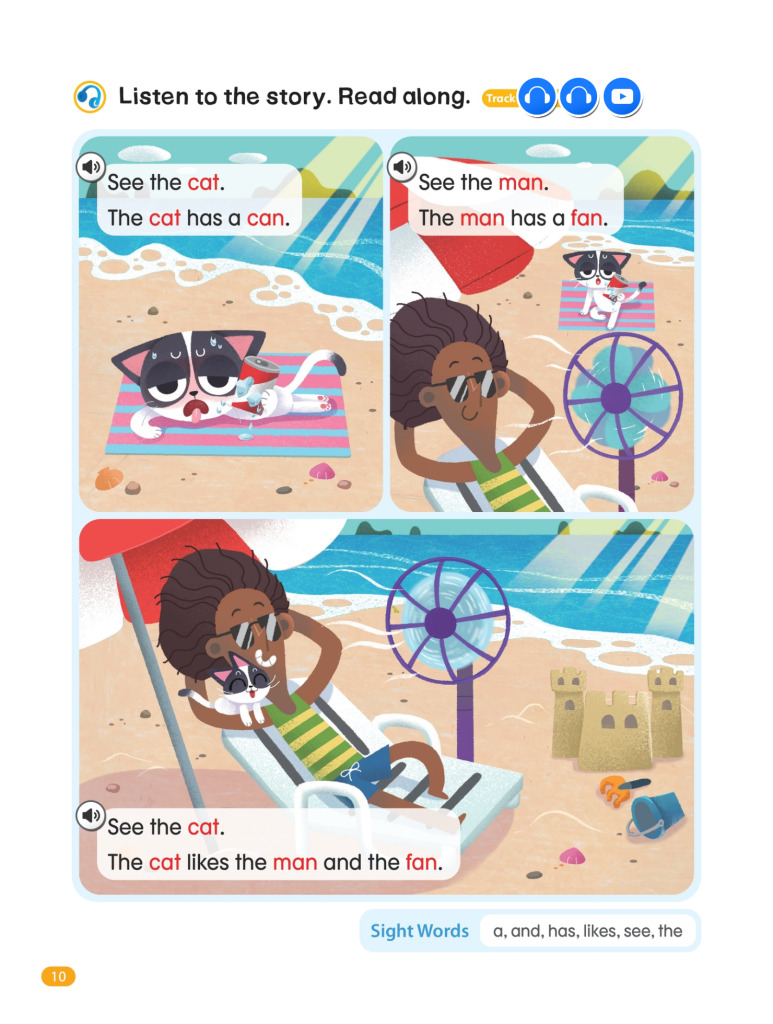
Smart Phonics Readers is a reader series, distinct from the Smart Phonics course. Its short stories provide practice with selected sounds and words in context. The presentation shows the story format, highlighted phonics targets, activities and a picture dictionary. A reader can therefore accompany current phonics learning.
Video: e-future Smart Phonics Readers. Notice how the phonics focus appears inside a story rather than only in a word list. Compare the text with what your learners can already decode.
Find Smart Phonics Readers in the e-Library catalogue on eFuture. For a separate explanation of print–sound connections, read phonics: how children learn to read in English.
A reading-skills course such as Smart Reading has a different role from freely chosen readers. You can combine structured skills work with reading for pleasure without requiring learners to complete phonics and an entire reading course before they are allowed to enjoy books.
Three comic series for different interests
In our work with comics in schools and holiday classes, we have seen children want to read in English when the stories are interesting and suited to their level. Comics give them a story worth talking about, while illustrations help show who is speaking, how characters feel and what has happened.
School Adventures: camp, familiar tales and science discoveries
Jack and Bella’s adventures open up several kinds of conversation. The video includes summer camp and the emotions of meeting new people, encounters with familiar story worlds, and a passage from Tummy Trouble involving a journey inside the body. Use these examples to see whether your group is most drawn to relationships, fantasy or finding out about the world.
Video: Soo & Gari’s Story Time! — School Adventures. Notice the Bella in Wonderland role-play and the move from illustrations to dialogue. Afterwards, invite learners to choose a scene they would like to read themselves.
Browse School Adventures comic readers.
Vera the Alien Hunter: mystery, humour and dialogue
Vera meets Luca, a mysterious cat from another planet, and becomes involved in adventures with aliens. The video demonstrates looking at illustrations, listening to a passage and acting out a scene. Short exchanges lend themselves to paired reading, while predicting what happens next brings attention back to the story.
Video: Soo & Gari’s Story Time! — Vera the Alien Hunter. Watch how the presenters first use pictures to establish the situation, then give the characters their own voices. Select a short passage and let learners decide who will read each part.
Browse Vera the Alien Hunter comic readers.
Magic Adventures: a school morning with a magical turn
In A New Girl in School, Jack’s ordinary morning leads to a meeting with the mysterious Olivia. The presenters explore the pictures, focus on words and demonstrate a role-play from another part of the story. A familiar setting offers a starting point, while the magical element gives readers a reason to be curious.
Video: Soo & Gari’s Story Time! — Magic Adventures. Notice the picture walk before reading and the changes of voice during the role-play. Before revealing the next passage, invite learners to predict what the new character might do.
Browse Magic Adventures comic readers.
Practical activities with comics
Let learners spend time with the story first. Then choose an activity that fits the lesson’s purpose and the group’s interest. There is no need to use every idea with every book.
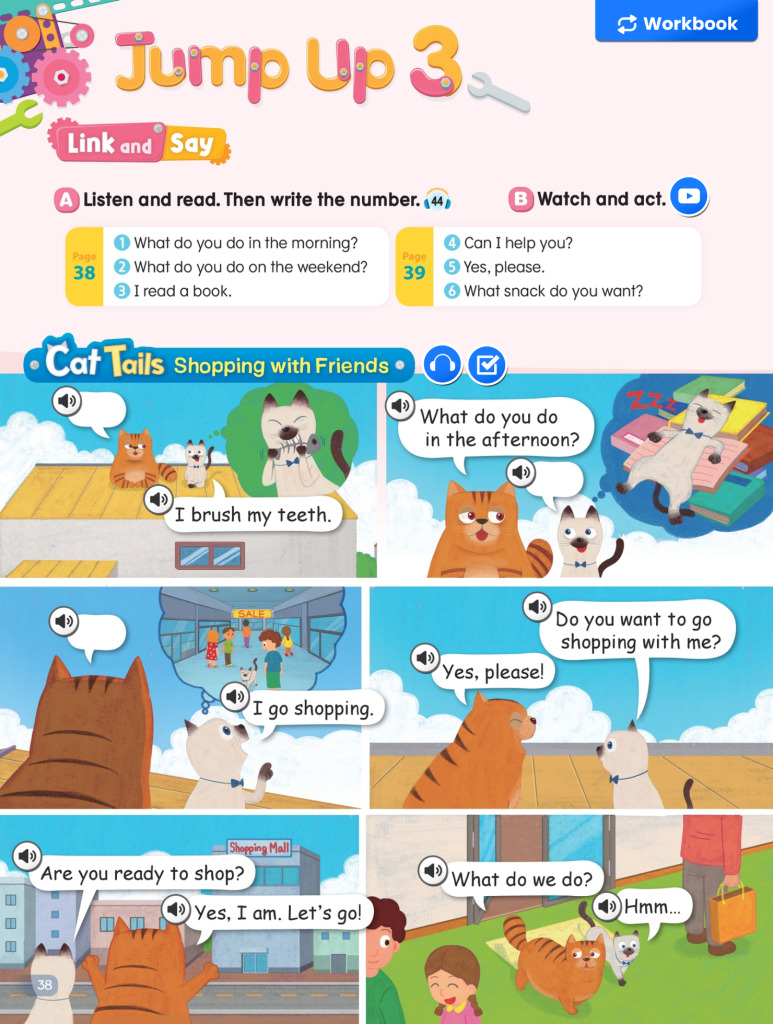
Picture walk: explore before reading. Select a few panels. Learners identify characters, setting and emotions, then suggest what might be happening. The pictures establish a context before they read the dialogue.
Prediction: pause before the next panel. Learners say or draw what might happen next. After reading, they compare their idea with the story. The aim is to follow events, not to guess one correct answer.
Role-play: read a scene in pairs. Learners choose characters and read with the book in their hands, thinking about what each character means. Then they can swap roles. The dialogue has a listener, and rereading has a clear purpose.
Reading with emotion: change the delivery. Choose a familiar passage and an emotion card, such as happiness, surprise or worry. One learner reads with that feeling and a partner identifies it. Discuss which interpretation fits the situation in the book.
An alternative ending: add a final panel. Learners give a character a different choice and show its consequence. A drawing with a short speech bubble is enough for beginners; more independent readers can create a dialogue.
The other ideas from the e-future “Try Comic Readers!” webinar are listening and imagining a scene, changing the voice, Speed Reading as a separate fluency activity with familiar text, a project, listening and standing up at an agreed word, art and craft, and flashcard games. Choose a format that gives learners a reason to return to the content.
Video: Looking for Fun Reading Materials for EFL learners? Try Comic Readers! The webinar demonstrates a picture walk with School Adventures, reading with emotion, changing voices, and ideas for role-play and alternative endings. Choose one technique and adapt it to a passage your learners already understand.
Developing oral reading fluency
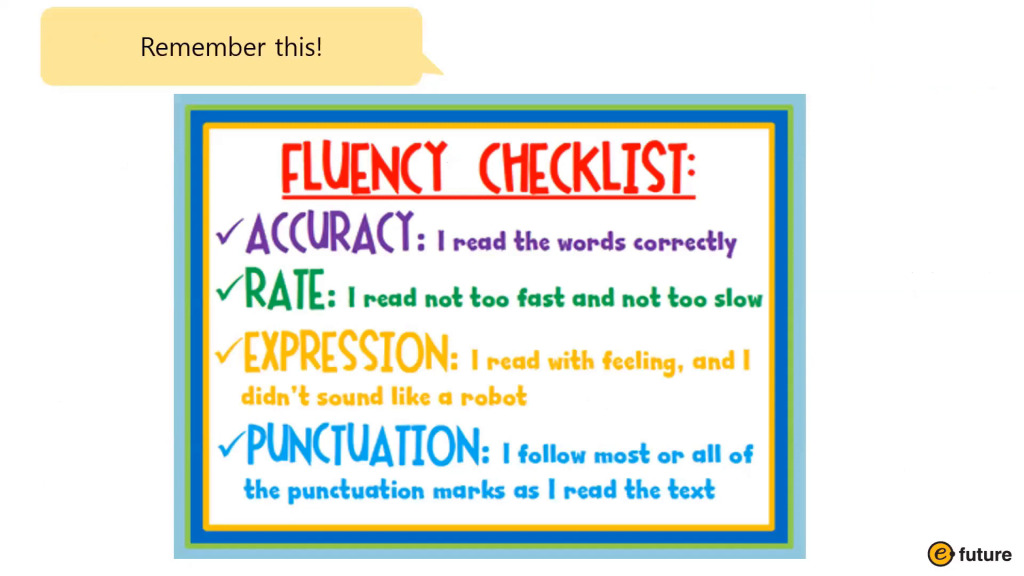
Returning to a short, well-understood scene can support reading aloud. Focus on the four elements of the Fluency Checklist from the e-future “Try Comic Readers!” webinar:
- Accuracy: reading the words correctly.
- Rate: reading at a natural pace, neither too fast nor too slowly.
- Expression: conveying the feeling and meaning of a line.
- Punctuation: pausing and grouping words in ways that reflect the meaning and punctuation.
Invite learners to reread with one focus, such as a clearer pause at the end of a sentence. They can listen to their own recording and notice a change. If you use timing, compare a learner’s own attempts while preserving accuracy and understanding, rather than turning the activity into a class race.
This is a separate teaching activity. Silent extensive reading does not require a public performance or a speed check after every book.
Making reading part of the school week
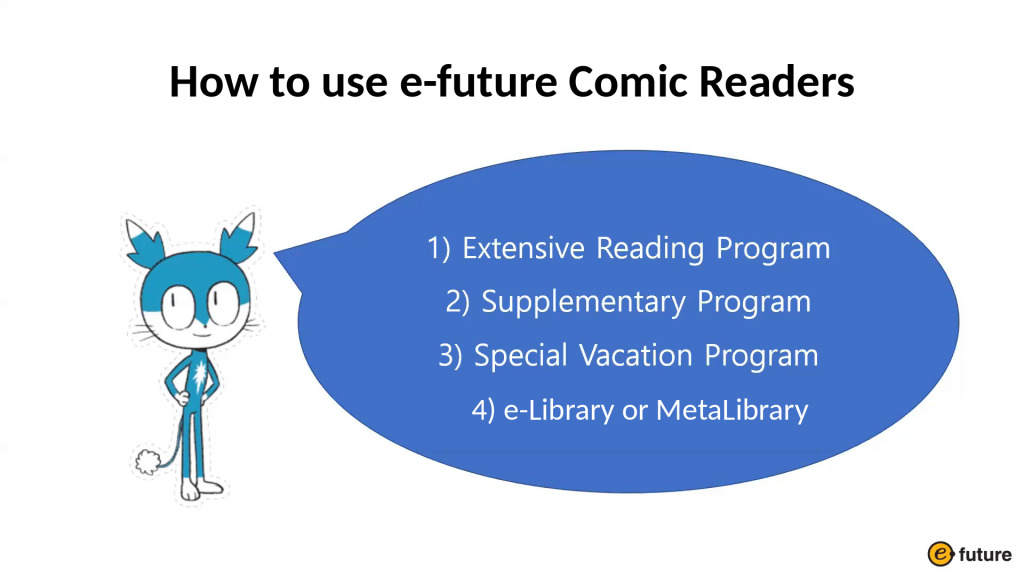
Readers can be used in four ways:
- An extensive reading programme: a reading programme in its own right;
- A supplement to a course: alongside coursebook work;
- A holiday programme: material for a shorter programme;
- e-Library or MetaLibrary: a digital library gives learners access to books beyond shared lesson time.
Match the organisation to your group and keep space for learner choice.
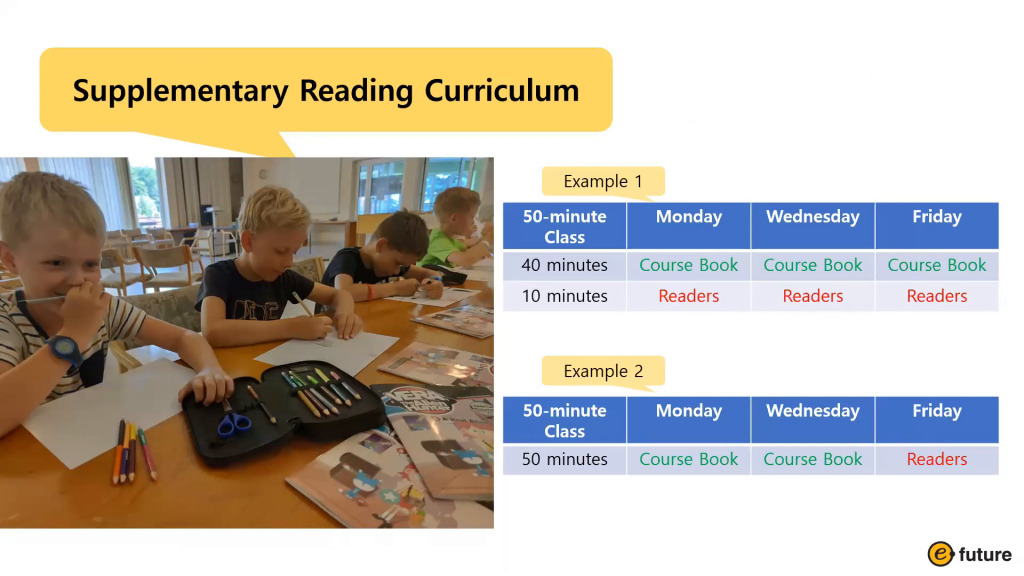
Two sample timetables show how a school might protect time for books:
- A short block in every lesson: for 50-minute classes on Monday, Wednesday and Friday, use 40 minutes for the coursebook and 10 minutes for readers.
- A dedicated reading lesson: use Monday and Wednesday for 50 minutes of coursebook work each, and Friday for 50 minutes with readers.
If your group meets once or twice a week, keep the principle of regular contact and adapt the timetable. A short block can protect quiet, independent reading time; a longer session can include shared reading and a chosen follow-up activity. For a holiday programme, choose a story the group will enjoy returning to, rather than trying to compress a whole term’s course into a few sessions.
e-Library and MetaLibrary for schools
The featured readers are available through e-future’s online library offer. Schools can choose e-Library or MetaLibrary. Both provide a catalogue of reading material, with different environments and tools around the reading experience.
e-Library: books, audio and teacher tools
In e-Library, learners can read, listen to recordings and use activities alongside books. Teachers organise classes and review activity and results. It is an option for schools looking to make a digital library part of regular work with texts.
Video: Make Reading Fun and Easy with Readers on e-future’s e-Library. Look for The Ant and the Grasshopper, the explanation of headwords versus word count, and the later demonstration of an ebook and its activities. This is an e-Library presentation, not a MetaLibrary demonstration.
Explore e-Library and request teacher trial access.
MetaLibrary: reading with missions and activities
MetaLibrary brings books together with missions, points and a learner’s personal space. Teachers can plan missions and review reading status and quiz results. Additional activities include text-based character conversations: learners type an answer or select a suggested response. This is different from recording themselves reading aloud.
Explore MetaLibrary and request teacher trial access.
Compare the libraries with your own group in mind
During a trial, explore the same simple journey: a learner chooses an interesting book, opens it, reads or listens, and the teacher finds information about their work. Then consider whether your group would benefit most from e-Library’s book-centred environment or MetaLibrary’s missions and rewards.
Keep time for freely chosen reading within an extensive reading programme. Platform tools can support organisation while book choice and reading enjoyment remain central.
See current school subscription options for both libraries. Group access starts from 10 learners. Each library’s page provides a route to request a teacher trial before choosing a solution for your school.
Questions from teachers and parents
Does an easy book still help learners develop?
Yes. Learners revisit familiar language in context, process it more comfortably and give more attention to meaning. For extensive reading, ease is an advantage that makes more frequent and sustained contact with English possible.
Do learners need to know every word?
They need to follow the story without constant interruptions. An occasional unfamiliar word can sometimes be understood from context or passed over. If difficulty obscures the story, offer a more accessible text for independent reading or read together.
Do comics count as worthwhile English reading?
Yes. Graded comics use language selected for learners, while pictures and dialogue work together to tell a story. School Adventures, Vera the Alien Hunter and Magic Adventures also offer opportunities for optional role-play, discussion and rereading.
Should every book end with a test?
Leave room for books without tests. A short conversation, recommending a title to a friend or choosing the next book can be a natural continuation. Select exercises and quizzes according to the purpose of a particular lesson.
Must learners finish phonics before their first reader?
Stories, shared reading and audio can accompany English learning from the start. Choose independent reading that matches the child’s current skills, and use phonics to support word decoding alongside it.
Does the whole class need to read the same book?
A shared book supports discussion and work on a selected scene. During extensive reading time, learners can choose different titles at appropriate levels. Both approaches can have a place in the weekly plan.
Print or an online library?
Choose the format that makes regular reading easier for your group. Printed comics offer a book-in-hand experience, while an online library provides a choice of titles and digital tools. You can use both formats in different parts of your programme.
Further reading for teachers
- Extensive Reading Foundation — what graded readers are.
- Dr Rob Waring — introduction to extensive reading on e-future e-Library.
- Richard Day and Julian Bamford — Top Ten Principles for Teaching Extensive Reading.
Start with a small selection of accessible stories and a conversation about which one the learner wants to read. A well-chosen book gives them a reason to return to English for the next part of the story.