
Formative assessment in English lessons: a practical guide
Formative assessment in an English lesson starts before the task: children know what they are learning and how they will recognise success. During the lesson you check how it is going, and your feedback tells them what to do next. This guide turns five strategies into ordinary classroom routines for primary schools, language schools and private lessons: child-friendly goals and success criteria, exit tickets, a feedback model with worked examples, ways to track all four skills, self-assessment for young learners, and four short e-future recordings with the exact minutes worth watching.

In short
- Formative assessment happens while learning is still going on and helps you decide what comes next. Summative assessment sums up a unit, a term or a year.
- The core is a lesson goal and two or three success criteria, shared with children before the task in words they understand.
- Useful feedback has four parts: what is good, what needs fixing, how to fix it and what to work on next.
- Short, regular observations of each skill show progress far better than one big test per term.
- Children in the first years of primary school can judge their own work when the tool is simple: colours, faces or a thumb.
- Grades stay where your school requires them; formative routines work alongside them.
Contents
- Formative and summative assessment: the difference
- Five strategies for an ordinary English lesson
- Feedback children can act on
- Tracking progress in all four skills
- Self-assessment and peer assessment with young learners
- What to look for in a teacher guide
- eSmart Class: your group's progress in one view
- Talking to parents about progress
- Frequently asked questions
- Sources
Formative and summative assessment: the difference
In Inside the Black Box (1998), one of the most widely cited texts on classroom assessment, Paul Black and Dylan Wiliam write that assessment becomes formative when the evidence is actually used to adapt the teaching to meet students' needs. What matters is not the type of task but what teacher and learner do with the result.
In an English class the difference is easy to see. The end-of-unit test on "Animals" is summative. When, halfway through the unit, you ask children to show with a thumb whether they can already describe an animal with three adjectives, and you change tomorrow's plan because of what you see, you are assessing formatively.
| Feature | Formative assessment | Summative assessment |
|---|---|---|
| When | During learning, in every lesson | At the end of a unit, term or year |
| Purpose | So that learner and teacher know what comes next | To sum up achievement |
| Form | Comment, symbol, conversation, short note | Grade, percentage |
| Who assesses | The teacher, the learner, a classmate | Mainly the teacher |
| English lesson example | An "I can…" card after a lesson on the weather | A Present Simple test |
A 2024 systematic review of 40 studies on formative assessment in K-12 English as a foreign language (PMC) makes the same point: this kind of assessment lets teachers adjust their teaching in real time to what learners need. The review also recommends involving students through self-assessment and peer assessment, and using learning management systems to make assessment more efficient.
Your school's rules come first
Formative assessment usually fits national rules well. In Poland, for example, the School Education Act (consolidated text, Journal of Laws 2025 item 881, in Polish, Article 44b) lists among the aims of school assessment helping pupils learn by telling them what they did well and how they should continue learning; the detailed rules are set by each school's statute. Wherever you teach, check your school's assessment policy before you introduce new symbols or change how ongoing marks are recorded. The routines in this guide work alongside the grades your school requires.
Five strategies for an ordinary English lesson
Most formative assessment frameworks build on the same five strategies. Poland's Centre for Citizenship Education (CEO), which brought formative assessment into Polish schools, summarises them in a short guide (in Polish) by Małgorzata Ostrowska: sharing learning goals and success criteria; discussions and questions that show whether and how pupils are learning; feedback that makes progress visible; letting pupils learn from each other; and helping pupils take ownership of their learning. Here is what they look like in a language classroom.
1. Goals and success criteria children understand
Curriculum goals are written in language children do not understand. Give every lesson a goal in plain words and treat success criteria as the evidence that shows the goal has been reached. In English, the goal fits naturally on the board as an "I can…" statement, with two or three concrete criteria underneath. For a Year 2 lesson on food:
- Goal: I can say what I like and don't like.
- Success criteria: I use I like and I don't like. I name at least three foods. I speak in full sentences.
Choose verbs you can observe: name, ask, describe, write. "I understand food words" is hard to check; "I can name five foods" takes seconds. For the youngest learners, show the criteria as pictures.
What to watch: Joseph Hills, an ELT consultant at e-future, plans backwards: goal first, then how he will check it, then the activities. From 21:15 to 23:30 he builds a learning outcome for a unit on favourite animals with verbs you can assess (identify, describe) instead of understand, then adds two smaller goals; a minute later he reminds teachers to share outcomes with the class. From 36:00 to 37:20 he turns to rubrics: hand them to pupils before they write, and leave one row blank so each child can add a personal target, such as neater handwriting or fewer spelling mistakes.
2. Questions the whole class answers
Instead of "Is everything clear?", ask a question everyone answers at once. Children hold up card A, B or C, show is or are on mini whiteboards, or point to a picture. Within ten seconds you know whether to move on or go back. Lolly sticks with names work too: anyone may be asked, so the whole group thinks, not just the three keen pupils at the front.

Exit tickets. At the end of the lesson every child hands you a slip with an answer to one or two questions linked to the goal, for example "Write one sentence with there is" or "Draw and label two things in your bedroom". Afterwards, sort the slips into three piles: got it, nearly there, not yet. The piles tell you how to open the next lesson and who needs a few minutes with you.
3. Feedback, not just a grade
This strategy gets its own section below, because it is the heart of formative assessment and the place where most problems arise.
4. Pupils learning from each other
Simple formats work: recalling in pairs what you need for today's goal, pair conversations, quizzes done in pairs, a lesson summary in small groups. In English lessons, criteria checklists are especially useful: one child reads a dialogue, the other checks it against two points on the board. A child who explains to a classmate where the -s is missing in he plays strengthens the rule for both of them.
5. Pupils as owners of their learning
At the end of the lesson, children return to the goal and decide how far they have reached it. Older pupils write one sentence in their notebook: "Next time I want to…". A learning journal or portfolio lets them see their progress and keep track of what they agreed with you. This planning habit pays off later, all the way to high-stakes exams such as Poland's Grade 8 English exam.
Feedback children can act on
A model widely used in Polish schools, taught in a CEO course for formative assessment leaders (the feedback module, in Polish), gives feedback four parts:
- Plus: what the pupil did well.
- Minus: what needs improving.
- Hint: how to improve it.
- Next step: what to work on next.
The same material stresses that feedback refers only to the criteria agreed before the task. If punctuation was not in the criteria, do not open your comment with commas.
Dylan Wiliam puts the central idea in one line: the only important thing about feedback is what students do with it (The Secret of Effective Feedback, 2016). He also points out that, as many studies have shown, students often learn less when teachers give feedback than when they write nothing at all, which is why the form matters. Plan time for pupils to use your comments, for example five minutes at the start of the next lesson to rewrite one sentence.
Example: a short "My pet" text in Year 4
Criteria: three sentences about what the animal looks like, one about what it likes doing, correct use of has got.
- + Great use of three adjectives: small, brown, funny. I can picture your hamster straight away.
- – Your second sentence says It have got. With it we need has got.
- Hint: underline every sentence with it and check that each one has has.
- Next step: add one sentence with because, e.g. I love him because he is funny.
Example: speaking in Year 1
With a six-year-old, two sentences said in a few seconds are enough: "Lovely, you said I like apples in a full sentence. Now try telling me what you don't like: I don't like…". You praise what the criteria asked for and give the next step straight away.
Feed-up, feedback, feed-forward
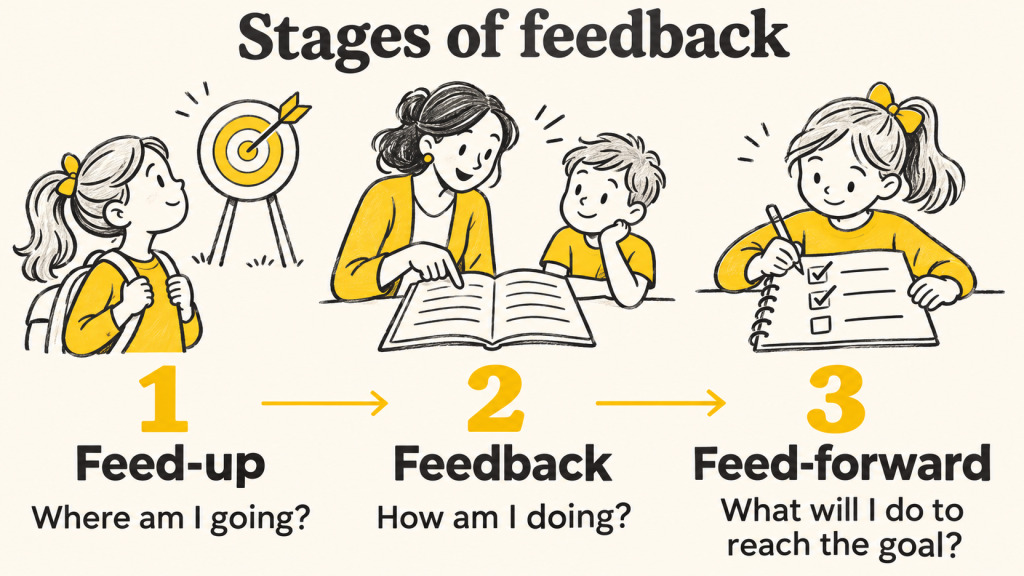
On the European School Education Platform, Belgian teacher trainer Tineke Turck describes feedback as a dialogue with three steps: feed-up (establishing the purpose: why are we doing this?), feedback (how am I doing?) and feed-forward (how can I achieve this?). It makes a handy checklist for English teachers. Even a short comment in a workbook can answer all three questions.
What to watch: From 39:00 to 42:05 Dr Ken Beatty describes a habit he dropped: correcting pupils' work in front of the class. Instead, after the first written assignment he finds something good in every student's work and shares those examples with the group, and students start asking each other how they did it. He then shows an exercise from an e-future book and the "good news sandwich": good news, one specific problem (assassinate misspelled although the word is printed just above), good news again.
Tracking progress in all four skills
School assessment policies often name the same sources of evidence: observation of everyday work, independent tasks, speaking, reading with understanding and project work. Each skill, however, needs a slightly different tool.
| Skill | What you observe | Quick tool | How often |
|---|---|---|---|
| Listening | Does the child respond to instructions, point to a picture, do the action? | "Simon says", pointing cards, a short recording with a task | Every lesson, 2–3 minutes |
| Speaking | Full sentences, pronunciation, confidence, use of new vocabulary | Observation list with names, a recorded dialogue | A few pupils per lesson, in rotation |
| Reading | Decoding, fluency, comprehension | Reading a short text aloud, a question about it, an "I can read…" card | Weekly, with the class reader |
| Writing | Use of the sentence model, spelling, organisation | A short text marked against 2–3 criteria | After each unit |
A few habits that make this manageable:
- Keep a simple observation list. A grid with names and three columns (got it, nearly, not yet) is enough to show you after a month who needs support.
- Collect samples. A recording from September and one from January tell parents more than any mark.
- Separate decoding from comprehension. A child who reads cat, hat, map fluently does not always understand a sentence with those words. Check both. For question ideas, see our guide to short English reading texts.
- In content-based lessons, check content with little language. A learner may understand the content but not yet be able to explain it in English. Mind maps, drawings, true/false and short answers show understanding without heavy language demands.
What to watch: In a webinar on language testing and assessment, John Read talks about assessing speaking in ordinary lessons from 50:00 to 53:30. The teacher monitors pair and group work, keeps records on a checklist and observes one group this week and another next week, because classroom assessment is not a one-off event. He also shows a smiley-face self-assessment sheet for young learners after a paired speaking task, and a peer feedback form in which most statements are worded positively.
Self-assessment and peer assessment with young learners
The idea behind assessment as learning is that learners judge what they still need in order to reach a goal, set their own next steps and check whether they get there, always working with criteria agreed in advance. It works with young children too, as long as the tools are visual and quick.
Formats for children who cannot yet write much:
- Traffic lights. A green, amber or red dot next to a task: I can, nearly, I need help.
- An "I can…" picture card. The child colours a star next to each skill they have mastered.
- Two stars and a wish. In peer assessment, a child names two things that went well and one thing a classmate could improve.
- Thumbs. Up, sideways or down after each stage of the lesson. It takes five seconds and shows at once who has lost the thread.
Introduce peer assessment gradually. Practise first on work that belongs to nobody in the class, such as a text you wrote yourself. Agree that comments are about the work, not the person, and that every comment refers to the criteria on the board.
What to look for in a teacher guide
A good teacher's book makes formative assessment much easier because it takes some of the preparation off your plate. When choosing a series for a school or a tutoring group, check whether it includes:
- Lesson goals phrased as skills, ideally in a form you can copy onto the board as "I can…".
- Comprehension questions for use during the lesson, not only an answer key.
- Ideas for differentiation: what to do with the child who finishes early and with the one who needs extra support.
- Unit tests and reviews, so that summative assessment follows the same goals as everyday work.
- Consistency with the workbook and audio. If the goal is about listening, you need a recording and a task that lets you check it.
- Guidance on observing speaking, because speaking cannot be assessed on paper.
An example from the e-future range: the Smart Phonics 1 Teacher's Manual gives teachers downloadable resources including a placement test, unit tests, review tests and a final test, answer keys, sample lesson plans and certificates. The whole Smart Phonics series includes cumulative reviews and progress tests. A unit test can serve formative assessment too: instead of recording only the score, pick one task with the child to revisit a week later.
When comparing series, look at one full sample lesson: student book, workbook and teacher's guide. You will see straight away whether the goal set at the start returns at the end. For short quizzes as a starting point for class discussion, see our round-up of platforms for English lessons.
eSmart Class: your group's progress in one view
A paper observation list works well for one group. Once you teach several classes or many private students, a platform helps. eSmart Class is a learning management system for teachers who use e-future textbooks, with class e-books, downloadable teaching resources and online practice. Teachers can track total learning time and time spent on each unit, and check progress for students who have completed practice activities and tests; students can review incorrect answers by clicking the question number. Teachers can request access from e-future.
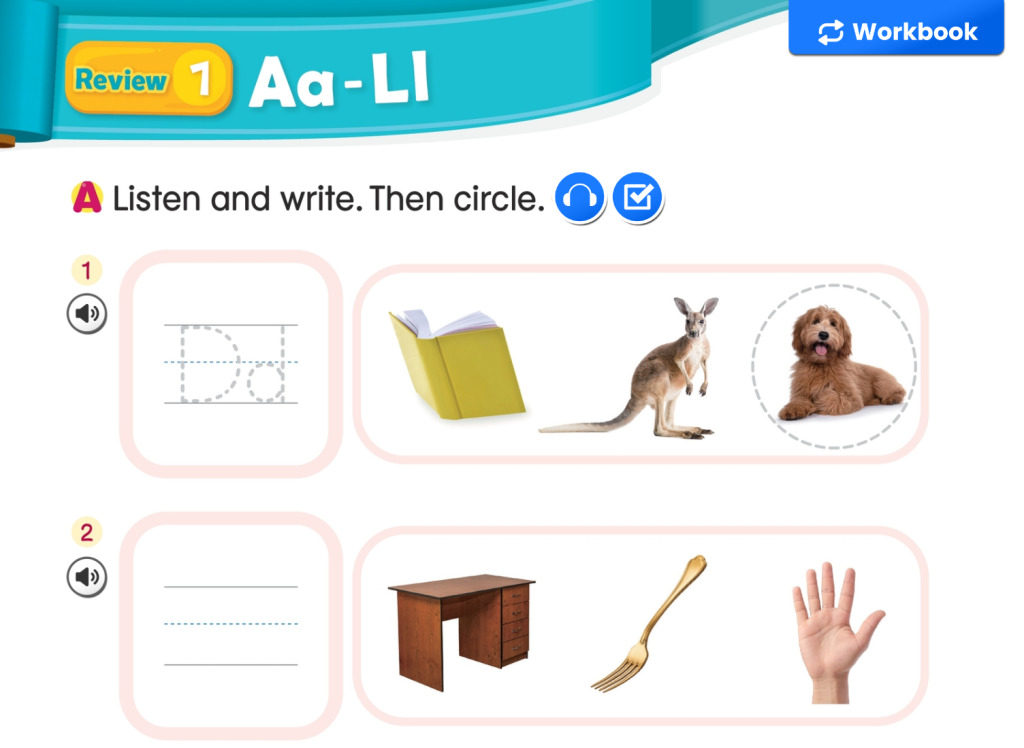
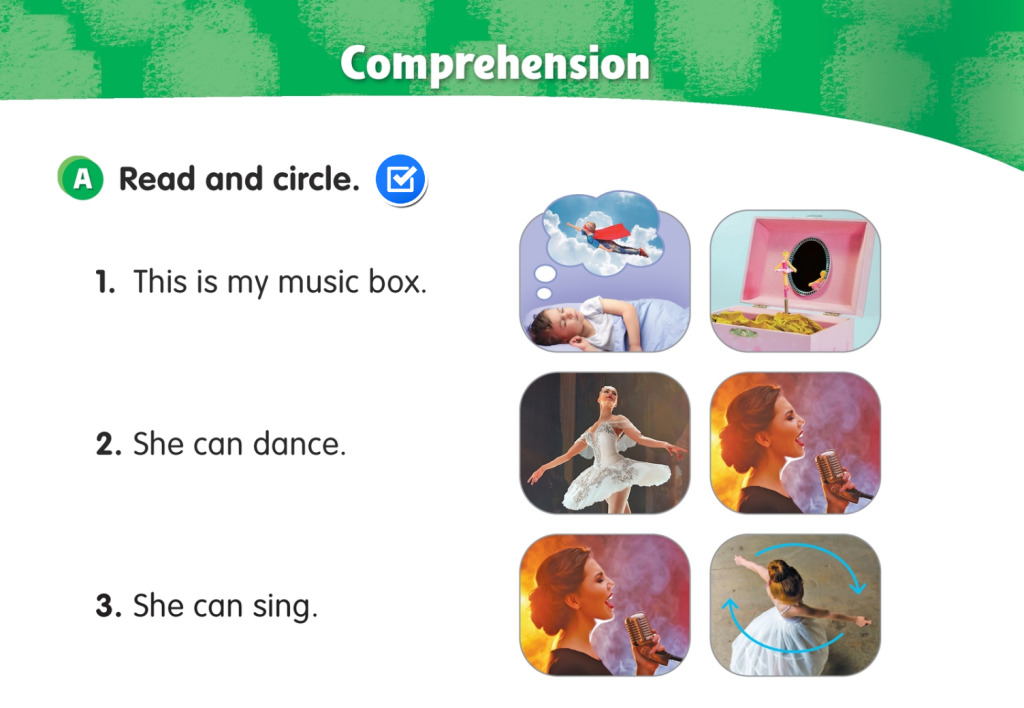
What to watch: From 01:50 to 04:00 this platform tutorial shows the student list for a unit: who has started the practice, how long it took, how many stars they earned and their test score. From 04:58 to 07:40 it opens a student's test report in Smart Phonics 1: the score compared with the class average, correct and incorrect answers, a teacher comment the student will see on their own page, and a listening item where the student heard book but chose bat.
Use the report formatively: find the question that caused trouble for a large part of the group and open the next lesson with it. Write your comment on the test using the same four parts as in the notebook. For separate reading and listening practice, e-future offers Smart Reading (six levels, each in three parts) and Smart Listening (three levels, each in three parts).
Talking to parents about progress
A parent who only ever sees grades has no idea how to help at home. Share progress with parents in the same format you use with children:
- What the child can already do. Be specific: "Ola can talk about her family in five sentences."
- What they are working on. "She still mixes up he and she."
- How to help at home. "When you look at family photos, ask: Who is this? Is he your uncle?"
Bring samples to parents' evenings: a recording, a short text from September and one from January, a self-assessment card. In eSmart Class you can register parent accounts for your students, and messages sent through the platform also appear on parent pages. Families who home-educate can use the same tools themselves; our guide to English in home education shows how to plan it. Tutors who want to report to parents regularly will find ideas in our guide on becoming an effective English tutor.
Frequently asked questions
Does formative assessment mean giving up grades?
No. Grades stay where your school's rules require them, mainly for tests and end-of-term reports. Formative assessment covers everyday work: while learning is still going on, pupils get comments that show them how to improve before the test.
How young can children assess their own work?
Simple self-assessment with faces, colours or thumbs works in the first years of primary school. One condition: the criteria must be short, shown as pictures and discussed before the task. Introduce peer assessment step by step, practising first on anonymous work.
How much lesson time does formative assessment take?
Sharing the goal and criteria takes a minute or two at the start. Hinge questions and thumbs take seconds during the lesson, and a self-assessment or exit ticket another two or three minutes at the end. Written feedback takes longest, so focus it on two or three criteria rather than correcting everything.
Should feedback be in English or in the children's first language?
With young learners and with more complex comments, use the language they understand best: what matters is that the child knows what to fix. Short praise and "I can…" goals can be in English from day one. As age and level rise, so can the share of English in your comments.
Sources
- Paul Black, Dylan Wiliam: Inside the Black Box: Raising Standards Through Classroom Assessment (Phi Delta Kappan, 1998)
- Formative assessment in K-12 English as a foreign language education: A systematic review (PMC, 2024)
- Dylan Wiliam: The Secret of Effective Feedback (ASCD, 2016)
- European School Education Platform: Providing meaningful feedback to children
- Centre for Citizenship Education (CEO): formative assessment in theory and practice (in Polish)
- CEO course for formative assessment leaders, module four: feedback (in Polish)
- Polish School Education Act, consolidated text, Journal of Laws 2025 item 881 (in Polish)