
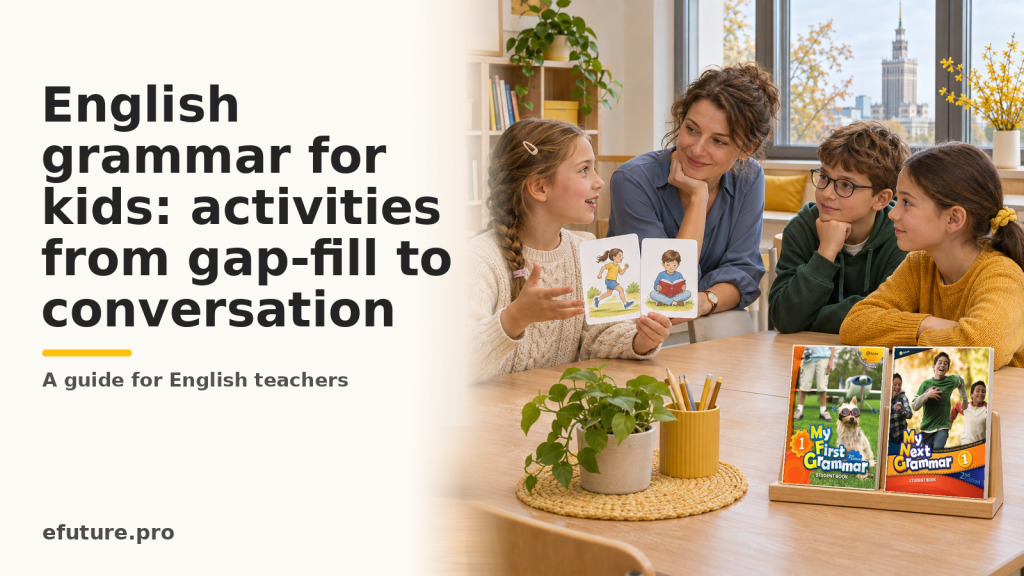

Children learn grammar when they hear a structure in a situation they understand, use it in play, and then meet it again in a new sentence and a new topic. This guide gives you activities matched to age (from preschool to the early teens), a ready-made Present Simple sequence, eight no-photocopy games and ways to check progress without a rules test. Four recordings from the e-future ELT channel sit next to the topics they cover. It is written for EFL teachers and tutors working with children, and for parents who teach English at home.
In short
- With preschoolers and children aged 6–9, structures come through stories, songs, rhymes, role-play and movement games. Instead of hearing a rule, children notice a difference: a dog – two dogs, I have – she has.
- From around age 10, learners can work consciously with form, for example the Present Simple. Keep the explanation short and spend the lesson speaking, playing and working in pairs.
- Take every structure through three levels: controlled (gap-fill), guided (describing a picture) and communicative (talking about yourself).
- Structures need to come back. Spiral, cumulative revision is now written into curricula such as Poland's new core curriculum for English in grades 4–8.
- Progress shows when a child builds a sentence in a new situation without help, not when they can recite a rule.
Contents
- Start with the principle: grammar in context, not in a chart
- What curricula ask for: an example from Poland
- Matching grammar activities to age
- Three levels of practice: from gap-fill to conversation
- Present Simple for kids: a ready-made activity sequence
- Grammar practice without photocopies: 8 games
- Worksheets, online quizzes or a grammar series
- Checking progress and responding to errors
- Grammar in stories, songs and recordings
- e-future materials for grammar practice
- Frequently asked questions
- Sources
Start with the principle: grammar in context, not in a chart
An adult asks, "Why is there an -s here?" A seven-year-old asks, "What happens to the cat next?" That difference shapes grammar work with children. A young learner does not need the name of a tense or a sentence diagram. They need to hear the same structure many times in an interesting situation and then use it themselves.
In an e-future webinar, university lecturer Dr Ken Beatty tells a story about his three-year-old son, who said I swimmed with Mommy. Nobody at home said "swimmed". The boy had built his own rule from walked, jumped and played and applied it to a new verb. Beatty says we are all "grammar-solving machines". He did not give his son a lesson; he simply replied, Oh, you swam with Mommy, and the boy repeated the correct form. That is good news for teachers: children look for patterns on their own. Our job is to give them plenty of meaningful examples and well-chosen feedback.
In the same talk, Beatty describes grammar as a toolbox. Learners reach for it to say more clearly when something happened, who has what and how ideas connect. So a good activity always carries meaning: the child says something about themselves, a picture or a story, rather than just filling in a form.
What to watch for: the "I swimmed" story and the difference between a one-off mistake and a repeated error (about 12:00–16:00), a quick ungraded test before a new grammar point so that learners see for themselves what they still need (about 22:30), and an overview of seven ways to teach grammar, each with task ideas (from about 23:30). The talk lasts about an hour.
What curricula ask for: an example from Poland
National curricula across Europe set grammar goals in different ways. Poland's is a useful example because a new core curriculum for primary schools started in September 2026. Under the regulation of 11 March 2026 (Journal of Laws 2026, item 378, in Polish), it applies first in grades 1 and 4 and then year by year in the following grades; the previous curriculum still applies to the other grades in 2026/2027. A few points from the new text are relevant to grammar practice anywhere:
- Preschool. Foreign language learning "takes place through play" and is built into everyday routines, with simple phrases, songs and rhymes, short dialogues and simple instructions.
- Grades 1–3. Children produce very short, simple utterances from a model, describe themselves, their interests and preferences, name and describe people, objects and everyday actions, and recite rhymes and songs. They understand words and very simple sentences, including audio and video, with help from pictures, props, facial expressions and gestures. The target at the end of grade 3 is CEFR A1.
- Grades 4–8. One common set of requirements covers grades 4 to 8, with A2 expected at the end of grade 8 for the first foreign language. At A1, learners use a "minimal range of grammatical means" needed for the other requirements. The text names two principles explicitly: spiral teaching, meaning regular return to earlier topics, and cumulative teaching, meaning that each return builds on what came before. It also recommends small steps and an accepting attitude to errors that do not block communication.
Whatever curriculum you follow, the direction is the same: communication first, then conscious work on form, with regular revision built in.
Matching grammar activities to age
The same material can delight an eight-year-old and bore an eleven-year-old. Use the table below as a rough starting point that follows the usual order of structures in children's courses. Adjust it to your syllabus and your group.
| Age / stage | What to practise | Formats that work well | Watch out for |
|---|---|---|---|
| Preschool (3–6) | fixed phrases: I like…, It's a…, Can I have…? | action songs, props, movement games, a puppet or toy | writing, names of rules |
| Ages 6–9 | be, have/has or have got, can, there is/are, prepositions of place, plurals | picture stories, rhymes, role-play, picture-card games | long worksheets, sentence translation |
| Ages 9–12 | Present Simple, Present Continuous, Past Simple, comparatives | sentence chains, dice games, quizzes, picture descriptions, short texts | gap-fills with no speaking |
| Ages 12–14 | contrasting tenses, the passive, conditionals | discussions, short written texts, error correction, exam-style tasks | rules without context |
Preschool and ages 6–9: structure hidden in play
At this stage grammar means repeated sentences. Work with short, fixed patterns and change one word at a time: I've got a red ball / a blue car / a big dog. Stories with a repeated line, picture cards and props work well.
Instead of explaining a rule, help children notice the difference. Sue Kim, an e-future teacher trainer, shows this with plurals. Rather than saying "to make a noun plural, add -s, but after -s, -sh, -ch, -x and -z add -es", she holds up one pen and then four: a pen – four pens, an egg – two eggs. The children see what changed. The same move works with I have / she has and a simple two-column chart.
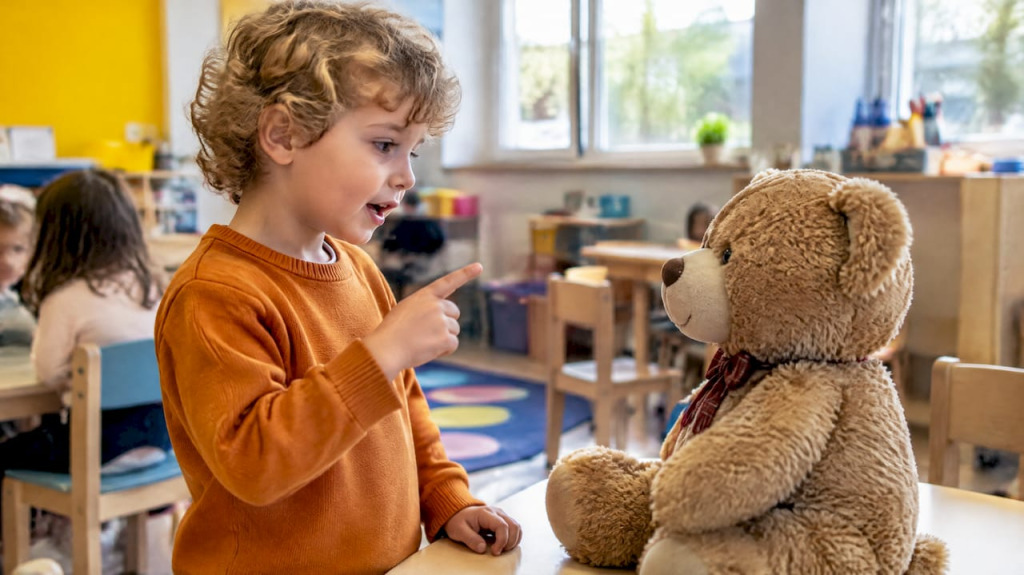
A teddy bear that "can't speak English" is a good excuse for children to correct its mistakes. The bear says She have a cat, the children fix it and repeat the correct sentence. If you teach a preschool group, see our guide to choosing preschool English books.
Children aged 6–9 are also learning to read, so you can point out endings such as -s or -ing in words they can already decode. That is why grammar practice pairs well with phonics.
What to watch for: Sue Kim's four principles for young learners: make it meaningful, make it interactive, make it fun and link and recycle (about 8:30). Watch how she helps children notice a difference with pens and eggs instead of explaining (about 10:00–15:00), the game with the Chip toy and a bag full of objects (about 29:30) and the guessing game Can they swim? (about 43:00). Most examples come from My First Grammar 1, but the principles work with any coursebook.
Ages 9–12: first rules, still with movement
Around this age children start to see that language has a system. You can name the Present Simple and show how it is built, but keep the explanation to a few minutes and spend the rest of the lesson using the structure. Dice with pronouns and verbs, sentence-building cards, online quizzes and pair work all work well. Before a new topic, try a short ungraded test, as Beatty suggests. Learners who say "we've done this" will see for themselves what is worth revising.
Ages 12–14: working consciously with errors
Older learners like to know why. They can compare tenses, look for errors in other people's texts and write short pieces. Beatty suggests several tasks that suit this stage:
- Grammar in advertising. Learners collect comparatives and superlatives from English slogans, including wrong ones such as the funnest sport, and explain what to correct.
- Order of events. A short text with past tenses (Amy had been watching TV when the phone rang…) and one task: put the events in the order they actually happened. Learners have to read the meaning of the verb forms to solve the puzzle.
- Self-correction in five weeks. In week one the teacher corrects everything and explains. Then errors are marked with a code (for example 1 for subject–verb agreement), then without a code, then only with a cross in the margin, and finally the teacher lists only the types of error. Learners find more and more on their own.
Three levels of practice: from gap-fill to conversation
A common problem in grammar teaching is stopping at the first stage. A child fills in every gap correctly and then cannot say one sentence about themselves. Take every structure through three levels:
- Controlled. Gap-fills, choosing the form, matching. Goal: the child sees the pattern. Example: She ___ (like) apples.
- Guided. The structure in context, still with support. Example: describe a picture of a boy's morning routine using the verbs given.
- Communicative. The child says or writes something real. Example: interview a classmate about their weekend and report back to the class.
Controlled practice is needed to secure the form. The trouble starts when children can do it without reading the sentence. Sue Kim shows a typical case: in a have or has exercise, a learner looks only at the first word and writes the form without knowing what the sentence is about. The fix is simple: add a question about meaning. First the child chooses the form (The ant has six legs), then decides whether the sentence is true by looking at the picture: yes or no. For Elephants have small ears the answer is no, so the child has to read and understand the whole sentence. The last items in the same exercise are about the learner: I have a great smile, We have a good class. Answers here will differ, and that is the point.
You can turn an ordinary worksheet into conversation the same way. After apple – apples, ask the child to draw some apples and say I have three apples. After an exercise on can, let learners say what they can do: I can ride a bike. I can't ski.
Differentiate within one group. A less confident learner gets a sentence frame (He ___ every day.) and key words; a stronger one gets an open question (What does your family do on Sundays?). Both work on the same structure at their own level.
What to watch for: Sue Kim starts with the difference between ESL and EFL (about 10:00). When English mostly happens in the classroom, learners need more revision and more links between topics. She then shows how to make one have/has page simpler, put it in context, personalise it and turn it into a game (about 24:00–52:00). Look especially at the yes/no task with the ant and the elephants (about 36:00) and the Roll and write dice game (about 49:00).
Present Simple for kids: a ready-made activity sequence
The Present Simple is usually the first tense children study consciously. It describes repeated actions, habits and daily routines, so topics are easy to find: daily plans, hobbies, family, animals.
A good model is the lesson plan "Present Simple na wesoło" (PDF in Polish), published by Primary School No. 5 in Kluczbork, Poland. It is a 45-minute review lesson for a language-focused grade 4 class, taught in May 2026 by Mariola Sobecka-Drozda. Learners practise affirmatives, negatives and questions through movement, picture cards, dice, sentence chains, error-hunting in pairs and Wordwall tasks. The third-person rule is fixed with the slogan "No S, no success!". Building on it, here is a sequence for four or five short sessions:
- Movement warm-up. Say a sentence about yourself (I play football). Anyone who does the same stands up. Then a child talks about a classmate: Tom plays football. Every missing -s gets a shout of "No S, no success!".
- Sentence dice. One die with pronouns (I, you, he, she, we, they), another with action pictures. Roll and say: She reads books. Harder version: a third die with "+", "–" and "?".
- Sentence chain. First child: I get up at seven. The next repeats and adds: Ola gets up at seven, and I eat breakfast. This trains memory and the third-person form. In the Kluczbork version, one learner says an affirmative sentence, the next turns it into a question and the third into a negative.
- Detective negatives. Show a picture; children correct false sentences: The cat doesn't swim. It sleeps. This is where you introduce don't/doesn't.
- Interview questions. A card with five Do you…? questions. Children walk around, collect Yes, I do / No, I don't answers and report one sentence about a classmate.
- Error correction. Five sentences, one error each: He go to school by bus. She doesn't likes pizza. Children find and fix them. This stage shows who really understands the rule, including that the verb loses its -s after does and doesn't.
At home the same sequence works at the kitchen table: parent and child take turns with the dice, and soft toys become the "classmates" for the interview.
Grammar practice without photocopies: 8 games
Not every activity needs a worksheet. Prepare these games once and reuse them for different structures.
- Simon says for imperatives: Touch your nose. Don't jump.
- What's in the bag? Take out objects one by one and say I have an orange. Then children guess what is left in the toy's bag: Does she have a banana? Every question repeats the structure, and children treat it as a puzzle.
- Where's the teddy? Hide a toy; children ask Is it under the table? They practise prepositions and questions.
- Guess who I am. A child thinks of an animal; the others ask Can it fly? Does it live in water?
- True or false with movement. True sentence: hands up. False sentence: crouch down and correct it.
- Yesterday and today. A "today" picture and a "yesterday" picture; children contrast them: Today I'm at school. Yesterday I was at the zoo.
- Roll and write. An odd number means have, an even number means has. The child writes the form from the die into the sentence and checks whether it is correct. If not, they miss a turn.
- Story with a gap. Read a familiar story and stop before a verb; children supply the form.
For more ideas on making grammar a part of the lesson students look forward to, see our guide how to make your students fall in love with grammar.
Worksheets, online quizzes or a grammar series
A quick search brings up hundreds of free printables and online quizzes. They are useful, but each tool solves a different problem.
| Tool | Strengths | Weaknesses | When to use it |
|---|---|---|---|
| Free printable worksheets | quick, good for one point | no sequence or revision, mixed quality, mostly controlled practice | as an add-on after a lesson |
| Online quizzes and games | instant feedback, motivating | easy to click at random, little speaking | as a warm-up or quick check |
| Grammar series or course with a workbook | planned progression, structures return in later lessons, texts and audio | needs purchasing and a plan | when you teach regularly all year |
| Digital reading library | grammar in natural text, lots of repetition, levelled | does not explain rules by itself | as regular reading alongside the course |
A course gives you the backbone, reading gives exposure, and games and quizzes bring the lesson to life. Sue Kim draws attention to how material is organised. In a linear syllabus, nouns are followed by pronouns and then adjectives, and the earlier topic disappears from lessons. In a spiral syllabus, each new structure links to earlier ones and they are practised together. When you use a free worksheet, ask the four questions from her webinar: does it carry meaning for the child, does it involve interaction, is it fun, and does it link back to earlier structures? Often a meaning question, a drawing or a pair interview is all it takes.
Checking progress and responding to errors
A rules test tells you little about whether a child can use a structure. Quick, everyday signals tell you more. In the Kluczbork lesson, the teacher gets ongoing feedback from the Wordwall tasks. At the end every learner says one sentence of their own (an exit sentence), and the class self-assesses with a thumb: up for "I understand and can do it", sideways for "I need more practice", down for "I need help". Learners can also finish the sentences Today I can… and I need more practice with….
You can add:
- Exit sentence. Before the break, each child says one sentence about themselves with the new structure. Sentences should not repeat.
- Transfer. Check the structure in a different topic from the lesson. If the child practised the Present Simple with animals, ask about their family.
- Error log. Note two or three recurring errors in the group and come back to them in games rather than correcting in front of the class.
- Questions about the learner in the test. End a test with a few personal questions: How old are you? What color are your eyes? Sue Kim shows a section like this in the My First Grammar 1 final test. You can ask the same questions orally.
- A monthly recording. One minute of the child speaking, recorded on a phone. A few recordings in a row let learners and parents compare.
When correcting, separate mistakes from errors. Beatty calls a mistake something everyone makes and the speaker notices; an error is repeated and needs attention before it becomes fixed. You can let mistakes go. For an error, choose a quick recast in conversation (Oh, you swam with Mommy) or, for a persistent problem, an explanation. Beatty refers to work by Professor Rod Ellis's team in which explicit explanation was remembered longer, and he recommends mixing both approaches as the situation requires. With younger children, Sue Kim suggests giving the correct model and helping them notice the difference: one egg – two eggs.
Grammar in stories, songs and recordings
Children who read and listen a lot in English meet the same structures in many situations: in dialogue, in a story, in a song. The same form appears with different words and in a different context, so the child has material to work out the pattern from. Poland's new curriculum for grades 4–8, for example, lists exposure to the language in class, authentic texts, films and recordings, and independent work with books, including graded readers, among the important elements of language teaching.
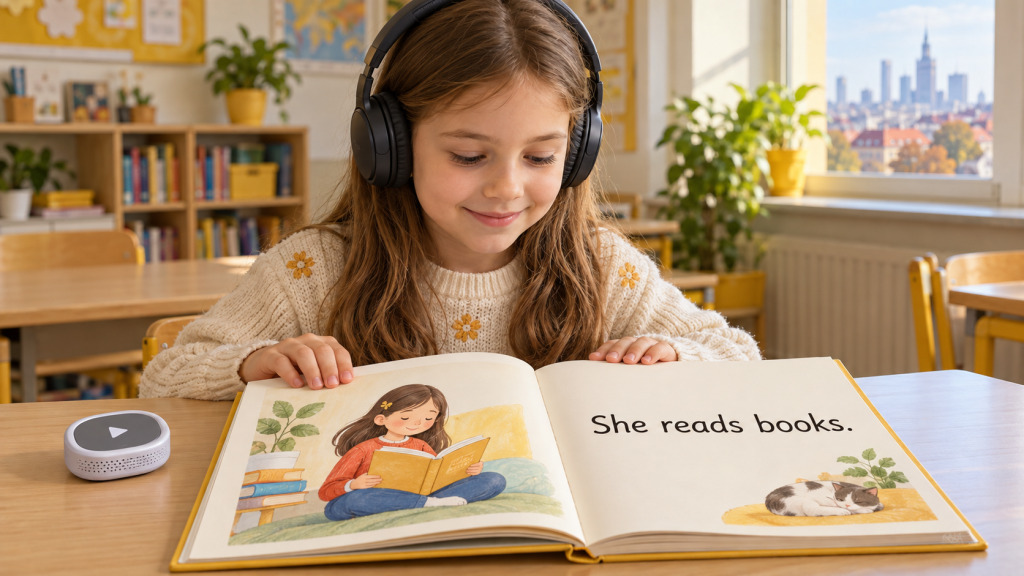
Before you add another rule worksheet, check whether learners have met the structure in a text, a song or a recording. If not, start there. A child describing a butterfly's life cycle practises the Present Simple through an interesting topic. A short text with audio and a question about the content often gives more to talk about than ten more gaps. For choosing texts and next steps in reading, see our guide helping children read in English: choosing the next step.
e-future materials for grammar practice
If you want a clear structure for grammar in a class or at home, start with a series in which structures come back to a plan.
My First Grammar and My Next Grammar. My First Grammar has three levels, each with a student book, workbook and teacher's manual; together with My Next Grammar it covers ages 7–14. My Next Grammar continues at A1, A1–A2 and A2. Both series follow a spiral syllabus. According to the product description, My First Grammar includes practice in context and personalised exercises, and after purchase teachers can download extra materials such as lesson plans, grammar posters, worksheets and tests. In My First Grammar 2, the Present Simple covers lessons 11–13: affirmatives, negatives and yes/no questions. The Present Continuous follows, and the book ends with a midterm and a final test. For a comparison of both series and where to start, see how to make your students fall in love with grammar.
To see what such a lesson looks like in practice, watch the model lesson for lesson 14 of My First Grammar 1, which covers have and has:
What to watch for: in 13 minutes the lesson goes through every stage described in this guide. It opens with the Look and learn chart and a talk about a picnic picture (0:00–3:00), then a guessing game about what is in the bag (about 3:20), matching and the Circle and check task in which learners decide whether a sentence is true (about 5:00–7:30). After that come a description of a snowy picture, the Link and review section, which sends learners back to an earlier lesson if they do not remember a structure (about 10:30), and the Roll and write dice game (about 12:00).
A course with grammar in context. Hand in Hand is a seven-level course for children aged 6–12 that links vocabulary and grammar development with CEFR levels and Young Learners English exams. Its teacher materials include vocabulary and grammar worksheets. In his talk, Beatty uses Hand in Hand pages to show the exchange What does he do in the morning? – He goes to school. and a game in which learners describe pictures in their own words. For preschoolers there is Little Hands, home of the character Chip, whose toy Sue Kim uses in her webinars.
Reading and listening. Smart Reading is a six-level series for building reading fluency, with audio available via QR codes. For regular reading at school there are two digital libraries. e-Library offers 1,204 readers from Pre-A1 to B2, with narration, highlighted text and activities after reading for learners, and classes, recommendations and results for teachers. The catalogue includes Classic Readers with controlled grammar and the comic series Vera the Alien Hunter, which combines reading with speaking, listening and grammar. MetaLibrary uses the same catalogue and adds missions, rewards, speaking practice, pronunciation feedback and conversations with characters. Both libraries are for groups of at least ten learners, and both pages let you request a trial. Current options for schools are on the online library subscription page.
Parents teaching at home may find our guide to English in home education useful.
Frequently asked questions
At what age should children start learning English grammar?
From the start, but not as rules. Preschoolers and children aged 6–9 pick up structures through songs, stories and games with repeated sentences. Even then they can notice differences such as a dog – two dogs. Naming tenses and discussing sentence structure usually comes later, from around age 9 or 10.
How often should children practise grammar at home?
Little and often. One game and one short text at a regular time fit into a week more easily than a long session now and then. What matters more than length is that the same structure comes back on different days in new sentences and topics.
Are free worksheets enough to learn grammar?
As an add-on, yes; as the only resource, usually not. Worksheets tend to practise one point at the controlled level and do not return to it in later weeks. Regular learning needs a series with planned progression plus exposure to English in texts and recordings. You can make a worksheet richer with a question about meaning or a short pair conversation.
How do I explain the third-person -s in the Present Simple?
Start with examples, not the rule: I play, you play, she plays. Ask the child to notice what changes. Then practise it in games, for example with "No S, no success!" every time the -s is missing. Show the other half of the rule straight away: after does and doesn't the verb goes back to its base form.
Can My First Grammar be used alongside another coursebook?
Yes. The product description presents the series as a supplement to coursebooks or as a main book. In her webinar, Sue Kim adds that it works alongside e-future courses and other publishers' coursebooks as long as their grammar sequence is broadly similar. Before choosing a level, compare the book's contents page with your class syllabus.
Sources
- Regulation of the Minister of Education of 11 March 2026 on the core curriculum for preschool and primary education, Journal of Laws 2026, item 378 (in Polish)
- Polish Ministry of Education: new core curricula for preschool and primary school, implementation timeline (in Polish)
- Lesson plan "Present Simple na wesoło", grade 4b, Primary School No. 5 in Kluczbork (in Polish)
- Dr Ken Beatty: Young Learners: Falling In Love With Grammar, e-future ELT
- Sue Kim: Tips for Teaching Grammar to Young Learners, e-future ELT
- Sue Kim: Effective Grammar Lessons for EFL Children, e-future ELT
- My First Grammar Model Lesson, e-future ELT