
7 Steps to Effective Online English Learning for Children Through Extensive Reading
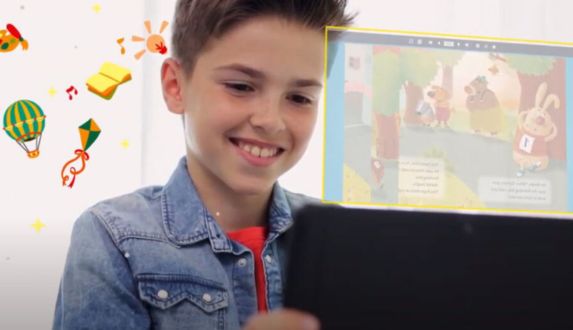
A coursebook introduces new English, but it cannot give children enough reading to become fluent readers. Extensive reading fills that gap: learners read lots of easy, interesting books, choose them themselves and follow the story instead of decoding every word. This guide explains what extensive reading is, how it differs from intensive reading, and how teachers and parents can build it into school and home life in seven steps, including with an online library.
At a glance
- Extensive reading means reading large amounts of easy text for enjoyment and general understanding, without a dictionary and without a test after every book.
- A book is at the right level when the reader knows around 98% of the words. For a beginner, that means no more than one or two unknown words on a page.
- Regular reading matters more than long, occasional sessions. Schools running extensive reading programmes usually aim for about one book a week.
- Audio, reading aloud and shadow reading support extensive reading, but they are separate activities with their own goals.
- A reading journal and genuine choice keep children coming back to books without rewards for every page.
Contents
- What extensive reading is
- Extensive and intensive reading
- Step 1. Choose the level: around 98% known words
- Step 2. Set a routine and a realistic goal
- Step 3. Use audio and multimedia
- Step 4. Keep vocabulary in context
- Step 5. Reading aloud and shadow reading
- Step 6. Motivation and a reading journal
- Step 7. Let children choose
- e-future resources for extensive reading online
- Frequently asked questions
- Sources
What extensive reading is
Extensive reading means reading many accessible texts, usually whole books, to enjoy a story or find out about something. The Extensive Reading Foundation sums it up in four words: learners read quickly and enjoyably, with adequate comprehension, so they don't need a dictionary. The aim is reading fluency. The coursebook introduces new words and structures; extensive reading lets learners meet them again and again in context.
The best-known description of the approach is the ten principles set out by Richard Day and Julian Bamford in 2002:
- The reading material is easy.
- A variety of material on a wide range of topics is available.
- Learners choose what they want to read, and can stop reading a book that is too hard or not interesting.
- Learners read as much as possible.
- The purpose is usually pleasure, information and general understanding.
- Reading is its own reward, so it is not usually followed by comprehension questions.
- Reading speed is usually faster rather than slower.
- Reading is individual and silent.
- Teachers orient and guide their students.
- The teacher is a role model of a reader.
Quantity matters here. Dr Rob Waring, an Executive Board member of the Extensive Reading Foundation, explains in his introduction for e-future e-Library that a typical word needs 10–20 meetings before it stays in memory. To meet each of the 1,000 most frequent English words at least 20 times, learners need to read about 160,000 words of text. A typical coursebook, he notes, contains only about 30,000–60,000 words and lasts a year. Coursebooks introduce language; repetition on that scale comes from reading many books.
Extensive and intensive reading
Most reading in English lessons is intensive: a short passage, new vocabulary, comprehension questions, a grammar point. The Extensive Reading Foundation compares the two approaches to driving lessons and driving on the road. Learners need both, but each has a different job.
| Feature | Intensive reading | Extensive reading |
|---|---|---|
| Purpose | learn new vocabulary, grammar or a reading strategy | read fluently and for enjoyment |
| Text | short, often above the learner's level | a whole book, easy for the reader |
| Who chooses | the teacher or coursebook | the learner, with guidance |
| Dictionary | often needed | hardly needed |
| Pace | slow, with re-reading | smooth, without stopping |
| After reading | questions, exercises, marks | a chat, a recommendation, the next book |
If a child stops every few words and finds reading tiring, they are reading intensively, even when the plan was reading for pleasure. The fix is an easier book, not more effort.
Step 1. Choose the level: around 98% known words
Everything else depends on this step: a book that is too hard turns extensive reading into intensive reading. Hu and Nation concluded that unassisted reading for pleasure needs at least 98% of the running words to be known, or roughly one unknown word in fifty. Laufer and Ravenhorst-Kalovski suggest two thresholds: 95% as a minimum for acceptable comprehension and 98% as the optimal level. Both studies worked with adult learners of English, so with children these figures are a guide rather than a standard to measure.
The Extensive Reading Foundation describes three zones. Below 90% known words, reading is frustrating. Between 90% and 98%, a text suits teacher-supported study in class. From 98% upwards, learners are in the extensive reading "sweet spot".
Nobody counts percentages in practice. Day and Bamford offer a simpler check: for beginners, no more than one or two unknown words per page; for intermediate learners, the "rule of hand", no more than five.
Tip for teachers. In the first session, put books from three neighbouring levels on the tables. Learners read one page and fold down a finger for each word they don't understand. If they run out of fingers on one hand, they try a lower level. Then walk round and ask quietly: "Is it easy? Do you want to keep reading?" In a multilingual class this check works the same for every learner, whatever their home language.
Tip for parents. Ask your child to read the first page and tell you what happened, in any language you share. If they ask about every other sentence, choose an easier book. The e-future placement test, designed for primary grades 1–6, can suggest a starting point. Its result is a recommendation; the teacher and a page of the actual book have the final say.
For how to read level labels (CEFR, headwords, Lexile) and choose a series, see Graded readers and comics: choosing books children want to keep reading.
Step 2. Set a routine and a realistic goal
Day and Bamford see a book a week as probably the minimum for extensive reading to pay off and become a habit. For beginners this is realistic, because books at low levels are only a few pages long. The Extensive Reading Foundation notes that schools typically ask students to read about one book a week or more.
Count goals in books or pages rather than minutes at a desk. Children can see their progress, and adults can adjust the target to book length.
Tip for teachers. Protect a regular slot for silent reading, for example 10–15 minutes once or twice a week, as both the British Council and the Extensive Reading Foundation suggest. Keep it even when the syllabus is busy. During that time, read alongside the class or talk quietly with individual readers about their books.
Tip for parents. Pick a time that genuinely fits your child's day: after school, on the bus to an activity or before bed. Start with one short book a week. When that has worked for a month, add a second. Keeping the same time slot makes it easier to keep reading through school holidays.
Step 3. Use audio and multimedia
A recording helps children connect the written word with its sound and hear the rhythm of a sentence. The Extensive Reading Foundation recommends that teachers sometimes read aloud to learners or play the book's audio. It also points out that we read faster than a narrator speaks, so reading while listening should be part of a programme rather than a replacement for silent reading. Listening to lots of easy recordings, which the ERF calls extensive listening, is the sister approach.
In an online library, learners can listen to a narrator, follow highlighted text, check new words and return to where they stopped. This is a helpful start for children who are still getting used to English spelling, which is often far from how words sound.
Tip for teachers. Start a new series, or the first book at a higher level, with audio. Learners then read the next titles in the same series silently. Let less confident readers keep the audio for longer.
Tip for parents. Try "listen first, then read": one chapter with the recording, and the same chapter alone the next day. Let your child listen to a favourite book many times. Repetition consolidates the same words and phrases.
Step 4. Keep vocabulary in context
In extensive reading, children learn words by meeting them repeatedly in stories. A dictionary used for every sentence breaks the flow. The British Council advises avoiding dictionaries during extensive reading; learners can note words in a vocabulary notebook and look them up after reading. The Extensive Reading Foundation adds that translating texts into the first language works against automatic processing of English.
If one word blocks the meaning of a whole scene, explain it briefly. If there are many such words, go back to Step 1 and change the level.
Tip for teachers. Once a week, ask each learner to bring one word they noticed in their book, together with the sentence they found it in. Collect them on a class word wall. Keep vocabulary tests out of extensive reading.
Tip for parents. If your child tends to translate every sentence, suggest a rule: read to the end of the page, then talk about what happened. After reading, ask: "What do you think that word meant?" Two or three words from a book are enough for a notebook.
Step 5. Reading aloud and shadow reading
Extensive reading is silent by design. Reading aloud practises something else: pronunciation, pace, pausing and intonation. The Extensive Reading Foundation points out that many learners feel anxious about reading aloud in front of others, and that reading aloud while following the meaning is hard. Use short passages learners already understand.
In shadow reading (shadowing), learners listen to a recording and read along with the narrator or a moment behind, copying the pace and intonation. It works best on a short paragraph the learner already understands.
AI Reading Fluency Builder in eSmartClass is built around this technique. It works with English Wave, Hand in Hand 2nd Edition and e-future Discovery. Learners listen to a text and read it aloud while speech recognition checks every word. Practice has three steps: paragraph practice, shadowing and a final assessment showing accuracy and reading speed in words per minute. The teacher sets up access for the class and sees the results. The video AI Fluency Practice Tutorial – Part 2 on the e-future ELT channel shows how it works.
Tip for teachers. After silent reading, pick a short dialogue from one book. Learners listen once, read along with the recording, then record themselves. Compare each recording with the learner's previous one, not with classmates. The fluency criteria (accuracy, rate, expression, punctuation) are covered in the section on reading aloud in our guide to graded readers and comics.
Tip for parents. Take turns reading a comic dialogue, one character each. Once a week your child can record a favourite page on a phone. After a month, listen to the first and the latest recording together.
Step 6. Motivation and a reading journal
Day and Bamford write that reading is its own reward. According to the Extensive Reading Foundation, if a book matches the learner's level, there is no need to test comprehension. The British Council highlights something else: learners are encouraged when the teacher takes an interest in their reading and keeps a record of what they read and enjoyed. That record also helps the teacher recommend the next book.
A reading journal is a simple way to do this. The free e-future My Reading Journal is available to download and print, so children can record each book they finish.
Tip for teachers. Put up a class chart that grows with every book the whole group reads. A shared goal keeps reading from becoming a race. Once a month, ask three learners for a one-minute book recommendation.
Tip for parents. Praise specific things: "You finished the whole series", "You chose a harder level yourself". The best reward for finishing a book is choosing the next one. If you use stickers, give them for regular reading, not for speed.
Step 7. Let children choose
In a review of 44 extensive reading programmes, Richard Day found that learner choice was the most widely used principle, applied in 38 of them. Learners choose books by interest and can swap a book that turns out too hard or dull. The Extensive Reading Foundation suggests reading a few pages before choosing, not judging by the cover alone.
Real choice needs variety: stories, comics, adapted classics and non-fiction. The e-future library catalogue includes the comic series Vera the Alien Hunter, Magic Adventures and School Adventures, as well as Classic Readers, Art Classic Stories, PYP Readers and early readers such as Little Sprout Readers, Phonics Fun Readers and Smart Phonics Readers. Printed series are listed under Readers and comic books.
Tip for teachers. Set up a shelf with books at three levels and in different genres. Show the class how to try a page and how to return a book that didn't work for them. Abandoning a book is not failure.
Tip for parents. Offer three suitable books and let your child pick one. If they don't like it after a few pages, they can choose another. A child reading the fifth comic in the same series is still reading in English.
e-future resources for extensive reading online
e-Library and MetaLibrary share one catalogue of 1,204 readers from Pre-A1 to B2. A short test helps recommend a level, and learners can still browse the whole catalogue. The full title list can be downloaded from the e-Library page.
- e-Library: audio, highlighted text, a dictionary and saved progress. After reading, learners complete quizzes and games, record themselves reading and can write a review. Teachers create classes, recommend books and review results. A computer is recommended.
- MetaLibrary: the same catalogue with missions, rewards, reading aloud with pronunciation feedback and, in selected titles, conversations with characters. It works on computers, tablets and phones.
- Free sample: the demo version shows the reading view and post-reading activities.
Both libraries are sold to schools, with a minimum of 10 students and no individual subscriptions. Parents can ask their child's teacher whether the school uses one of them. For a comparison of the two libraries and a school example, see e-Library, MetaLibrary and “I Read in English”: from book choice to classroom ideas. Pricing for schools in Europe is on the Online Libraries page.
If a child is still learning to decode words, start with Helping children read in English: choosing the next step. For work with short texts in class, see Short English reading texts: choosing a text and checking understanding.
Frequently asked questions
How is extensive reading different from reading in class?
In class, learners usually read a short text to learn new vocabulary or grammar. That is intensive reading. In extensive reading they read whole, easy books for meaning and enjoyment, choose them themselves and don't have to complete tasks after each one.
How much should children read?
Day and Bamford suggest a book a week as a likely minimum. For beginners, that is a few short pages. Regularity matters more than quantity on any single day: a fixed time at home and a fixed silent reading slot at school.
Isn't an easy book a waste of time?
No. Ease is the first principle of the approach. It lets children read more, meet the same words many times and read more fluently. A book is only too easy if it bores the reader because there is nothing new in it.
Do children need a test after every book?
No. If the book is at the right level, a short chat, a journal entry or a recommendation to a friend is enough. Quizzes in an online library can be an extra, not a condition for moving on to the next book.
At what age can children start?
Sharing and listening to books with an adult can start in pre-school. Independent extensive reading begins once a child can read simple sentences. The e-future library catalogue starts at Pre-A1, with rhyming books and phonics readers.
How can I help if my own English is limited?
You don't need to translate. Your child can use the book's audio, while you ask about the characters and events in your own language, help choose books and keep a regular reading time. A reading journal shows both of you how far they have come.
Sources
- Richard R. Day and Julian Bamford, “Top Ten Principles for Teaching Extensive Reading”, Reading in a Foreign Language 14(2), 2002
- Extensive Reading Foundation, Guide to Extensive Reading, 2011 (PDF)
- Marcella Hu Hsueh-chao and Paul Nation, “Unknown vocabulary density and reading comprehension”, Reading in a Foreign Language 13(1), 2000
- Batia Laufer and Geke C. Ravenhorst-Kalovski, “Lexical threshold revisited”, Reading in a Foreign Language 22(1), 2010
- Richard R. Day, “Extending extensive reading”, Reading in a Foreign Language 27(2), 2015 (PDF)
- British Council TeachingEnglish, “Extensive reading”
- Dr Rob Waring, “Extensive Reading”, e-future e-Library
- e-future: AI Fluency Practice Tutorial – Part 2 (YouTube)