
Present Continuous for kids: rules, examples and exercises
The present continuous is the tense English uses for what is happening right now: I'm reading, She's running, They're playing football. One sentence is enough for a child to get the idea: "what I'm doing at this moment". The form never changes its shape: subject, am / is / are, and a verb ending in -ing. This guide gives you an age-appropriate explanation, board-ready tables, the -ing spelling rules, movement games built around What are you doing?, four exercise sets with answers and three e-future videos where the tense comes to life in a song, a chant and a demo lesson.

In short
- The present continuous describes an action in progress at the moment of speaking, or a temporary situation, e.g. I'm wearing a raincoat today.
- Form: subject + am / is / are + verb + -ing. Negatives add not; questions move am / is / are to the front.
- Signal words: now, right now, at the moment, today, plus Look! and Listen!.
- Learners usually produce the -ing ending before the is or are that goes with it. He running is a normal stage, and it passes with the right practice.
- Very young learners pick up What are you doing? I'm jumping! as a whole chunk through songs and movement. Tables and spelling rules come later.
Contents
- What is the present continuous? Explaining it to a child
- How to build present continuous sentences
- The -ing ending: spelling rules
- Signal words: how to spot the tense
- Present continuous vs present simple in brief
- When to introduce the present continuous
- The same tense at every age: Hand in Hand and English Wave
- Movement games built around What are you doing?
- Exercises with answers
- Common mistakes: where they come from and how to respond
- e-future materials with the present continuous
- Frequently asked questions
- Sources
What is the present continuous? Explaining it to a child
The name sounds serious, but the idea is simple. Present means "now", continuous means "going on". We talk about something that is happening in front of our eyes.
With younger learners, a film comparison works well. The present continuous is the pause button: we freeze the picture and say what everyone is doing. The dog is jumping. The boy is laughing. Mum is cooking.
The Cambridge Dictionary lists several uses of the tense. For primary pupils, the first two are enough:
- What is happening now: I'm drawing a cat.
- What is true "for now": My grandma is staying with us this week.
Older pupils also meet fixed plans for the near future: We're visiting Paris on Saturday. With young children it pays to wait, so the first meaning settles before a new one arrives.
It helps to know what your learners bring from their first language. In German, French or Polish, one present form usually covers both "I read every evening" and "I'm reading right now" (ich lese, je lis, czytam). English splits these meanings into I read and I'm reading. Once a child notices the split, choosing the form becomes a question about meaning rather than a rule from a table.
How to build present continuous sentences
The present continuous has two building blocks: a form of be (am, is, are) and a verb ending in -ing. That is how both the Cambridge Dictionary and BBC Learning English describe it. If your pupils already say I'm happy or She's at school, half the work is done.
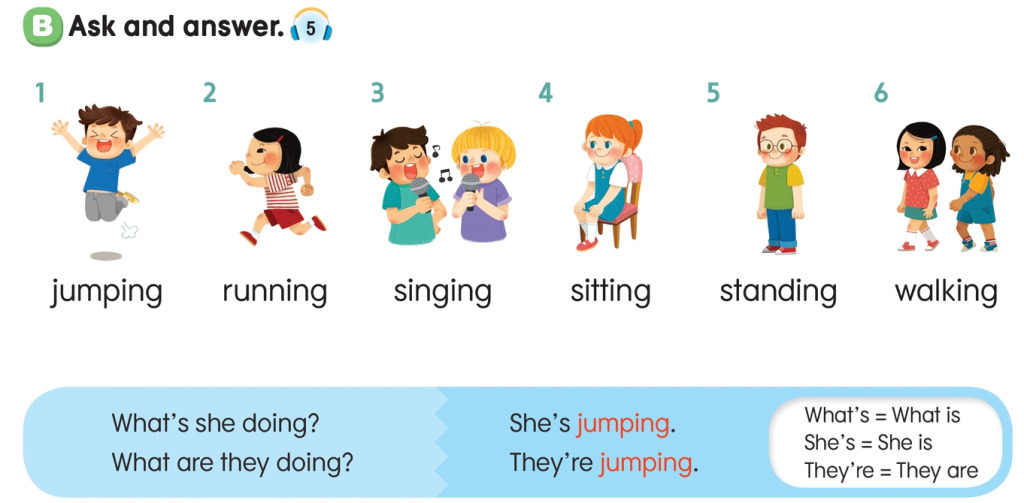
Positive sentences
| Subject | Full form | Short form | Example |
|---|---|---|---|
| I | I am | I'm | I'm eating an apple. |
| you | you are | you're | You're singing. |
| he / she / it | he is / she is / it is | he's / she's / it's | She's swimming. |
| we | we are | we're | We're playing. |
| they | they are | they're | They're dancing. |
The Cambridge Dictionary notes that the short forms are used more often than the full forms, especially in speech. So teach I'm jumping from day one, not only I am jumping.
Negative sentences
Add not after am / is / are. In speech we mostly use isn't and aren't.
- I'm not sleeping.
- He isn't watching TV.
- They aren't running.
A note for teachers: in the first person we say I'm not. Some children build I amn't or I'm n't by analogy; show them that not is a separate word that follows 'm.
Questions and short answers
In questions, am / is / are jumps to the front. Show it literally: move a card with is in front of the subject.
- You are reading. → Are you reading?
- She is cooking. → Is she cooking?
Short answers repeat the same verb: Yes, I am. / No, I'm not. Yes, she is. / No, she isn't. Positive short answers are never contracted: Yes, I am, not Yes, I'm.
Wh- questions start with the question word: What are you doing? Where is he going? Why are you laughing? What are you doing? is the single most useful sentence in the topic. Let children hear it in every lesson, including in real moments: when someone is looking for a pencil case or staring out of the window.
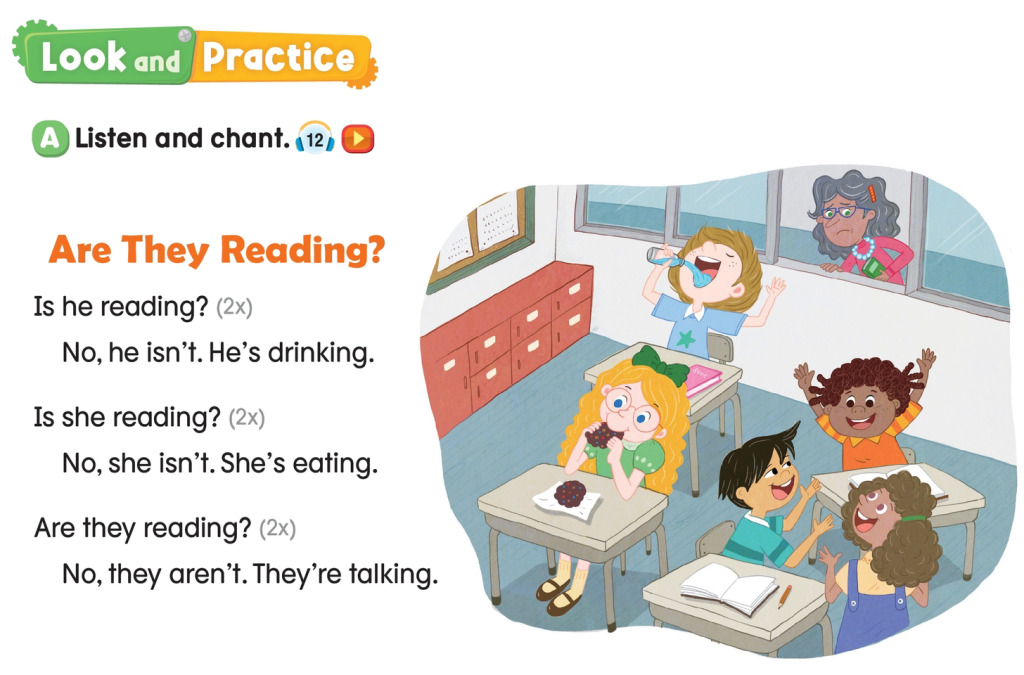
A chant from Smart English 3 practises questions and negative short answers in one go. Every verse follows the same pattern: a question, a "no" and the correct information.
What to look for: the clip is just over a minute long. Around 0:10 the chant asks about a boy (Is he reading? No, he isn't. He's drinking.), around 0:16 about a girl (No, she isn't. She's eating.) and around 0:28 about a group of children (No, they aren't. They're talking.). From about 0:36 the verse repeats. On the second play, pause after each question and let the class answer before the recording does.
The -ing ending: spelling rules
Children rarely struggle with -ing when speaking. The trouble starts when they write. Five rules cover nearly everything, and the Cambridge Dictionary sets out the main ones with examples.
| Rule | Examples |
|---|---|
| Most verbs: add -ing | read → reading, play → playing, eat → eating |
| Silent -e: drop the e, add -ing (but ee stays: see → seeing) | write → writing, make → making, dance → dancing |
| Short verb ending in vowel + one consonant: double the last letter | sit → sitting, run → running, swim → swimming, stop → stopping |
| -ie ending: change to y, add -ing | lie → lying, tie → tying |
| -w, -x, -y are never doubled | snow → snowing, fix → fixing, play → playing |
For teachers: in longer verbs we double the consonant only when the last syllable is stressed (begin → beginning, but visit → visiting). British spelling also doubles a final l (travel → travelling); American spelling does not (traveling).
Young learners don't need every rule at once. Start with the "just add -ing" group and a handful of verbs they already know: run, swim, sit, write, dance. Learn those exceptions as whole words, each with a gesture.
Signal words: how to spot the tense
Some words and phrases almost always come with the present continuous. Pupils can underline them in a text like detectives:
- now: I'm doing my homework now.
- right now: She's talking on the phone right now.
- at the moment: They're having lunch at the moment.
- today / this week: I'm wearing my new shoes today.
- Look! and Listen!: Look! The baby is walking! Listen! Someone is singing.
Look! and Listen! work especially well in class because they point the child straight at a picture or a sound they can describe.
Present continuous vs present simple in brief
The present simple describes what we usually or regularly do. The present continuous describes what we are doing now, or "for now". A BBC Learning English 6 Minute Grammar episode shows the difference with a pair of sentences: John checks his email every morning and I'm checking my email at the moment.
| Present simple | Present continuous | |
|---|---|---|
| Meaning | usually, every day, always | now, at the moment, for now |
| Signal words | every day, usually, always, on Mondays | now, right now, at the moment, today, Look! |
| Example | I play football on Saturdays. | I'm playing football now. |
A picture with two thought bubbles helps: a calendar in one (present simple), a clock with a "now" arrow in the other (present continuous). For each sentence, the child points to the bubble it belongs to.
Older pupils need one more point. Verbs for states, feelings and knowledge usually stay in the simple form: I like pizza, I know the answer, I want a dog. The Cambridge Dictionary gives the example I don't know the name of the street and notes that state verbs are usually used in the simple rather than the continuous form.
When to introduce the present continuous
Look for two signs of readiness. First, the child uses I am, you are, he is comfortably in simple sentences (I'm happy, He's my brother). Second, they know a dozen or so action and everyday verbs: run, jump, eat, drink, sleep, read, write, swim, sing, dance, cook, play.
The Cambridge English Young Learners framework gives a useful benchmark. The present continuous, without future meaning, is already on the grammar list for Pre A1 Starters, the first of the three levels, with examples such as What are you doing? and The cat's sleeping. In the A2 Flyers speaking test, children tell a short picture story, and the handbook lists the present continuous of action verbs among the structures they will need most often.
e-future courses show how the tense can grow level by level:
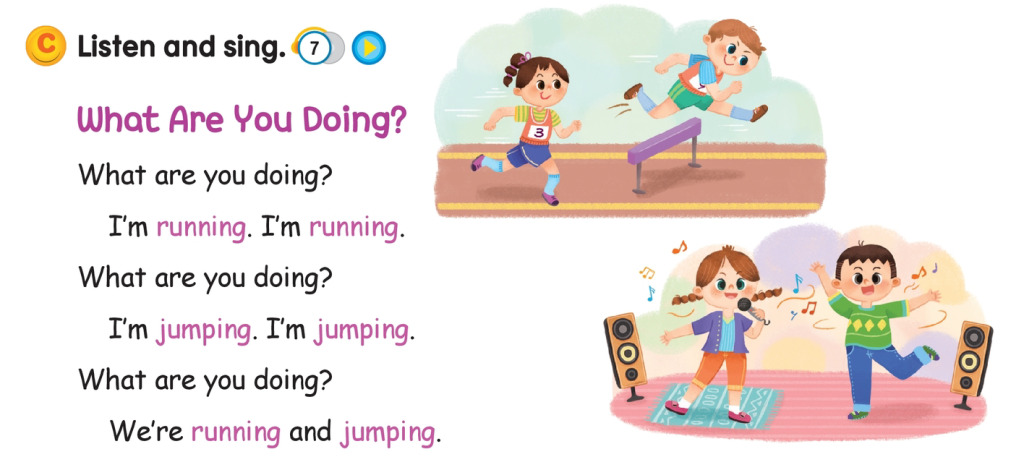
- Preschool (age 5). In Little Hands 3, children sing What are you doing? I'm walking. I'm jumping. Nobody mentions tenses. They pick up the pattern by ear, the way they learn a song. For more on working with materials in this age group, see our guide to English materials for preschool.
- Early primary. In Let's Smile 3, the song What Are You Doing? belongs to Unit 1, and the second units of Let's Smile 3 and Smart English 3 add he, she, they, questions such as Is he reading? and short answers. Children can already read simple sentences at this age, so you can show how -ing "sticks" to the verb.
- First explicit rules. In My First Grammar, a grammar series for ages 7–9, the first level already introduces the present simple and the present continuous in positive sentences, negatives and questions.
- Upper primary: My Next Grammar. The next step after My First Grammar is My Next Grammar. Its first level, used from around age 10, returns to the present continuous and sets it against the present simple and adverbs of frequency in detail. Pupils also form wh- questions in different tenses, so a lesson can put What are you doing now? right next to What do you usually do on Saturdays? Pupils write more at this age, so -ing spelling, state verbs and future plans have something to work on. In the third level, the same be + -ing pattern returns in the past continuous.
For the youngest learners, the easiest start is a song with movement. Each verse is one action the children can act out straight away.
What to look for: the song lasts half a minute and has five verses with animated children: around 0:04 I'm walking, 0:10 I'm jumping, 0:13 I'm running, 0:19 I'm dancing, 0:25 I'm singing. On the first play, children just act out each verb. On the second, pause after the question and let the group answer and move on their own.
The same tense at every age: Hand in Hand and English Wave
The present continuous doesn't stop at early primary. Learners keep coming back to it, each time with a harder job to do: first they describe what they are doing, then they separate "now" from "usually", and later they use it for plans. Two e-future courses, one for children and one for teenagers, show how this works in class.
Children: Hand in Hand 2
Hand in Hand is a seven-level primary course for ages 6–12, with word and grammar lists linked to CEFR and Cambridge YLE levels. Level 2, for learners aged 8+, gives the present continuous two units: one about playing outside (Doing Things Outside) and one about activities at home (Doing Things Inside). In the first, children describe other people: What's she doing? She's walking. What are they doing? In the second, the conversation gets personal. Mila and Matt's dialogue includes What are you doing? I'm reading. Can I come over?, and yes/no questions with short answers follow: Is he talking? Yes, he is. No, he isn't.
That dialogue makes a ready-made pair-work model. Pupils swap in another activity from the same unit (I'm drawing, I'm painting, I'm writing) and decide whether their partner can come over. No new vocabulary is needed, and every pair asks What are you doing? several times.
Older learners: English Wave 1–3
English Wave is a six-level course for teenagers, from A1 to B2. Many language schools start it earlier than secondary school: ten-year-olds work through English Wave 1 to consolidate the whole of A1, 11–12-year-olds move on to English Wave 2 and 13-year-olds to English Wave 3. The present continuous appears at each of these levels, every time in a different role:
- English Wave 1, Unit 7 People and Activities. A lesson on what people are doing, with a listening about people wearing costumes, introduces the present continuous and ends with a speaking game, Guess what I'm doing. The lesson before it practises adverbs of frequency and How often…?, so the "usually" versus "now" contrast sits inside one unit.
- English Wave 2, Unit 1 Spending Time Outdoors. A review of the present simple and the present continuous, built around a camping trip. The dialogue opens with What are you doing? I'm packing my bag for my camping trip and soon moves to You go camping every year, right? Then pupils act out activities in groups, their partners ask What are you doing?, and the answers combine both tenses.
- English Wave 3, Unit 1 School Clubs. The same review, this time about school clubs. Pupils act out an activity from a club, classmates guess it in the present continuous and then say in the present simple what the club does. The grammar chart sets pairs side by side, such as I build robots and I am building a robot. Unit 2 introduces the past continuous, and Unit 7 presents the present continuous for plans, alongside will and be going to.
The mechanics are familiar from preschool: someone acts something out and the others guess. What changes is the language task. A five-year-old says I'm jumping; a teenager has to decide quickly whether they are talking about now or about a habit. So the charades in the next section work with older classes too, if you add a second round in the present simple.
Movement games built around What are you doing?
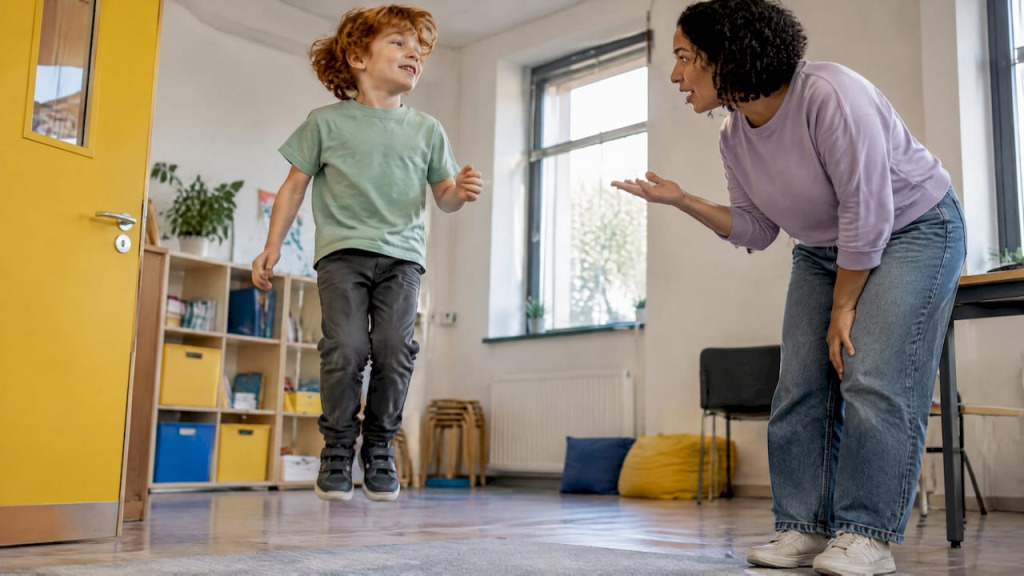
This tense is all about movement, so the quickest way in is through action. A child really does something, someone describes it, and the -ing form gets linked to an action that is happening right then.
Whole-class games
- Action charades. A pupil draws an action card and mimes it. The others guess: Are you swimming? No, I'm not. Are you flying? Yes, I am! Questions and short answers get practised together.
- Freeze frame. Everyone moves to music. When the music stops, they freeze, and the teacher describes: Anna is dancing. Leo is jumping. After a few rounds, the children do the describing.
- Card on the head. A volunteer holds an action card above their head without looking at it and guesses: Is she drinking? Is she sitting? The class answers No, she isn't or Yes, she is.
- Slam the card. Action cards lie on the table. The teacher says a sentence (They're running), and two children race to slap the right picture first.
- What's happening in the picture? A large scene with lots of characters: a park, a beach, a kitchen. In pairs, pupils ask each other What is the girl doing? Older ones write five sentences, two of them negative.
- Spot the difference. Two almost identical pictures. In picture A the boy is reading. In picture B he is sleeping. The task calls for full sentences and comparison.
You can see several of these games in a Let's Smile 3 demo lesson. The teacher works through the unit At Home to camera, with the digital book on screen.
What to look for: from 0:15 the card-slam game (They're running. She's jumping.), from about 2:45 questions and answers about a picture (Is she talking? No, she isn't. She's writing.), from 4:08 the chant Is she sleeping?, from 9:31 charades where the teacher mimes and the class asks Are you dancing?, from 12:15 a personal question (What are your mom and dad doing now?) and from 14:31 the card-on-the-head guessing game.
One-to-one lessons and home
- Mystery sounds. Play a sound (a kettle, a dog barking, rain) and ask: Listen! What's happening? The child answers: It's raining. A dog is barking.
- Phone call to Grandma. Role-play a phone call: Hi! What are you doing? I'm making a cake. And what is Dad doing? Short scenes like this work well in online lessons too. For more on planning one-to-one lessons, see how to become an effective English tutor.
- Photo diary. Parent and child take a few photos of everyday activities, and in the evening the child writes captions: Mum is washing the dishes. The finished album is both a keepsake and a review.
- Picture talk while reading. At every illustration, ask: What is he doing? Is she laughing? The child practises the pattern inside a story. For ideas on choosing books and working with an online library, read our article on e-Library, MetaLibrary and "I Read in English".
For more ways to make grammar feel like play, see our guide on how to make your students fall in love with grammar.
Exercises with answers
Copy these onto a worksheet. They go from easiest to hardest.
Exercise 1. Fill in am, is or are
- I ___ drawing a dragon.
- The cat ___ sleeping on the sofa.
- We ___ having breakfast.
- Tom ___ riding his bike.
- My friends ___ playing in the garden.
- You ___ wearing a nice hat.
Exercise 2. Write the -ing form
Write the -ing form of each verb: 1. read, 2. swim, 3. write, 4. play, 5. sit, 6. dance, 7. lie, 8. run.
Exercise 3. Present simple or present continuous?
Choose the correct form.
- Look! The baby (sleeps / is sleeping).
- I (go / am going) to school every day.
- Shh! Dad (talks / is talking) on the phone.
- My sister (likes / is liking) chocolate.
- We (play / are playing) tennis on Fridays.
- What (do you do / are you doing) now?
Exercise 4. Correct the mistake
Each sentence has one mistake.
- He running in the park.
- What she is doing?
- Are you reading? Yes, I'm.
- She is writeing a letter.
- I'm liking this song.
Answers
Exercise 1: 1. am, 2. is, 3. are, 4. is, 5. are, 6. are.
Exercise 2: 1. reading, 2. swimming, 3. writing, 4. playing, 5. sitting, 6. dancing, 7. lying, 8. running.
Exercise 3: 1. is sleeping, 2. go, 3. is talking, 4. likes, 5. play, 6. are you doing.
Exercise 4: 1. He is running in the park. 2. What is she doing? 3. Yes, I am. 4. She is writing a letter. 5. I like this song.
Common mistakes: where they come from and how to respond
Several present continuous errors have a well-documented cause. In Principles and Practice in Second Language Acquisition (1982), Stephen Krashen brings together studies on the order in which learners of English acquire grammatical endings and function words. In this "average" order, the -ing ending sits in the first group, while the auxiliary in front of it (he is going) comes only in the second. Krashen also describes transitional forms that learners pass through. One of them is a question without inversion, with an example from research on children learning English as a second language: What she is doing?
The takeaway for teachers is encouraging. A child who says He running is halfway there: the -ing is in place and the is is still settling. Patiently filling that gap works better than going back to the start of the topic.
| Mistake | Where it comes from | What helps |
|---|---|---|
| He running. | -ing appears in speech before is; many first languages use a single verb form here | the "two blocks" gesture: two fingers, two parts, is + running |
| What she is doing? | the question is built from the statement without changing the word order | move the is card in front of the subject, then chant the question |
| She is read. | the child remembers is but drops the ending | rhythmic repetition with a clap on the ending: read-ING, swim-MING |
| I am going to school every day. | the new tense spills over into sentences about habits | the two bubbles again: calendar or clock? |
| writeing, siting, runing | spelling rules only matter when writing | an exceptions poster on the wall and whole-word cards |
Correct gently by echoing the right form in a natural reply. The child says He running, and you answer Oh yes, he is running fast! The pupil hears the correct pattern without feeling they have failed. During controlled practice, a short pause and two raised fingers can prompt the child to add the missing is on their own.
e-future materials with the present continuous
The present continuous sticks best in materials where it keeps coming back in songs, stories and games. Here are e-future options by learner age.
Preschool: Little Hands 3. Little Hands 3 Student Book is for 5-year-olds, level Pre A1, the top level of the four-level preschool course. It offers stories, catchy songs and chants, including What are you doing? from the video above, plus alphabet and phonics support for early literacy. Action flashcards are all you need for freeze frame and charades.
Early primary: Let's Smile 3 and Smart English 3. Let's Smile 3 is for young EFL learners aged 9+, level Pre A1, part of a seven-level primary course built on stories, songs and games, with language targets that are linked and recycled. The demo lesson with charades and the card-on-the-head game comes from this course. Smart English 3 (2nd edition, ages 9+, Pre A1) combines comics, chants and songs, and its AI Andi speaking app lets pupils repeat sentences and play the characters from each unit. The Are They Reading? chant above is its second unit.
First rules: My First Grammar. My First Grammar is a grammar series for ages 7–9 built on a spiral syllabus, so structures come back and get extended in each book. Its first level introduces the present simple and the present continuous in positive sentences, negatives and questions.
Reading: e-Library. In e-Library, pupils read books with audio and highlighted text, and teachers create classes and review activity results. The illustrations are ready-made prompts for What is the boy doing? For an overview of other digital tools, see our article on platforms for English teachers.
Next step: My Next Grammar. My Next Grammar follows on from My First Grammar for upper primary learners (A1–A2), again with a spiral syllabus. The first level compares the present simple and the present continuous in detail and practises adverbs of frequency, the second builds up the past simple, and the third adds the past continuous. Pupils who learned how the sentence is built in My First Grammar now learn to choose the right tense.
Older children and teenagers: Hand in Hand and English Wave. Examples from both courses are in the section The same tense at every age.
Frequently asked questions
What is the simplest way to explain the present continuous to a child?
Say it's the "right now" tense and show it straight away: jump and say I'm jumping! Then ask the child to do the same. Rules and tables can wait; meaning and the melody of the sentence come first.
At what age do children learn the present continuous?
The chunk What are you doing? I'm jumping! can appear as early as preschool, as a song and a movement game. In early primary, he, she, they, questions and short answers follow. The full form, negatives and -ing spelling are usually taught once pupils start writing more. The one prerequisite is confident use of am / is / are. In the Cambridge Young Learners framework, the tense already belongs to Pre A1 Starters. With older learners it comes back in contrast with the present simple and as a way to talk about plans, for example in My Next Grammar and English Wave.
Why does a child say "He running" even after learning the rule?
Because the -ing ending shows up in speech before the is that goes with it. Krashen describes this as a typical order among learners of English. Many first languages express the idea with one verb form, so the second part is easy to drop. The two-blocks gesture and calmly echoing the correct version help.
How can pupils quickly tell the present continuous from the present simple?
Ask: "Is it happening now, or does it usually happen?" If now, choose the present continuous and look for now, at the moment, Look!. If usually, choose the present simple and look for every day, usually, always.
Sources
- Cambridge Dictionary, English Grammar Today: Present continuous (I am working)
- Cambridge Dictionary, English Grammar Today: Verbs: types (state and action verbs)
- BBC Learning English, Lower intermediate, Unit 2, Session 2: 6 Minute Grammar, Present continuous and present simple
- Stephen D. Krashen, Principles and Practice in Second Language Acquisition (1982), chapter II, pp. 12–15
- Cambridge English, Pre A1 Starters, A1 Movers and A2 Flyers: Handbook for teachers (2024), Pre A1 Starters grammar and structures list