
English classroom games for kids: 20 tried-and-tested ideas
Teachers in Ethiopia, India and Indonesia describe the same classroom games as teachers in Spain or Korea: Bingo, 20 Questions, a spelling chain. Games travel well because the rules carry the language, and a good one works whether you have 12 children in a language school or 45 in a state primary class. A useful classroom game takes a few minutes, practises the vocabulary or structure of the current unit and gets the whole group listening, speaking or moving, not just one volunteer. Below are 20 games for kindergarten and primary classes, grouped by what you need: nothing at all, picture cards, a board, or just a reason to talk. Each comes with an age guide, a time and the skill it practises, and four sit next to recordings from the e-future ELT channel with the key minutes marked. We write for English teachers working with young learners anywhere; the section on games at home is also useful for parents.
In short
- Choose the aim first (eight words from the unit, one question, one structure), then the game.
- A single game usually runs for 3–8 minutes. Keep a games slot short and stop while children still want more.
- Preschoolers respond to instructions with their bodies, children aged 6–9 name and ask, and older primary pupils build sentences and compete in teams.
- Demonstrate the rules with one round and two volunteers. It is quicker than explaining, and in a class with several home languages it is the one explanation everyone understands.
- A child who makes a mistake loses a point or becomes your helper, but stays in the game.
In this article
- How to choose a game for your group
- Games with no materials
- Picture card games
- Board and paper games
- Speaking and grammar games
- Which game practises which skill
- How to run a game so that it teaches
- Games as part of the lesson plan
- Games at home and in home education
- e-future materials with ready-made games
- Frequently asked questions
How to choose a game for your group
Before you pick a game, answer four questions. It takes a minute and saves you the lesson where half the class is waiting for a turn and the other half has not understood the rules.
Age. Preschoolers and children in the first years of primary school learn mainly through listening and movement. Games based on TPR (Total Physical Response) work best for them: the child responds to an instruction with an action, so they can show they understand before they are ready to speak. The method was created by Dr James J. Asher. TeachingEnglish from the British Council describes it as working in large and small classes alike, and in mixed-ability groups, because the action carries the meaning. Pupils aged 9–12 enjoy team competition and can handle games that involve writing and building sentences.
Level. With beginners, choose recognition games: point, touch, hold up the card. Once children know the words, move to games where they say them, and then to games where they put them into sentences. This is simple scaffolding: at each stage the child gets as much support as they still need, and you gradually take it away.
Group size. With four to six children, any game works. Class sizes vary enormously from country to country, and in a class of 25, 35 or more, choose formats where everyone plays at once (Simon Says, Four corners) or where pupils play in pairs and small teams (Find your partner, Slam in fours). The TeachingEnglish worksheet on games in the classroom, built on interviews with teachers from several countries, recommends competing teams as a strategy for big classes.
Home languages. In an international school or a city class with families from several countries, children may share no language except the little English they have. Choose games where the action shows the meaning (Simon Says, Four corners, Slam) for the first weeks, and keep games that need long explanations for later. In a class that shares one first language, the challenge is different: children slip into it as soon as the game gets exciting. The section on common problems below deals with that.
Room and materials. Running games need space. In a small room, choose games played at desks, or swap running for steps on the spot. With picture cards, start with six to eight and add more once the group has the first set.
Games with no materials
You can run these at any moment: as a warm-up at the start of the lesson, when there are five minutes left before the bell, or when the group needs to move. A short warm-up in English helps children switch languages, especially when they arrive straight from a lesson taught in the language of schooling.
1. Simon Says
Age: 4+ · Time: 5 minutes · Practises: understanding instructions, body parts, action verbs
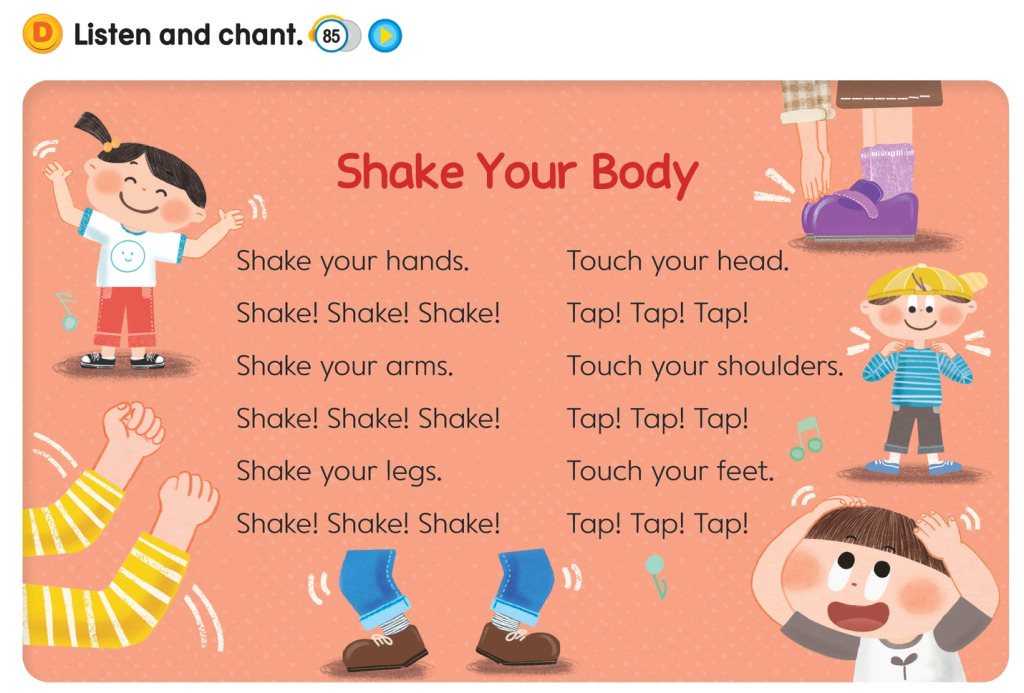
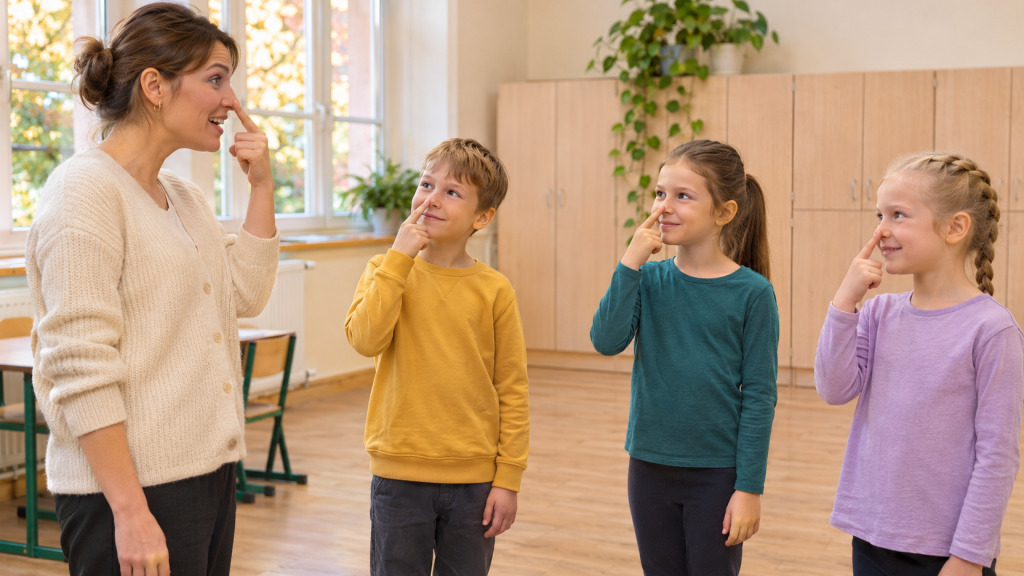
You give instructions, and children follow only the ones that start with "Simon says…". "Simon says touch your nose" means move; "Touch your nose" on its own means stay still. The TeachingEnglish lesson plan on classroom language builds the game up in stages: first plain instructions with a demonstration (Stand up, Sit down), then the "Simon says" phrase and the first trap, where you say "No!" and signal the children to stay where they are. At first you do the actions with them; later you only say the instructions.
A child who gets it wrong does not sit out. They become your helper and spot other players' mistakes. After a few lessons, hand the role of Simon to a pupil: the child giving the instructions uses far more English than the children following them. The most common mistake is speeding up too early. Children then copy the classmate next to them instead of listening.
2. I Spy
Age: 5+ · Time: 5 minutes · Practises: vocabulary, initial sounds, yes/no questions
"I spy with my little eye something beginning with B." Children guess an object in the room. With the youngest, swap the letter for a colour ("something blue"). With older children, allow up to ten yes/no questions, such as "Is it bigger than a football?". The letter version links vocabulary to the first sound of a word, which is exactly what children practise in phonics. Say the sound, not the letter name: /b/, not "bee". The game also works on a busy illustration from the course book, where children hunt for animals, things of one colour or letters.
3. What's the time, Mr Wolf?
Age: 4+ · Time: 5–8 minutes · Practises: numbers, asking the time · Needs: plenty of space
One child is the wolf and stands with their back to the group at the other end of the room. The others chant "What's the time, Mr Wolf?" and the wolf answers, for example, "It's three o'clock!", so the group takes three steps. At "It's dinner time!" the wolf turns round and chases them. The child who is caught becomes the next wolf. Children repeat the same phrase many times without feeling they are drilling. Once the group knows the game, add your own versions with other times of day: "It's bath time", "It's play time".
4. 20 Questions
Age: 8+ · Time: 5–10 minutes · Practises: yes/no questions, unit vocabulary
One person thinks of a thing, ideally from recent vocabulary, and the group may ask up to 20 questions that can only be answered "Yes" or "No": "Is it an animal? Does it have four legs? Can it fly?". TeachingEnglish lists it among the games that practise question forms and useful vocabulary, next to a close relative, Who am I?, described by Hintsa, a teacher from Ethiopia: he writes names of well-known people on slips of paper, sticks them on two pupils' backs, and they ask the class yes/no questions to find out who they are. With young learners, use animals or characters from the course book instead of celebrities. Write three question frames on the board (Is it…? Does it have…? Can it…?) so that less confident pupils have something to lean on. When a pupil chooses the word, ask them to whisper it to you first. You can then help them answer, and nobody changes the word halfway through.
What to look for in the recording: e-future trainer Gary plays 20 Questions with the webinar audience. The questions move from general to narrow until someone guesses the elephant (around 14:30–18:30). Straight after comes the tip about the pupil telling the teacher the word first (around 18:30–19:00). From about 34:00 to 37:00 he plays I Spy on a crowded picture: first the open "What animals do you see?", then the specific "How many fives do you see?", and finally a hunt for single letters for children who are still learning phonics. The webinar runs for about an hour; the rest covers more warm-ups and activities built on course book pages.
5. Telephone (whisper chain)
Age: 6+ · Time: 5 minutes · Practises: pronunciation, telling sounds apart
You whisper a word or a short sentence to the first child in a row, who passes it on. The last child says aloud what they heard, and you compare it with the original. In a big class, make three or four rows and race: the row that delivers the sentence unchanged wins. Choose sentences with word pairs your learners tend to mix up. Which pairs depends on their first languages: ship and sheep trouble learners from many language backgrounds, light and right are a common pair for some learners from East Asia, berry and very for many Spanish speakers, three and free or think and sink for many others. A mistake at the end of the row then becomes a quick pronunciation exercise.
6. Four corners
Age: 6+ · Time: 5–8 minutes · Practises: listening, vocabulary, describing
Put a card with a word from the unit in each corner of the room. On "Three, two, one, go!" every child goes to a corner and says the word on its card. Then you call one of the words: children in that corner win a point, and everyone changes corners. With older pupils, give a clue instead of the word ("It's an animal. It can swim.") so they have to understand the whole description. Hand the job of calling the corner to a pupil as soon as you can.
Picture card games
Picture cards (flashcards) are the most common resource in a young learner classroom. Memory, Snap!, What's missing? and picture bingo are explained step by step in a separate guide on our blog, "Flashcards for kids: how to choose them and how to teach with them", together with how to introduce new words. Here we keep three games in which the cards are used for listening, movement and conversation.
7. Slam
Age: 5+ · Time: 5 minutes · Practises: listening, telling similar sounds apart
Lay four to six cards on a table while the players keep their hands on their heads. You say a word. Whoever slaps the right card first, with a hand or a fly swatter, takes it. In class, play in fours: one pupil reads words from a list, three play, and roles change after three rounds. In a harder version, the table holds pairs of similar words and you say only one of them, or just the sound. Build the pairs from the sounds your own class confuses: ship/sheep, three/free, wet/vet, light/right or berry/very, depending on the learners' first languages. With a lively group, swap slapping for touching with one finger; at a crowded table it is easy to hit a classmate's hand.
What to look for in the recording: the teacher first checks that the pupil knows the words on the cards (fish, fork, panda, pen) and only then starts the game, with hands on heads and a fly swatter (around 0:00–0:30). Soon the roles swap and the pupil asks "What is it?" (around 0:30–0:50). From about 1:00 the cards show the letters p and f, and the teacher gives only the sound. At the end (around 1:20–2:10) she explains the point of this version: it helps learners practise two sounds they confuse. The video is just over two minutes long and in English.
8. Flashcard race
Age: 5+ · Time: 5 minutes · Practises: vocabulary, reaction speed · Needs: space by the board
Stick the cards on the board or lay them out at the far end of the room. Two teams line up. You say a word, and the first child in each line runs to touch the right card. Whoever touches it first says the word aloud, wins a point and goes to the back of the line. TeachingEnglish describes a similar game, Ball throw: one team names a card and a player from the other team throws a ball of paper at it. With children aged 7–9, give a riddle instead of a word: "It's yellow. It's a fruit. Monkeys like it."
9. Find your partner
Age: 6+ · Time: 5–7 minutes · Practises: questions and short answers
Every child gets a card: half the group have pictures, half have words (or questions and answers). Children walk around and look for their partner by asking in English: "Have you got a dog?". The answer is "Yes, I have!" or "No, I haven't. Sorry!". Drill both answers with the whole class before you start; without them, the conversation quickly slips into the first language. As a bonus, the game puts the class into pairs for the next activity.
Board and paper games
These games need a board, or paper and a pen. They work once children can write single words, usually from the age of seven or eight.
10. Hot seat
Age: 9+ · Time: 8–10 minutes · Practises: speaking, paraphrasing
One pupil sits with their back to the board, and you write a word on it. Their team describes the word in English without saying it until the pupil in the "hot seat" guesses. The game teaches children to find other words: "It's an animal. It's big and grey. It has a long nose." For less confident groups, put a sentence frame on the board: "It's a… It has… You can… with it." For advanced groups, add three words they may not use, as in Taboo.
11. Stop the Bus
Age: 8+ · Time: 8–10 minutes · Practises: vocabulary, spelling
Write five categories on the board, for example animal, food, colour, sport, clothes. Pick a letter, and teams write one word starting with that letter in each category. The first team to fill the row shouts "Stop the bus!". In a popular scoring variant, points go only to words nobody else wrote, so it pays to look for less obvious ones. Check spelling together: the team spells the word aloud in English while you write it on the board.
12. Hangman
Age: 7+ · Time: 5 minutes · Practises: the alphabet, spelling
The classic game with one rule: letters must be called out in English. It is good alphabet practice, and the letter names e, i and a are a trap for learners whose first language names them differently: in many European languages, the letter i is said much like the English name of e. Review the letters your group mixes up before you play, such as I and E or J and G, and start with short words without rare letters such as z or x. Instead of a hangman, you can draw a snowman or a flower losing its petals.
For a spelling game without any drawing, try Last letter, described by Shiva, a teacher from India, in the TeachingEnglish worksheet: two teams take turns, and each new word must start with the last letter of the previous one (class, shoe, egg…). It shows children quickly that English spelling does not always follow the sound.
13. Board race
Age: 8+ · Time: 5–8 minutes · Practises: vocabulary, spelling
Divide the board into two halves and give a category, for example "things in the kitchen". One player from each team runs up with a marker, writes a word and hands the marker to the next player. After two minutes, count only the words spelt correctly. Do not cross out a misspelt word straight away: ask the team to find the letter that needs fixing. It is a quick moment of self-correction.
14. Noughts and crosses
Age: 9+ · Time: 8–10 minutes · Practises: grammar, building sentences
Draw a 3×3 grid with a word or picture in each square. A team may claim a square only after making a correct sentence with its word, for example in the past simple (went, played, saw). If the sentence contains a mistake, the other team can correct it and take the square. Noughts and crosses is on the TeachingEnglish list of classroom games, and the advice to adapt games to what you are teaching applies directly: change the words in the grid and you can practise any structure.
15. Listen and draw
Age: 7+ · Time: 8–10 minutes · Practises: listening, prepositions, colours
Read a short description while children draw what they hear: "In the middle there is a big house. The house has one red door. There's a cat next to the door." At the end, they compare their drawings with the original or with a partner's. The activity is good for prepositions of place (in, on, under, next to) and for there is / there are. In the next round a pupil reads the description and you draw on the board.
Speaking and grammar games
In these games children speak in phrases and full sentences. Put the model they should use on the board before you start; without it, answers quickly shrink to a single word.
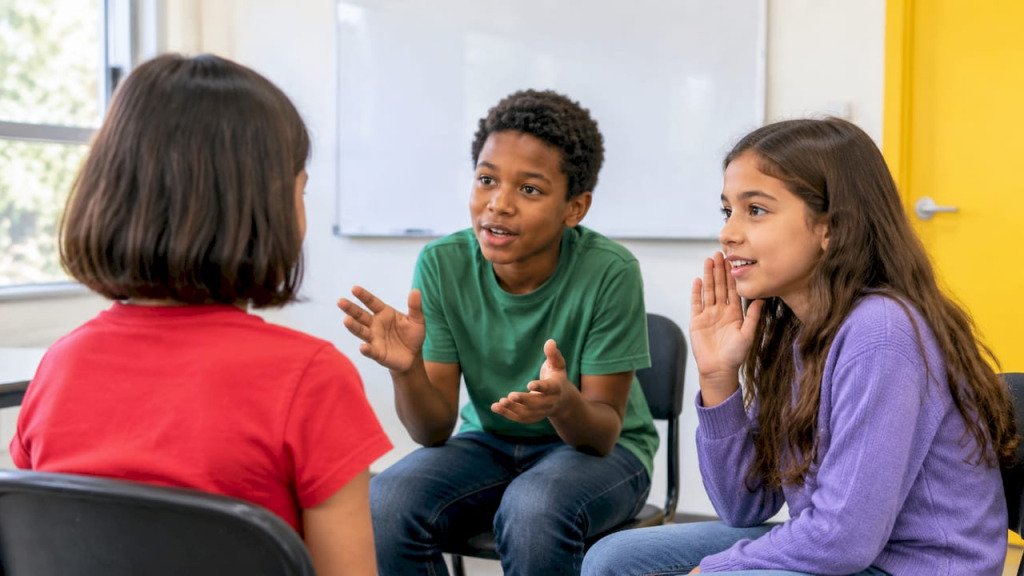
16. I went to the market to buy…
Age: 6+ · Time: 5–8 minutes · Practises: memory, vocabulary, sentence structure
The first player says: "I went to the market to buy an apple". The next one repeats it and adds an item: "…an apple and some milk". The list grows with every player. With older children, ask for quantity expressions such as a bottle of, a packet of and a bag of, and give a sheet with example words to children who run out of ideas. Let the market sell what local markets sell: mangoes, olives, rice or cheese, whatever the children actually see. In class, play in groups of five or six so that everyone speaks several times.
17. Role-play: at the shop, the doctor's, the restaurant
Age: 6+ · Time: 10 minutes · Practises: speaking in context, polite phrases
Give pairs a short situation and two or three phrases to use: "Can I have…, please?", "How much is it?", "Here you are". A few simple props (a basket, a menu, an empty medicine box) make a big difference to younger children's engagement. Once pairs know the dialogue, ask for one change: a different product, a different customer, a different ending. That is when pupils stop reciting and start speaking. Stories from the course book are ready-made material: children act out a scene with the recording first, then without sound, from memory.
18. Find someone who…
Age: 8+ · Time: 8–10 minutes · Practises: questions and short answers
Each pupil gets a sheet of prompts: "Find someone who has got a cat", "…can swim", "…likes pizza". They walk around asking questions ("Have you got a cat?") and write a name next to every "Yes". The rule is one name per prompt, so pupils have to talk to many classmates. Afterwards, collect the results on the board as a simple bar chart and describe it: "Five people can swim." It is a natural step towards third-person sentences.
19. Storytelling chain
Age: 7+ · Time: 5–8 minutes · Practises: speaking fluency, linking sentences
The first player says one sentence of a story, the next adds another, and so on. Younger children use simple sentences from the unit ("I like green." – "I like blue." – "Let's paint a rainbow!"); older pupils build a longer story with then, but and suddenly. Silly plot twists are a plus here: children speak quickly and stop worrying whether a sentence "fits". Give the first sentence yourself, for example "One morning a cat found a magic hat."
20. Would you rather…?
Age: 6+ · Time: 3–5 minutes · Practises: expressing preferences, giving reasons
Ask a question with two answers: "Would you rather play a board game or a video game?". Children walk to their side of the room and say "I'd rather…", or "I want…" in younger groups. Volunteers add "because…". With only two options it is easy to choose and hard to get wrong, which makes this a good warm-up for a shy group. Build the questions from the unit vocabulary: colours, food, animals, free time.
Which game practises which skill
| Game | Age | Skill | Materials |
|---|---|---|---|
| Simon Says | 4+ | understanding instructions, vocabulary | none |
| I Spy | 5+ | vocabulary, initial sounds | none |
| What's the time, Mr Wolf? | 4+ | numbers, questions | plenty of space |
| 20 Questions | 8+ | yes/no questions | none |
| Telephone | 6+ | pronunciation, listening | none |
| Four corners | 6+ | listening, describing | 4 cards |
| Slam | 5+ | listening, similar sounds | cards |
| Flashcard race | 5+ | vocabulary, reaction | cards, space |
| Find your partner | 6+ | questions and answers | cards |
| Hot seat | 9+ | speaking, paraphrasing | board |
| Stop the Bus | 8+ | vocabulary, spelling | paper, pen |
| Hangman | 7+ | alphabet, spelling | board |
| Board race | 8+ | vocabulary, spelling | board, markers |
| Noughts and crosses | 9+ | grammar, sentences | board |
| Listen and draw | 7+ | listening, prepositions | paper, crayons |
| I went to the market… | 6+ | memory, sentence structure | none |
| Role-play | 6+ | speaking in context | simple props |
| Find someone who… | 8+ | questions and answers | prompt sheet |
| Storytelling chain | 7+ | speaking fluency | none |
| Would you rather…? | 6+ | preferences, reasons | none |
The ages in the table are a rough guide, not a fixed limit. The level of the group matters more.
How to run a game so that it teaches
The same game can be five minutes of intensive review or five minutes of noise. A few decisions by the teacher make the difference.
- Choose the aim before the game. Write it in your plan: "the game recycles eight words from the Food unit" or "the game practises Have you got…?". The aim tells you whether you need a listening, speaking or writing game.
- Show, don't explain. Play one round with two volunteers in front of the class. TeachingEnglish stresses that clear instructions are very important with any game: in the worksheet, Eka, a teacher from Indonesia, gives an example and checks that her pupils have understood before a round of Bingo starts. Children grasp rules faster from a demonstration than from a description, even in their first language.
- Use the same game language every time. "Your turn", "Pass", "Well done", "Let's start", "I've got it!" repeated in every game quickly become classroom language. Put them on a poster next to the board.
- Watch the clock. A single game takes 3–8 minutes. Stop at the best moment, while children still want more. Young learners concentrate in short bursts, so two short games in a lesson usually teach more than one long one.
- Don't knock players out for long. A child who makes a mistake loses a point, becomes the referee or comes back after one round. Children left sitting with nothing to do are the first to start causing trouble.
- Correct on the go. When a child says "He have a dog", repeat the correct form naturally ("Yes, he has a dog!") and keep playing. This is called a recast: the child hears the correct form and the game does not stop.
- End the game with language. Ask for three words or one sentence from the game. That minute is quick feedback for you as well: you see which words the group already knows and which need another round next lesson.
Large classes without chaos
- Everyone plays at once, or in teams. In a class of 30, a queue for one chair means 29 children waiting.
- Agree on a quiet signal before the first game. For example a raised hand, or "One, two, three, eyes on me!" with the reply "One, two, eyes on you!".
- Number the players in each team. The TeachingEnglish lesson plan does this in a card game: you call "Number 1, come here", so every child gets a turn in order.
- Hand out roles. Referee, scorekeeper and word reader are jobs for children who are not playing in that round.
Common problems and what to do
- Children switch to their shared first language. Leave the two or three phrases the game needs on the board and give a team point for using them in English. In a mixed-language class this happens less, but children may fall silent instead; pair a newcomer with a confident partner for the first rounds.
- One-word answers. Give a sentence frame ("It's a…", "I've got…") and reward a full sentence with a bonus point.
- The same children always answer. Pick answerers at random (name sticks, team numbers) and set a rule that a different child speaks in every round.
- A shy child stays silent. Start with choral and pair answers, and only then ask in front of the class. TeachingEnglish notes that games help shy pupils start speaking English without fear.
What to look for in the recording: Hannah Ruppert taught EFL in Korea for eight years, at her last school as the speaking teacher. In this webinar she shows speaking games built on e-future course books. Around 11:30–14:00 she explains why games reduce the fear of mistakes: children want to win, so they guess and speak instead of waiting for the perfect answer. Around 15:20–16:30 she talks about positive feedback. Role-play with cut-outs and course book recordings comes at about 17:00–22:00, the storytelling chain at 22:00–24:30, and a survey with a bar chart, close to Find someone who…, at 34:00–35:40. From about 39:20 she suggests taking away a point instead of putting a child out. Her key advice comes at around 44:00–47:00: talk less, facilitate more, and let two pupils demonstrate the rules ("I need two helpers"). The webinar is in English and runs for about 50 minutes.
Digital games in class
Interactive whiteboards and online platforms widen your choice of games, but they need the same planning as card games: a clear aim, a short time slot and a link back to the course book vocabulary. For a comparison of five platforms, from Wordwall to Kahoot!, see Tools for English teachers: 5 platforms for your lessons.
Games as part of the lesson plan
A game teaches most when it brings back words and structures children have met in the course book, in a song or in a recording. Bingo or Slam then stop being a filler and become one more round of review. In practice: the warm-up recalls words from the previous lesson, the course book activities introduce new ones, and a game near the end of the lesson lets children use them.
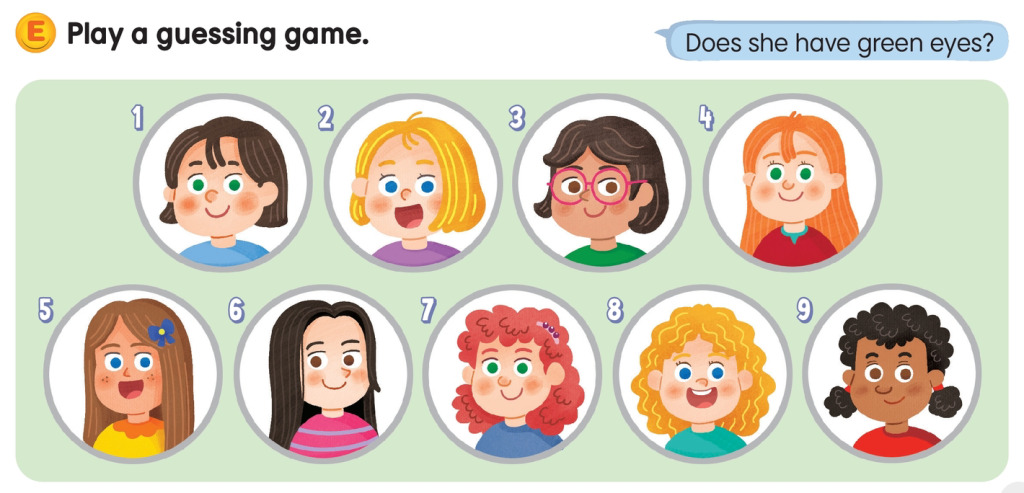
International reference points support this. The Common European Framework of Reference (CEFR), which most European school systems and many beyond Europe use to describe levels, says an A1 learner "can interact in a simple way provided the other person talks slowly and clearly and is prepared to help". That is a fair description of a child in a well-run game: the teacher slows down, demonstrates and helps, and the child takes part with a few words. Cambridge English describes its qualifications for young learners as built around tasks children enjoy, with levels linked to the CEFR. Whatever national curriculum you follow, a game that recycles the unit's language fits these aims.
Pupils design their own game
When pupils have played enough games, let them make one. It is a good project for pupils aged 9–12: they read and write rules, plan questions and then speak while they play. It takes two lessons.
- Lesson 1, 10 minutes. Groups of four choose a unit from the course book and a game format from this article: a board game with a dice, Stop the Bus, Board race or Find someone who….
- Lesson 1, 25 minutes. Each group makes 10–12 question or task cards and writes the rules in English. The rules have five sentences at most, in the imperative: "Roll the dice. Move your counter. Read the card. Answer the question."
- Lesson 2, 20 minutes. Groups swap games and play another group's game.
- Lesson 2, 10 minutes. The authors improve their rules based on the players' comments. The games go into a class games box and come back for review lessons.
The most common problems are rules that are too long and questions harder than the unit itself. That is why the five-sentence limit and the rule that every answer must be in the course book apply from the start.
Games at home and in home education
Most of these games move home without any changes. I Spy, Simon Says, 20 Questions and "I went to the market…" work at the table, in the car and on a walk. Parents do not need fluent English; they can explain the rules in their own language and keep the game words in English. We suggest three rules to parents: play short and often (a few minutes, several times a week), use the words your child is learning at school or in a book, and let your child run the game sometimes.
If you teach your child at home, build games into a regular weekly plan. Our guide to English in home education explains how to put that plan together.
e-future materials with ready-made games
Games are easiest to run when the material already has them built in. The board, the cards and the vocabulary then match, and you do not have to prepare everything from scratch.
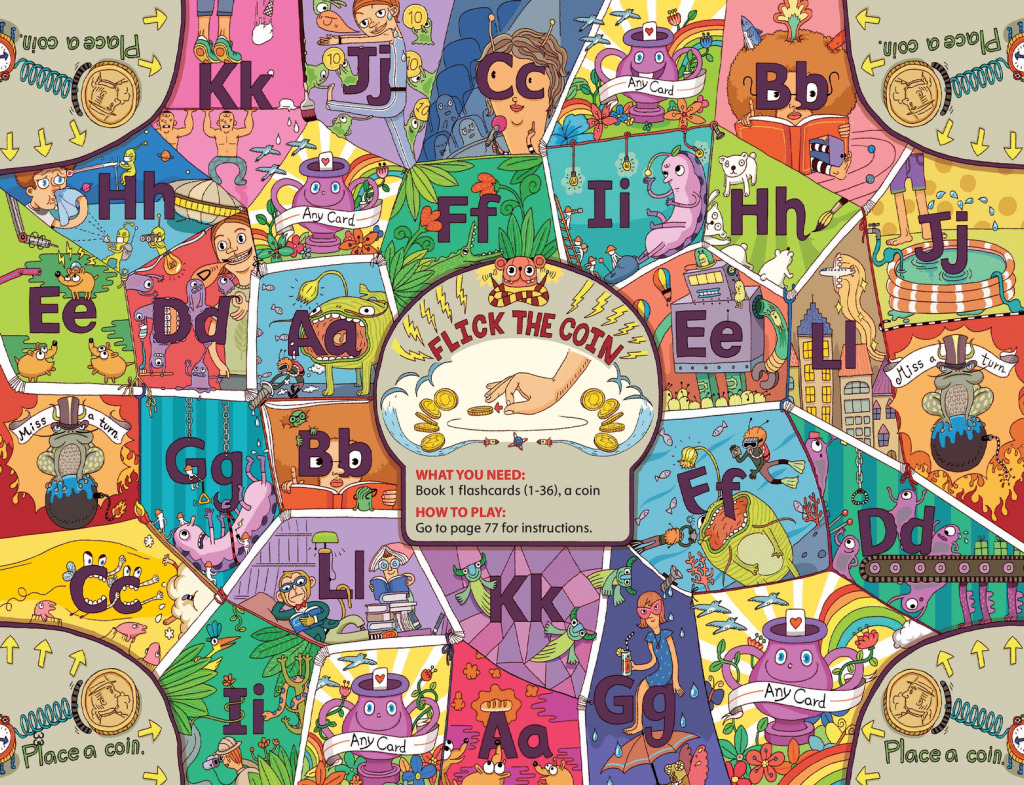
Smart Phonics Big Game Book. Smart Phonics 1 Big Game Book contains board games for reviewing single letter sounds in class, at Pre A1 level, and is a game resource for level 1 of the Smart Phonics 3rd Edition series. Smart Phonics 2 Big Game Book does the same for short vowels and level 2 words. A large board is easy for several players to see at one table.
What to look for in the recording: the video opens with the difference between the small board in the student book and the big board in the Big Game Book (around 0:00–0:40). Then come three games with picture cards. In Flick the Coin, a player flicks a coin, says the sound of the letter it lands on and finds a matching card (around 0:40–3:00). In Jump Over, they draw a card from a pouch and move their counter to the letter the word begins with (around 3:00–6:00). In Under the Sea, they roll a dice, say the sound and collect two cards with words for that letter (around 6:00–9:40). Turns are decided by "rock, paper, scissors", which adds a few more words of English. The video is just under ten minutes long and in English.
Let's Smile and Hand in Hand. Let's Smile is a seven-level primary course with stories, songs and "fun and communicative games", and its downloadable teacher resources include board games, flashcards and worksheets. Hand in Hand is a seven-level course for children aged 6–12, with projects in its CLIL units and additional teacher resources: an e-book, games and activities, flashcards and worksheets. In both courses, the stories and dialogues give you ready-made scenes for role-play, and the unit vocabulary fills game boards, Slam cards and noughts and crosses grids.
eSmart Class. eSmart Class gives teachers using e-future course books class e-books, downloadable teaching resources and online practice for each textbook, with progress you can monitor at a glance. Practice results show which words the group already knows, so you can choose the next game for the words that still need work.
Frequently asked questions
How much time should games take in one English lesson?
A single game usually takes 3–8 minutes. Lesson length differs between schools and countries, but in a typical 40–60-minute lesson with young learners, plan two short games: one as a warm-up and one to consolidate near the end.
Which games work in kindergarten?
Movement and listening games: Simon Says, What's the time, Mr Wolf?, Four corners with pictures and Slam with a few cards. Children do not need to speak in full sentences yet; it is enough that they respond to instructions and name pictures. For choosing materials for a preschool group, see English materials for preschool: what to choose and how to use them.
Can games be used to practise grammar?
Yes. Noughts and crosses with sentences, Find someone who… and "I went to the market…" practise specific structures in a natural way. For more ideas, read our guide on how to make your students fall in love with grammar.
How do I run games in a large class without chaos?
Choose games where everyone plays at once, or split the class into teams and small groups. Agree on a quiet signal, demonstrate one round, number the players and do not leave children out for long after a mistake. A short game with a clear demonstration runs more calmly than a long one with unclear rules.
What if children speak their first language during the game?
Leave the phrases the game needs on the board, practise them before you start and reward their use in English with a point. Some first language in an exciting moment is natural. What matters is that the words the game is meant to practise are said in English.
Do these games work in a class where children speak different home languages?
Yes, and movement and picture games work especially well, because the action or the card shows the meaning. Demonstrate every new game rather than explaining it, keep the game phrases on the board, and pair newly arrived children with a confident partner for the first rounds. English then becomes the shared language of the game.
Sources
- TeachingEnglish (British Council): Total physical response – TPR
- TeachingEnglish (British Council): Games in the classroom – teacher support worksheet
- TeachingEnglish (British Council): lesson plan Classroom language, giving instructions, rules
- Council of Europe: CEFR global scale, common reference levels
- Cambridge English: Qualifications for young learners
- e-future materials: Smart Phonics 1 Big Game Book, eSmart Class and the recordings from the e-future ELT channel referred to above