
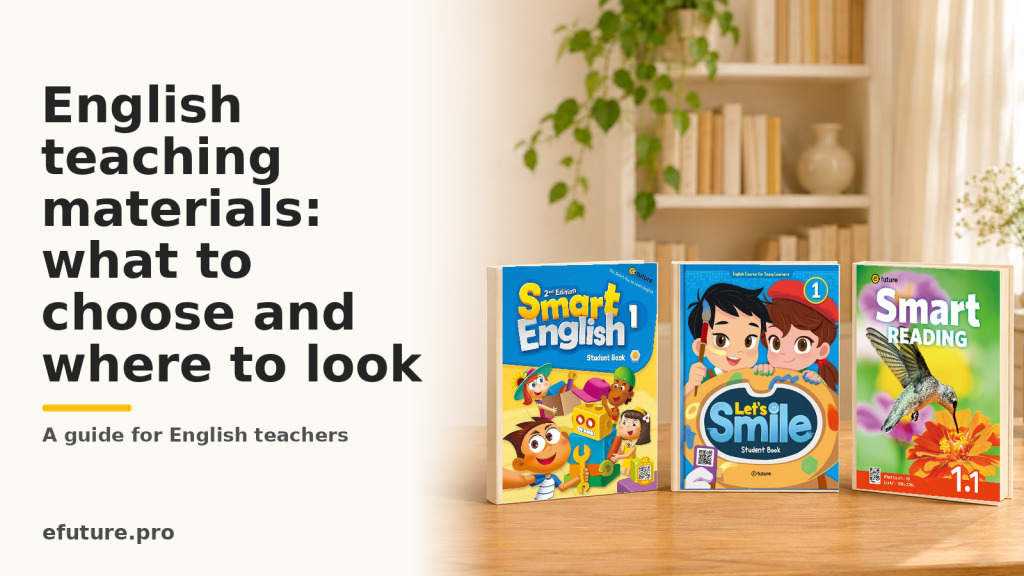
Good materials mean less time searching for another worksheet and more time talking with your learners. A school can organise its programme in two equally valid ways: choose a coursebook series and add focused skills practice, or build the programme around skills-based series without a main coursebook. Both routes need shared goals, a sensible progression and regular opportunities to use familiar language again.
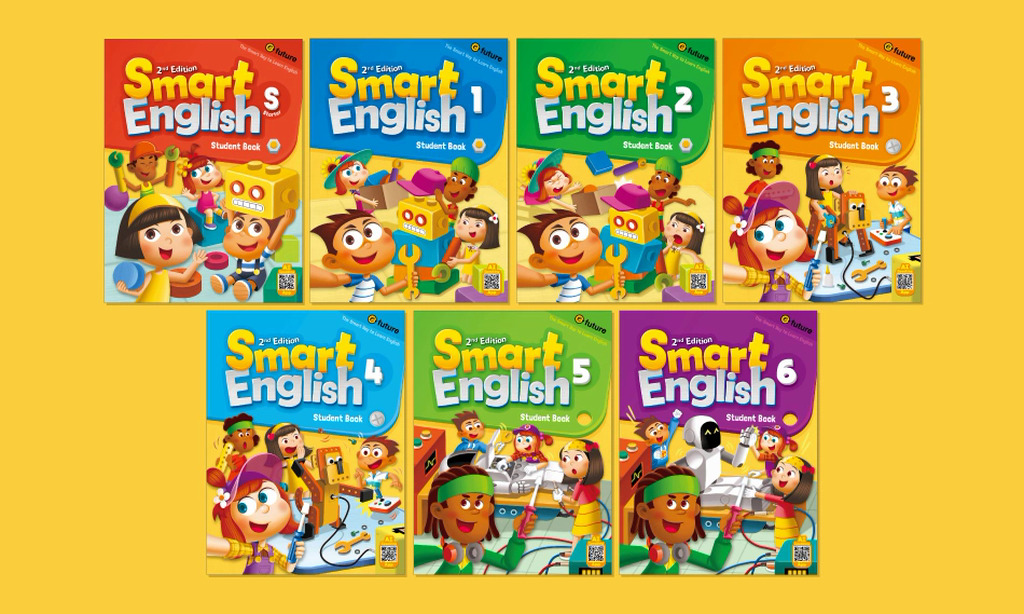
This guide compares four e-future coursebook series, phonics, focused skills materials and a five-lesson weekly model that also works without a single core coursebook.
In this guide
Two equally valid ways to build a programme
A. A coursebook series with selected skills materials
The coursebook provides a sequence of topics, vocabulary and structures. Phonics, reading or listening then receive extra attention where the class needs it. There is no need to add everything at once. Children who enjoy speaking but guess at written words may benefit from systematic phonics. Learners who follow their teacher easily but struggle with recordings may need regular focused listening practice.
This route is convenient when a school wants a common framework across several classes. Teachers can still shorten an activity, add a game or explore a topic that has caught the learners’ interest.
B. A complete skills-based programme without a main coursebook
A core coursebook is optional. Smart Reading, Smart Listening, 1200 Words for Tests, My First Grammar or My Next Grammar, and graded readers can form the basis of a school programme in their own right. The school’s plan connects them through language goals, appropriate levels, recurring themes, spoken and written tasks, and checks on progress.
The aim is not to finish a stack of unrelated books. With an animal theme, children might read a short passage, listen to someone describing a pet, organise useful words, then talk about a real or imaginary animal. Every resource does not have to cover the same topic in the same week. What matters is that learners meet and use language again in meaningful tasks.
Where a school offers more English lessons, there is room to give each area a clear focus. This may suit language schools or independent schools, among others. The actual timetable and the learners’ needs decide which route fits.
Soo Kim of e-future shows how to turn a book into a lesson plan and add skills series in her webinar on curriculum design. Using Smart English as an example, she spreads 20 units across a 10-month course, then shows how a school with 10 lessons a week can share the time between a coursebook and a reading, grammar or listening book.
Watch on YouTube · The Basics of ELT Curriculum Design, Soo Kim, e-future ELT
What to watch for: around 24:00–26:00, the Smart English “Link & Review” activity that brings back words from earlier lessons; around 35:00–38:30, turning coursebook units into months and lessons; around 39:30–41:30, dividing the week between a coursebook and skills series, plus a chart that lines up e-future series levels with Starters, Movers and Flyers.
Four coursebook series: choose the way you want to teach
Smart English: plenty of opportunities to talk
Smart English 2nd Edition has seven levels: Starter and 1–6. It is designed for primary-age EFL learners, with comics, dialogues, songs and cumulative review. The publisher also recommends it for a slower-paced curriculum. The overall range is Pre A1–A2: Starter and Books 1–3 are labelled Pre A1, Book 4 Pre A1–A1, Book 5 A1 and Book 6 A1–A2.
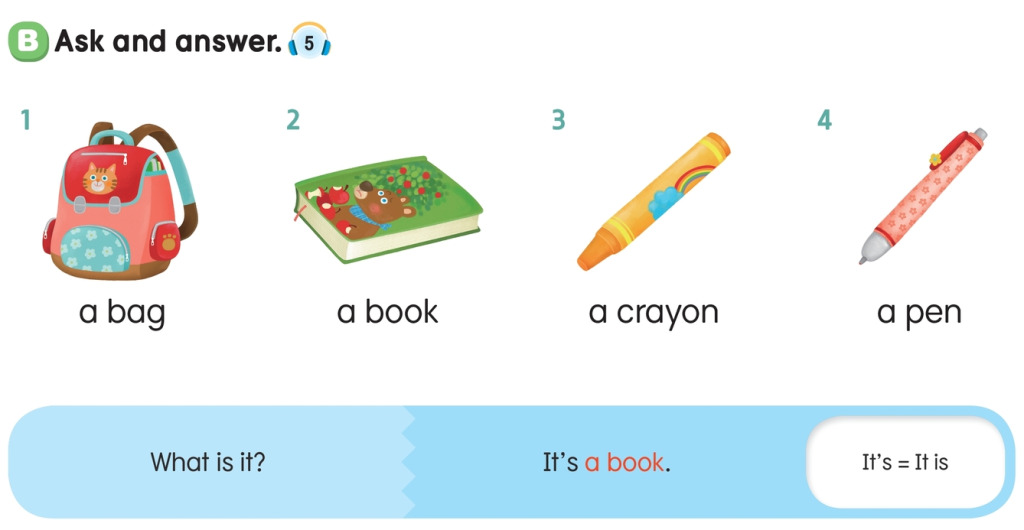
In the Book 1 sample, “My Things” moves from introductions to asking “What is it?” and answering with classroom objects. Take the exchange beyond repetition by hiding an object in a bag: one learner asks, the other checks and answers. Their own school things give a simple dialogue a real purpose.
Let’s Smile: communication through stories and play
Let’s Smile also has seven levels: Starter and 1–6, for young EFL learners. The series spans Pre A1–A2; Starter–3 work at Pre A1, while Book 6 is labelled A1–A2. Stories, songs, communicative games, CLIL lessons and World Link activities bring learners back to the same language in different situations.
In Book 1, “At School” includes identifying classroom objects, listening to a greeting dialogue and singing “What’s Your Name?”. Children can then have a short meeting with a classmate or a book character: say hello, introduce themselves and swap roles. The song becomes a starting point for conversation rather than a break between exercises. The series also has a YLE preparation package, so playful lessons sit easily alongside a later exam goal.
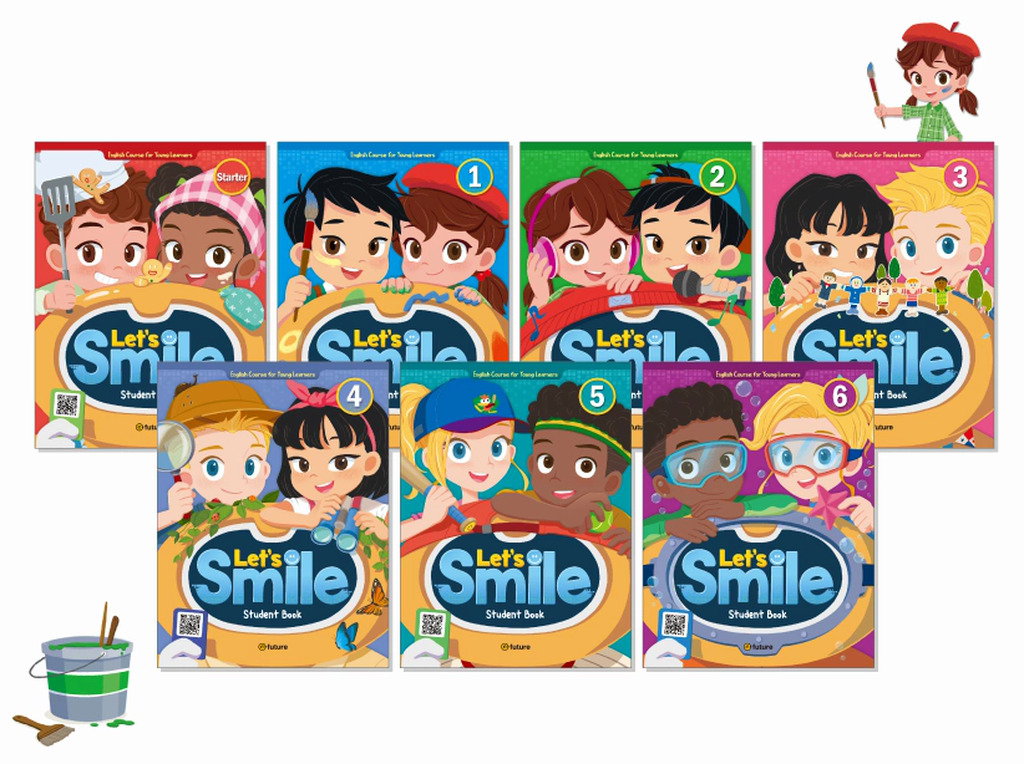
Compare the Let’s Smile books.
Hand in Hand: a planned Cambridge YLE pathway
Hand in Hand 2nd Edition has seven levels, Starter and 1–6, from Pre A1 to A2. Starter and Books 1–2 are Pre A1; Book 3 is Pre A1–A1; Book 4 A1; Book 5 A1–A2; and Book 6 A2. The primary course combines communication with global themes, CLIL and projects.
Cambridge YLE preparation is an explicit part of this edition. Books 1–6 include YLE Test Prep sections; Starter builds the foundations. In “In My Classroom”, children begin with greetings and introductions, then use classroom vocabulary in questions and a game. Language practice and getting used to the exam format support each other.
Watch on YouTube · Hand in Hand 2nd Edition: Now Upgraded, e-future ELT (2 min)
What to watch for: around 1:00, the YLE Test Prep pages with Listening, Reading, Writing and Speaking tasks in the Student Book; around 1:05–1:20, the components: Student Book with an integrated Project Book, Workbook and Teacher’s Manual.
See Hand in Hand and check the edition of the book you need. Match the Student Book, Workbook and teacher materials to the same edition when ordering.
English Wave: a secondary course for the next stage
English Wave is a six-level secondary course spanning A1–B2:
- Book 1 — A1;
- Book 2 — A2;
- Book 3 — A2–B1;
- Book 4 — B1;
- Book 5 — B1–B2;
- Book 6 — B2.
Reading, listening, speaking and writing are linked with vocabulary, grammar, CLIL and projects. The Book 1 sample has learners discussing favourite subjects, reading about classes and preparing their own paragraph. It is a useful opening for teenagers to talk about what they actually enjoy.
The series includes Test Prep. The publisher relates this practice to Cambridge exams and CEFR-based assessment. The series range ends at B2.
A Cambridge pathway: exam goals and book levels
The first three assessment milestones for children are Pre A1 Starters, A1 Movers and A2 Flyers. Hand in Hand 2nd Edition supports work across this range, with YLE preparation sections. The appropriate stage of 1200 Words for Tests can support vocabulary alongside reading and listening series.
Later, a school may plan towards A2 Key for Schools, B1 Preliminary for Schools and B2 First for Schools. English Wave offers language progression from A1 to B2 and Test Prep activities. Preparation for a chosen qualification is completed by its current task types, assessment criteria and official Cambridge sample materials.
After Flyers, choose the next book by what learners can already do: English Wave 1 is A1, while Flyers targets A2, so a class that has finished Flyers can start with a book that better matches its level. Check readiness for secondary-age topics as well. Not every learner needs to take every successive exam.
A CEFR label describes a book’s language level, while official materials show best how an exam works: check the qualifications and preparation resources on Cambridge English. What an exam can contribute and how to judge a child’s readiness is covered in our guide Cambridge English exams for children: benefits and learner readiness.
Four phonics pathways for children around 6–9
When children recognise spoken words but guess at them on the page, plan regular work connecting sounds and spelling. School Phonics, Smart Phonics, EFL Phonics and Speed Phonics are worth considering for children roughly aged 6–9. Readiness for work with letters, experience of English and the class’s pace matter more than age alone.
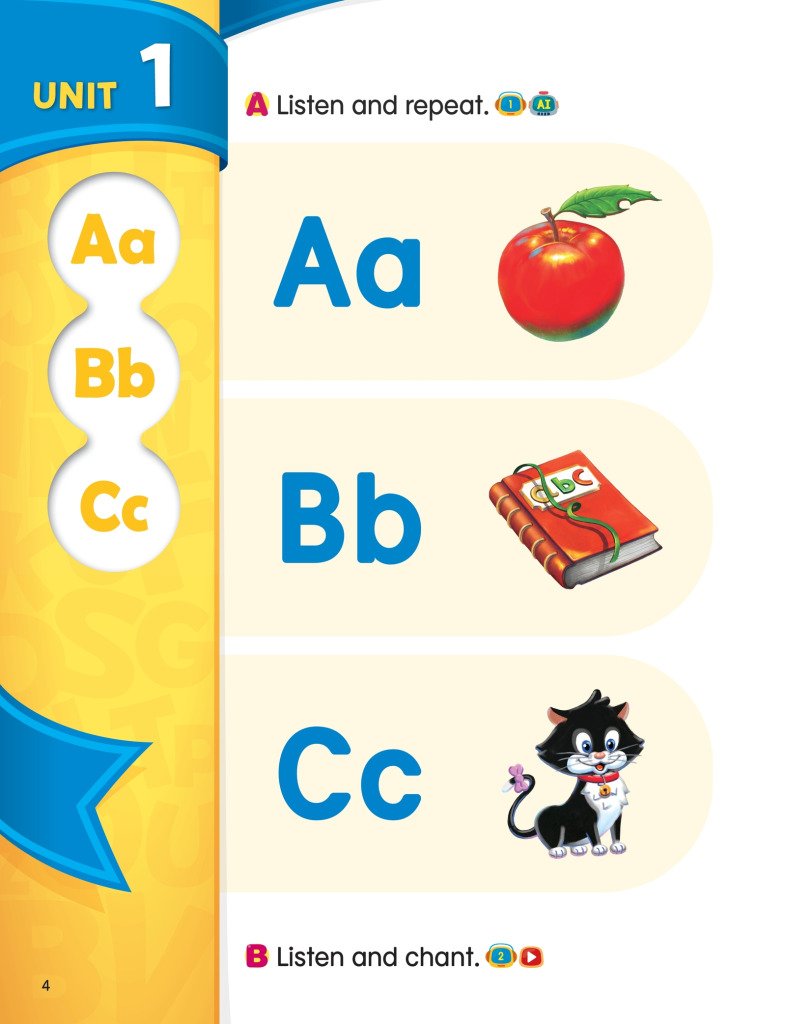
All four combine early reading and writing with play: double-sided picture-and-word flashcards, games, stories and eSmartClass support. Choose primarily by how the material is paced and how the books are organised.
- School Phonics — 4 levels. The Student Book includes practice activities, stickers and three readers. The series also has a separate Workbook.
- Smart Phonics 3rd Edition — 5 levels. Student Books and Workbooks are separate. The sequence spreads the phonics content across five books.
- EFL Phonics 3rd Edition — 5 levels. The edition offered has an integrated workbook.
- Speed Phonics — 3 levels. Each book combines the Student Book and Workbook. Its more compact sequence already covers single-letter sounds and short vowels in Book 1. You still set the pace for your class.
Start with a picture and the spoken word, turn the flashcard over, then find the word in a story. Children now have a reason to read: they want to know what the character does. Alongside phonics, children can enjoy stories read aloud or shared with their teacher.
Compare the four phonics series. Our guide Phonics: how children learn to read in English explains the sound-to-letter sequence step by step, and Helping children read in English: choosing the next step covers what to offer a child who can already decode simple words.
Skills series: choose a level for each area
Smart Reading: from a short passage to talking about the text
6 levels with 3 parts each: 18 books, from 1.1 to 6.3. This primary reading series covers Pre A1–A2. Level 1 is Pre A1, Level 2 Pre A1–A1, Levels 3–4 A1 and Levels 5–6 A2. Texts become longer and more demanding, with a growing proportion of factual content.
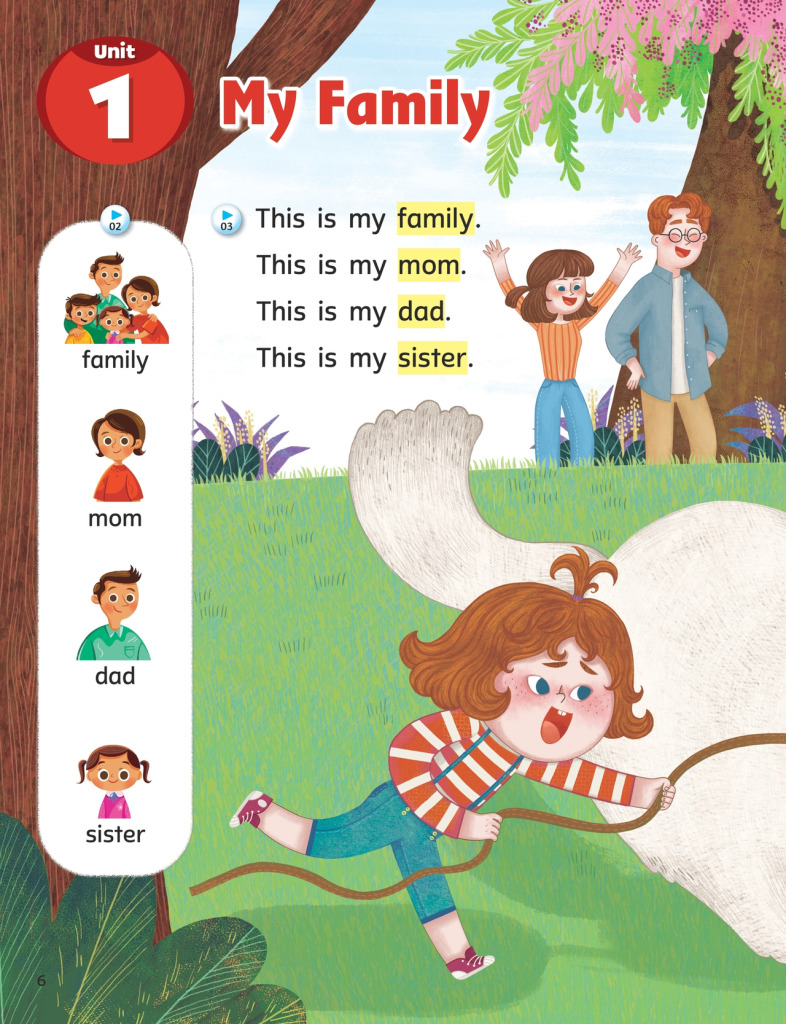
Figures such as “30–45 words” describe passage length, not the number of new words taught in the whole book. When selecting a level, check whether learners can understand the gist and find a relevant detail. The 1.1 sample, “My Family”, supports simple sentences with illustrations. Children can identify family members and add a sentence of their own. With another story, invite them to predict the ending from the title or ask a partner a question. Reading then leads to an exchange of ideas, not just reading aloud.
Smart Listening: listening, responding and speaking
3 main levels with 3 parts each: 9 books, from 1.1 to 3.3. The primary series spans Pre A1–A2. British and American voices and graded tasks move from recognising words towards understanding connected speech. A Dictation Book provides additional practice.
In “Pets” from the International Edition 1.1 sample, learners listen to animal vocabulary, number pictures and match responses. Follow up with a short exchange in pairs. If a recording feels difficult, split it into meaningful sections and set one specific task before listening.
1200 Words for Tests: vocabulary to use, not just memorise
3 stages with 3 books each: 9 books in total. Starters 1–3 work at Pre A1, Movers 1–3 at A1 and Flyers 1–3 at A2. Vocabulary selection is based on Cambridge YLE word lists. The series supports exam preparation alongside the programme’s other learning goals and practice with the exam format.
In Starters 1, “Bodies and Clothes” moves from key words into a short story set on a beach. Words return in sentences, pictures and activities. Extend the idea by having children describe an outfit for a trip or an amusing character. The series title does not mean that each volume teaches 1200 new words.
Choose a stage of 1200 Words for Tests.
My First Grammar or My Next Grammar
My First Grammar 2nd Edition has 3 A1 levels. Clear presentations and recurring practice help younger learners organise basic structures. My Next Grammar 2nd Edition has 3 further levels: Book 1 A1, Book 2 A1–A2 and Book 3 A2, for learners ready for more demanding work.
Choose First or Next according to what the class can already do, rather than their school year. Children at the beginning of Pre A1 can first work with simple spoken sentence frames and move to an A1 grammar book a little later.
After practising a/an, learners might describe what is in their own pencil case. With some/any, they could plan shopping for a class picnic. Grammar becomes a tool for expressing and writing an idea of their own.
See My First Grammar and My Next Grammar.
Graded readers and MetaLibrary: leave room for choice
Beginning readers can explore Smart Phonics Readers — 5 levels and 20 titles or Phonics Fun Readers — 5 levels and 25 stories. At A1, try Magic Adventures or Vera the Alien Hunter, each with 3 levels and 18 titles. At A2, consider School Adventures — 3 levels and 18 titles. Level is only the first filter. Children then choose a story that interests them.
In a reading lesson, one learner may choose an adventure while another wants an animal story. Sometimes the best follow-up is recommending the book to a friend, drawing a favourite scene or talking about what surprised a character. Our guide Graded readers and comics: choosing books children want to keep reading covers levels and a regular reading rhythm in more detail.
MetaLibrary is a digital alternative to a physical bookshelf, with readers spanning Pre A1–B2. It supports reading with audio, activities and missions, while allowing teachers to track learners’ work. Before the lesson, check which activities the chosen title offers.
Browse graded readers and comics.
Resources to help you prepare
For Smart Reading, the publisher lists audio, lesson plans, a syllabus, flashcards and worksheets. Smart Listening support includes audio, lesson plans and worksheets; 1200 Words for Tests has audio, additional practice and YLE preparation materials. My First Grammar and My Next Grammar have separate Workbooks and Teacher’s Manuals. These give teachers a practical starting point for planning and follow-up rather than creating every resource from scratch.
Support varies by book and edition; some resources are available through a teacher account or a local partner. When ordering, agree at the outset which books and access you need.
Five lessons a week: a skills-based model without a core coursebook
In this model, each of five weekly lessons has its own main focus. Schools adapt it to their timetable and learners, and five lessons do not have to mean five separate days.
- Smart Reading. Read and understand a passage, then discuss it or write a short personal response. Give learners a reason to read: find information, check a prediction or choose a favourite part.
- Smart Listening. Listen for a clear purpose, respond and practise orally in pairs. Return to useful expressions from the recording instead of stopping at the answer key.
- 1200 Words for Tests. Use level-appropriate vocabulary in sentences, a dialogue, a story or a short description. For a class working towards YLE, select Starters, Movers or Flyers to match its goal.
- My First Grammar or My Next Grammar. Focus on structures learners need to communicate. Follow controlled practice with an original sentence, a question for a partner or a short text.
- Child-chosen graded readers or MetaLibrary. Make time for reading for pleasure and general understanding. The teacher helps with level; learners choose the topic. A conversation about a book can replace another test.
Speaking and writing run through the week. Reading leads to discussion and a short text; listening leads to a response; vocabulary and grammar feed into learners’ own spoken and written language. Older students can bring these elements together in a project, such as a short game review or a guide for younger learners.
Before starting, agree shared goals and compare samples: Reading 1.1, Listening 1.1 and Grammar 1 are labels within separate series, not one shared level. The First/Next Grammar strand suits learners ready for A1–A2 work; with a beginner class, simple sentence frames are enough at first. Leave room for review, a slower pace when needed and brief checks on what learners can do independently.
The appeal is a set of ready-to-use, graded materials with teacher resources, alongside variety and genuine choice for children. The teacher creates the coherence; the books help sustain it. With fewer lessons, spread the different focuses across a longer cycle rather than squeezing five books into two sessions.
Free materials: look for a useful idea, not another random download
British Council’s TeachingEnglish offers over 400 full lesson plans, organised by CEFR, for primary, secondary and adult learners. There are also shorter activities and ideas for songs, poems and stories. These are useful for cover lessons, an extra discussion or a topic that has just come up in class.
Where you teach within a national or local curriculum, check the requirements that actually apply to your setting. Institutional resources can provide useful lesson ideas; match them to your learners’ language level, interests and learning goals.
Free resources can contribute to either programme model. The school’s plan still provides the sequence, review and balance of skills — a folder of downloaded files will not do that on its own.
Before ordering for the whole class
Consider age and interests, starting point and progression. Look at how the material leads into speaking and writing, what audio is available and which teacher resources support the lesson. Try a sample with the class: notice what learners do independently, where they need help and whether they get to use new language. Then decide on the set.
Digital materials: check the access, not just the platform name
eSmartClass supports compatible series through e-books, online practice and teacher resources. e-Library offers digital reading, activities and reports. MetaLibrary adds features such as missions and reading activities. Each has a different job, so choose it for a specific purpose.
Ask to see a specific book and a learner account before choosing. Check the activities children will see, what the teacher dashboard shows, how audio works and which resources are available with the selected product. For a subscription, agree the access period and number of learners; group subscriptions cover at least 10 users. See the current online library offers for available periods and terms.
For a comparison of the libraries with lesson ideas, read e-Library, MetaLibrary and “I Read in English”: from book choice to classroom ideas. Baamboozle, Wordwall, Kahoot!, Wayground and MetaLibrary in everyday teaching are covered in Tools for English teachers: 5 platforms for your lessons.
Teachers’ questions
Can I build a programme without a main coursebook series?
Yes. Smart Reading, Smart Listening, 1200 Words for Tests, suitable grammar materials and graded readers can form the basis of a standalone skills-based programme. The school plans the progression, review, speaking and writing tasks. A main coursebook is an option, not a requirement.
Should I use My First Grammar and My Next Grammar together?
One of them is enough. First has three A1 levels; Next moves from A1 to A2. Select a series and book according to the structures learners already understand and use.
Must Hand in Hand 6 be followed by English Wave 1?
No. Hand in Hand 6 in the second edition is A2, while English Wave 1 is A1. Choose the next book after checking skills, learner maturity and course goals, rather than following the numbering.
Do five lessons mean five days and five homework assignments?
No. They are five lesson units with different main focuses. The school decides how to timetable them and what homework is useful. The pattern can be spread over a longer cycle so that each book gets its time without adding to learners’ workload.
Does child-chosen reading have to end with a test?
Not every time. A conversation, a recommendation or a shared look at a favourite scene may be enough. Digital tasks and reports help teachers, and simply enjoying a book has its place too.
Choose materials for your school
Bring details of learners’ level and age, the number of lessons and any exam goal. Contact eFuture about choosing materials to compare a coursebook-led route with a skills-based programme and discuss the books and digital access you need.
Sources and further reading
- e-future 2026 catalogue: coursebooks pp. 28–35, grammar 54–57, Smart Listening 64–65, 1200 Words for Tests 74–75, Smart Reading 80–81.
- Cambridge English Qualifications for young learners and further Cambridge English Qualifications.
- British Council TeachingEnglish: free teaching resources.