
Flashcards for kids: how to choose them and how to teach with them
Picture cards work in almost any classroom where young children learn English: a state primary school in Spain, a language school in Vietnam, an international kindergarten with ten home languages in one group. A picture of a cat means the same thing to every child, whatever language they speak at home. That makes flashcards one of the few tools that need no shared first language. This guide is for teachers of young learners aged roughly 3 to 12. It covers choosing cards by age and level, introducing new words, spacing review, games for the classroom and home, and moving from a single word to sentences and books. Four sections include recordings from the e-future ELT channel.
In short
- Flashcards help children meet, memorise, review and consolidate vocabulary. Very young learners need pictures only; word cards come later, once children start reading in English.
- A picture is a shared reference in a class where children speak different languages at home. Use that: it lets every child join in before they can say much in English.
- Introduce a few new words a week and come back to them at intervals: the next day, a few days later, the following week.
- A short game gives children more reasons to repeat a word than a long drill. Stop or switch as soon as attention drops.
- A word starts working when the child uses it in a question, a sentence or a story. Flashcards cover one part of the plan; listening, reading, speaking and fluency practice cover the rest.
Contents
- What flashcards are and what they teach
- Choosing flashcards by age and purpose
- Introducing new words step by step
- Review: short, frequent and spaced
- Flashcard games for the classroom and home
- Flashcards at home: supporting children without pressure
- Making your own flashcards and printables
- From flashcards to sentences and books
- Frequently asked questions
- Sources
What flashcards are and what they teach
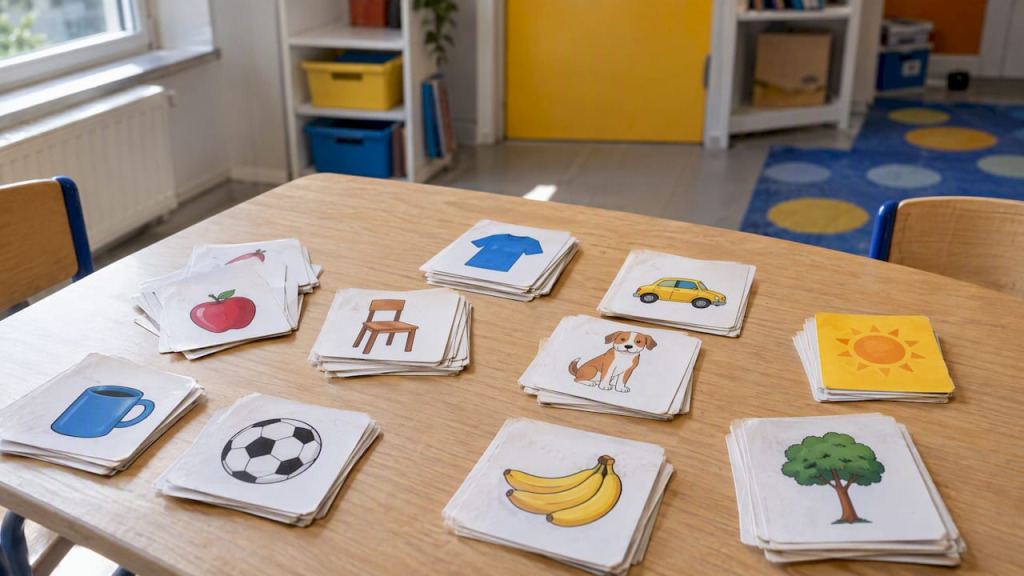
Flashcards are picture cards, used alone or with word cards. The Bell Foundation, which supports teachers of children learning English as an additional language, describes them as a tool for introducing, memorising, revising and consolidating vocabulary. It notes that revisiting vocabulary aids acquisition, and flashcards give learners a natural way to meet target words more often. The Foundation lists four formats:
- picture with the word in the learner's first language, useful when a newly arrived child needs a bridge from a word they already know;
- picture and English word on the same side, handy for children who are starting to read;
- picture on one side, English word on the other, so the card can be turned over after the child answers;
- picture-only cards with separate word cards, for matching pairs.
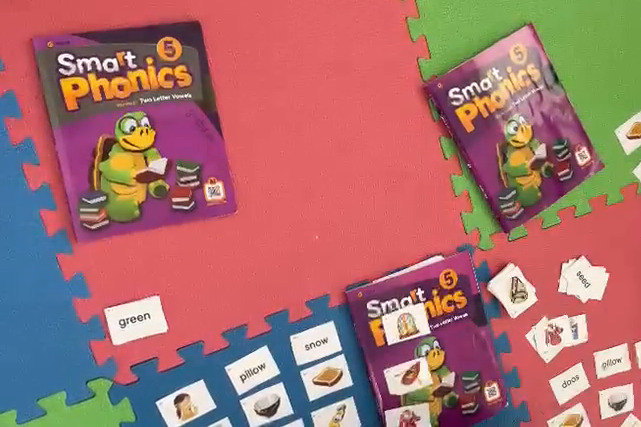
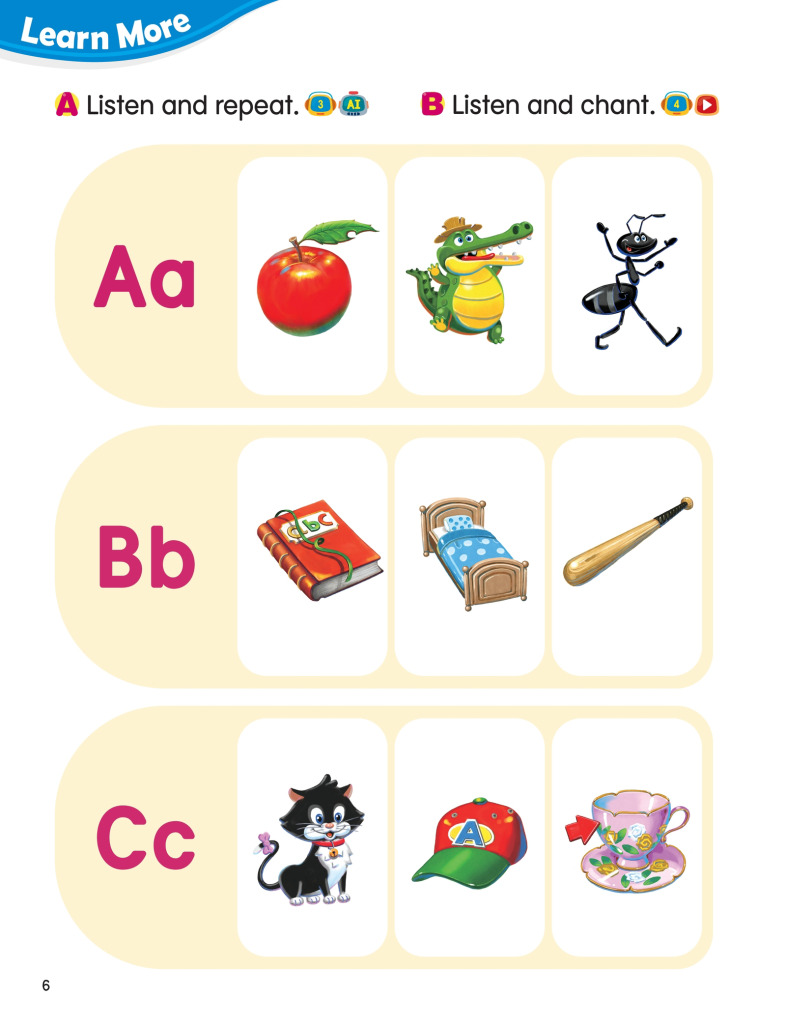
Ready-made flashcards in e-future books. This is the format of the cut-out flashcards in e-future books: a picture on one side and the word on the other. You will find them in all e-future phonics series (Smart Phonics, School Phonics, Speed Phonics, EFL Phonics) and in Let's Smile and Smart English. Children cut the cards out of the book and can practise the words from the lesson in class or at home, with no extra printing.
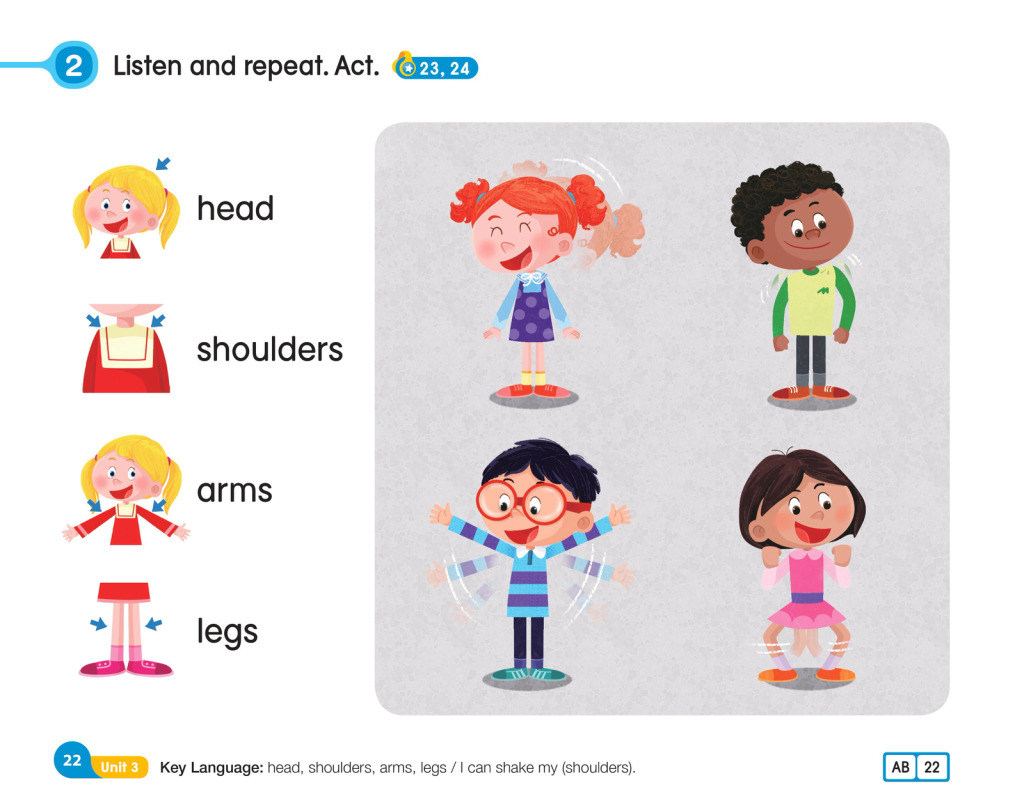
Flashcards are easiest to use for everyday nouns: animals, food, colours, clothes, toys, body parts and family members. A well-planned set also covers verbs (run, jump, eat), adjectives (big, small, happy) and simple patterns: It's a…, I like…, Have you got…?. With older children, cards help with spelling, letter–sound links and sentence building.
A flashcard mainly teaches children to recognise a word. To use it, they need a reason to say something, ask, request or tell a story. That is why games and sentences take up most of this guide.
Choosing flashcards by age and purpose
Before you buy or print a set, answer three questions: how old are the children, can they already read in any language, and what do they need these words for right now? A set for a three-year-old who is just getting used to the sound of English looks very different from one for a nine-year-old revising a coursebook unit on food.
| Age | Type of card | New words per set | Focus |
|---|---|---|---|
| 3–4 | large, clear picture, no text | 3–4 | listening, pointing, repeating, movement |
| 5–6 | picture, possibly a word on the back | 4–6 | short phrases, quick-reaction games, first letter sounds |
| 7–9 | picture card plus a word card to match | 6–8 | reading words, phonics, simple sentences |
| 10–12 | word, example sentence, picture as a prompt | 8–10 | spelling, collocations, topic vocabulary in context |
The numbers are practical starting points, not rules. School systems start English at very different ages, so a ten-year-old beginner in one country may need the same cards as a six-year-old in another. Go by level as much as by age, and add cards once children recognise the previous ones without hesitation. Cambridge English advice for parents sums up the general principle: rather than trying to learn lots of new words in one go, focus on a few new words every week.
If you need a neutral reference for which words to start with, the Cambridge English wordlists for Pre A1 Starters, A1 Movers and A2 Flyers are a good one. The three exams are designed for learners aged 6–12 and are aligned with the CEFR. Besides alphabetical lists, the document groups the vocabulary by topic (animals, the body and the face, food, clothes and so on) and shows which level each word belongs to. Teachers in many countries use it to check that a home-made set matches the level of the group, even when the class is not preparing for an exam.
Pictures before words
Start with picture cards only for the youngest learners. TeachingEnglish from the British Council recommends introducing word cards after picture cards so that the written form does not interfere with correct pronunciation. What interferes depends on the child's first language. A child who reads Spanish, Italian or Finnish, where letters map closely to sounds, will often sound out every letter of knife. A child who reads Arabic, Greek or Chinese may first need to get used to the Latin alphabet itself. In both cases, let children hear the word and link it to the picture first, and meet the spelling once they start learning how English letters and sounds work.
Topic sets, not random ones
Cards grouped by topic (farm animals, fruit, weather) make learning easier to organise and pair well with a song, a picture book or a coursebook unit. Ideally, the flashcards show the same words children are meeting in the course. That is how the teacher's sets for Little Hands, a course for children aged 2–5, are designed. At every level they include picture flashcards, which after purchase are also available as a PDF for printing, along with posters and the Chip puppet. The Little Hands 2 Teacher's Set for four-year-olds, for example, contains 79 picture cards: 51 vocabulary cards and 28 phonics cards. For more on choosing materials for a preschool group, see our practical checklist for preschool English books.
Cards in a multilingual class
In many classrooms the children do not share a home language: international schools, city schools with families from several countries, language schools in tourist regions. Picture cards help here because nobody needs a translation to understand them. Three habits make the most of that:
- Check the picture works across cultures. A sandwich, a postbox or a house can look very different from one country to the next. Choose images children in your group will recognise, or talk briefly about the difference.
- Let children say the word in their own language once. After the English word has been drilled, ask How do you say it at home? It takes thirty seconds, shows that every language in the room counts, and children often spot words that sound alike (banana, taxi, chocolate).
- Keep first-language words for individual support. A card with the child's home-language word, one of the Bell Foundation formats above, is a good bridge for a newly arrived pupil. For whole-class games, use the picture and the English word so that no single language dominates.
What to look for when buying or printing
- A clear picture: one object per card, no busy background. Apple should look like an apple, not an orchard scene.
- Size: cards for whole-class work need to be visible from the back of the room (A5 or larger); smaller cards are fine for table games.
- Durability: thick card or lamination, because cards will be passed around, hidden and caught.
- Level-appropriate vocabulary: 20 words children will actually use beat 200 random ones.
- Consistency with other materials: the same words in flashcards, songs and books mean many encounters without dull repetition.
Introducing new words step by step
This sequence works with a whole class and with one child at home. It takes only a few minutes, and it does not rely on translation, so it works the same way in a group where children speak five different languages.
- Show and say. Hold up the card and say the word clearly two or three times. Children just listen and look.
- Repeat together. Say the word as a group: whispering, loudly, in a happy or a sleepy voice. TeachingEnglish suggests this kind of choral drilling with varied intonation and volume, because children naturally copy the teacher's voice.
- You say, they point. Where's the cat? Children touch the right card. They don't need to speak yet; understanding is enough.
- Choose one of two. Is it a cat or a dog? Children answer with one word, and the question gives them the model.
- Name it alone. You show the card, the child says the word without a prompt.
- Put it in a sentence. I've got a cat., The cat is black. This is where the word starts working.
- Come back the next day. A short game with the same cards plus one or two new ones.
The sequence moves from understanding to speaking. A child who points to every card correctly at step three but is not ready to speak yet is still making progress. A quiet start like this is normal in a new language, and it may last longer for a pupil who has just moved to a new country. Give them time.
It helps to introduce a new word in a way that makes children want to guess it. In Reveal the word from the TeachingEnglish article, you cover a card and uncover it slowly. The Slowly Revealing game from the e-future ELT series works the same way:
What to watch for: the teacher demonstrates the game with an adult playing the pupil. She uncovers the card bit by bit, and the pupil only gets to see more after asking More, please (around 0:15–1:05). The first guesses are wrong (a frog, a lizard), so the guessing continues until the answer is alligator. The teacher then asks for the first sound of the word (around 1:05–1:20). At the end she explains why this is a good way to start new material: a hidden card makes children curious and keeps the whole group focused (around 1:55). The video is just over two minutes long.
Review: short, frequent and spaced
One encounter with a word is only the beginning. In a webinar for e-future, Paul Nation, a vocabulary researcher from New Zealand whose work is used by teachers around the world, names two things that decide whether a word is learned: how often it is met and the quality of each meeting. His talk translates into three principles for flashcard work:
- Space out the review. Nation explains that repetition spread across days is much more effective for long-term memory than the same amount done all at once. Three five-minute games across a week beat one fifteen-minute session. This matters most where English gets only one or two lessons a week: a short review at the start of each lesson keeps words alive between them.
- Let children retrieve the word. The most useful moment is when a child has to recall the word: they see the picture and must name it, or hear the word and must find the card. Meeting the word again in a new sentence or text is even better.
- Go back to old sets. According to Nation, the same material should come up at least four or five times during a course. Bring out the Animals set a month later and play a quick game before starting a new topic.
Nation also places word-card learning within a wider plan. Deliberate vocabulary study, including flashcards, is very effective in his view, but it should take up roughly a quarter of course time. The other three quarters belong to listening to and reading comprehensible material, speaking and writing with the words children have met, and fluency practice with familiar language.
What to watch for: the four equal strands of a well-balanced course and where flashcards fit within deliberate learning (around 21:50–23:20). Next, the difference between exact and varied repetition, and between immediate and spaced repetition (around 35:15–38:30). From around 39:40 Nation describes what deepens an encounter with a word: noticing, retrieval, retrieval in a new context and elaboration. At around 62:40 he answers a question about pictures: striking images can help a word stick, but the link between image and word needs to be strong, and pictures in reading books do not always support comprehension. The webinar lasts about an hour.
Flashcard games for the classroom and home
Games give children a reason to say the same word ten times, because the point is to win, not to "study". The games below need nothing but cards. Most come from TeachingEnglish, Cambridge English and the Bell Foundation, and they are played in classrooms in many countries under slightly different names.
Whole-class games
- Race to the card. Stick flashcards around the room. Say Banana! and children point or race to the right card. Make it harder with Hop to the cat or Run to something yellow. Then let pupils give the instructions.
- Reveal the card. Cover a card and uncover it slowly, or flash it for a split second. The first to recognise it says the word.
- Invisible flashcards. Stick nine cards on the board, draw a grid around them and drill the words. Remove the cards one by one while the class keeps "reading" the empty squares from memory.
- What's missing? Put a few cards out, children close their eyes and you take one away. Which one has gone?
- Picture bingo. Each child has a grid with a few words, and you turn over picture cards one at a time. The Bell Foundation suggests setting a sentence pattern children must say before they can cover a square, such as It's a river or I like….
- Which word am I? Word cards lie face down on the table. You pick a picture card without showing it and give clues. How many clues does the group need to find the right word?
Here is What's missing? played by an e-future teacher:
What to watch for: eight cards on the table and five seconds to memorise them (around 0:14–0:50), then shuffling, eyes closed and one card fewer (around 0:51–1:15). When the pupil gets stuck, the teacher gives a clue (around 1:30). The most useful tip comes at the end (around 1:43–2:10): with younger children, cut the set to five or six cards, and if the game is too easy, add more, up to ten or twelve.
Table and carpet games
- Memory (also called Pairs or Pelmanism). Two copies of each card, or picture–word pairs. Cambridge English suggests a simple rule: you keep a pair only if you can use the word in a sentence.
- Snap. Players take turns turning over cards. When two matching cards appear, the first to shout Snap! and use the word in a sentence wins them.
- Fly swatter. Cards lie on the floor, you say a word and the child swats the right card. Then swap roles.
- Shop. Food cards become goods for sale. Can I have an apple, please? Here you are. The word goes straight into a dialogue.
- Odd one out. Lay out four cards, one of which does not belong. Children say which one and why: A cow, a sheep and a pig live on a farm. A shark lives in the sea. The Bell Foundation recommends this kind of sorting because children have to explain their reasoning.
- Three-card story. The child picks three cards and makes up a short story. Cambridge English encourages children to use new words in stories they create, because they learn language best when they can communicate, not just memorise words.
If you want to move some of these games onto an interactive whiteboard, our guide to tools for English teachers compares platforms such as Wordwall and Baamboozle.
Flashcards at home: supporting children without pressure
In most countries where children learn English as a foreign language, English is not spoken at home, and many parents feel they cannot help. They can. How the activity feels matters more than perfect pronunciation, and parents can talk about the game in their own language while the cards stay in English. You can share these tips at a parents' evening, in a class newsletter or in a short message home, translated if your families need it.
Short and often. LearnEnglish Kids from the British Council reminds parents that children can usually concentrate only for short periods, so stop or change the activity when the child is bored or restless. That may happen after just a few minutes. A few minutes over breakfast several times a week is a good amount.
Praise and encourage rather than correct everything. The same site advises praising children when they do something well and not correcting every mistake, but encouraging them to use English to communicate. If a child says a apple, simply reply Yes, an apple! and keep playing.
Repeat games without worrying. Children need to repeat language many times to remember it, and a favourite game or song gives them confidence. It is fine to play the same game several days in a row, or to switch games with the same set of cards.
Start with the child's interests. A dinosaur fan will learn big, long, sharp more happily with dinosaur cards than with furniture cards.
Let children make their own cards. Cambridge English suggests writing a word on one card and drawing it on another, then keeping the finished cards in a "favourite word box".
Go beyond the cards. Once red is familiar, look for red things on a walk. Families who home-educate will find more ideas in our practical guide to English in home education.
Making your own flashcards and printables
Ready-to-print cards are available in the LearnEnglish Kids flashcards section. Besides classic topic sets, there are cards to colour in and write on. Colouring versions work especially well with preschoolers: a child who has coloured in their own giraffe card treats it as theirs. TeachingEnglish also suggests asking each pupil to draw one card after a new topic has been introduced, so the class ends up with its own set for games. In a mixed-language class, those drawings also show you how children picture everyday things at home.
If you make cards yourself, a few rules will save you time:
- Choose 6–10 words from one topic, not a whole dictionary at once.
- Print on thick paper (e.g. 200–250 gsm) or glue the printout onto card. Laminate the cards you'll use for active games.
- Keep one size. Cards in a set should be the same size and not see-through, so nobody can guess from the back.
- Make two copies if you plan to play Memory or matching games.
- Keep pictures and words separate: separate word cards will be useful once children start reading.
- Store sets in labelled envelopes. It is easy to go back to Animals a month later and see what children still remember.
- Write one sentence on the back that you use with the card, e.g. It's a frog. It can jump. Older children can read it themselves.
If you teach from a course, check what you already have. In the Little Hands teacher's sets, the picture flashcards are also available as a PDF for printing after purchase. For Smart Phonics, the online teacher materials on e-future SmartClass include big board games and review tests.
From flashcards to sentences and books
A flashcard is a starting point. Once children know a few dozen words, plan three next steps: questions and sentences, reading, and listening.
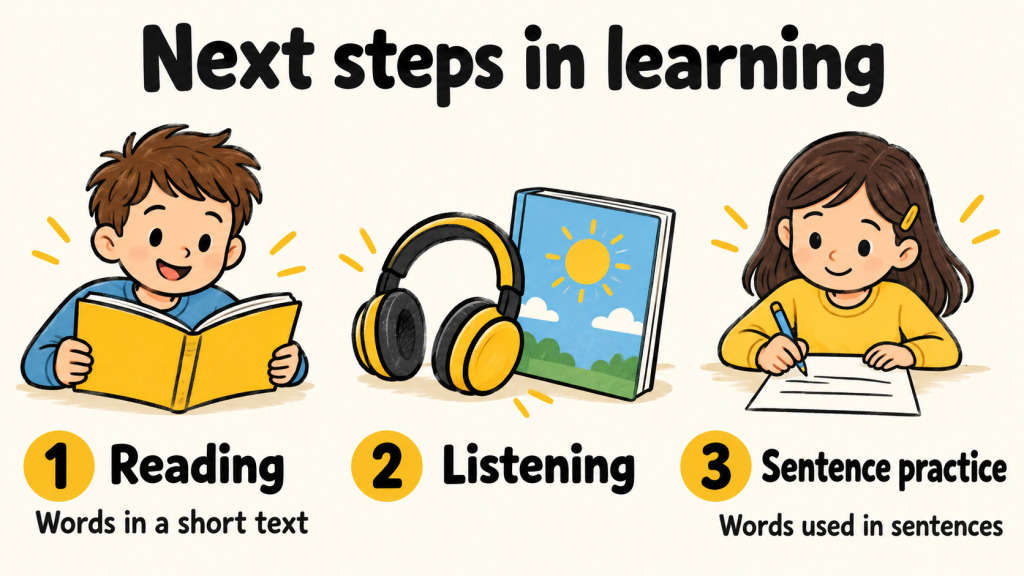
Questions and sentences. The simplest bridge from a word to a sentence is a game where children have to ask. In What's in the Bag? the teacher hides one of the familiar cards in a bag, and children guess with a full question.
What to watch for: first a quick run through the colours with What color is it? (around 0:10–0:45). The teacher stresses that you should check children know all the words before playing. Then six cards, a moment to memorise them, one card in the bag and questions such as Is it pink? Is it blue? with a limited number of guesses (around 0:58–2:20). In the second round, with fruit, the same game practises plurals: Are they grapes? Yes, they are (around 2:27–3:50).
Phonics: the bridge between picture and written word. Remember "pictures before words"? The moment you introduce word cards is a good time to teach letter–sound relationships, whatever writing system children use in their first language. A child who knows how sh or a short a sounds can read fish or cat on a card without help. We cover this stage in more detail in our article on how children learn to read in English with phonics. The five-level Smart Phonics series combines songs, chants, stories, animations and games, and board-game books such as Smart Phonics 1 Big Game Book let children review sounds and words through play.
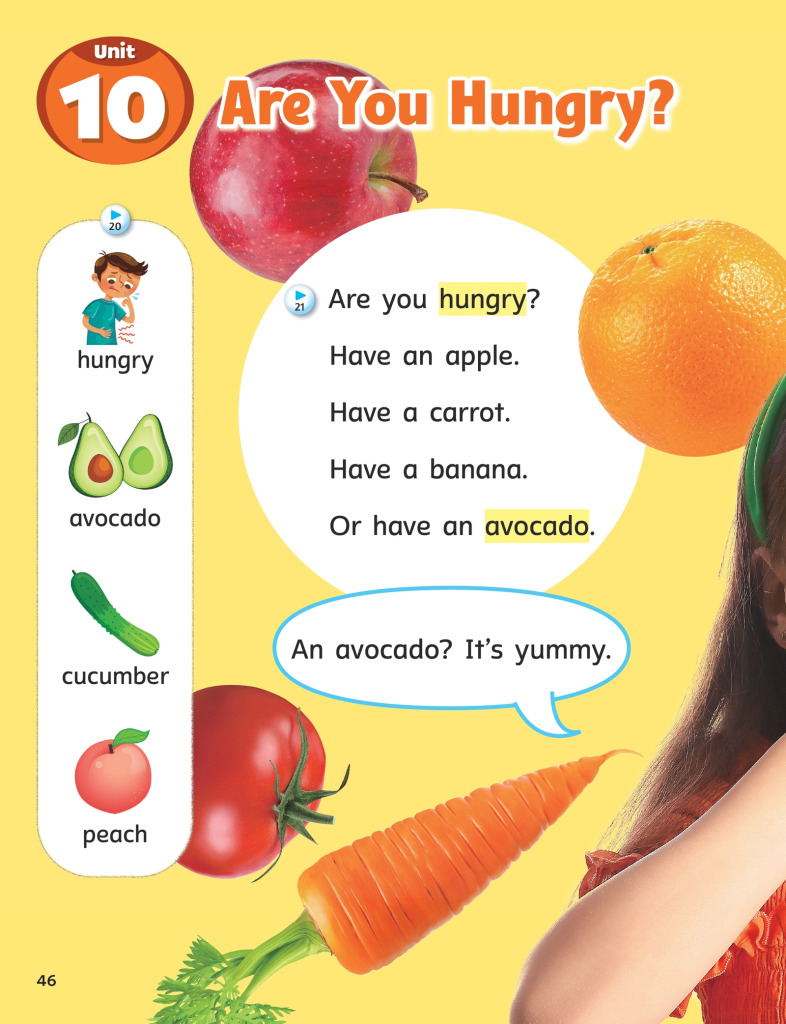
Reading: words in context. A word learned from a card and then met in a short text gains meaning and natural word partners. This is the varied encounter Nation talks about. Smart Reading 1-2 is an integrated student book and workbook that introduces 40 new words, with audio for every passage available via QR codes. For choosing the right texts, see our articles on helping children choose the next step in reading and on short English reading texts.
Listening and books for the whole group. If you run a language school, a kindergarten group or classes for several families, you can carry flashcard vocabulary into regular reading and listening. The e-Library and MetaLibrary online libraries are available as a group subscription for 6 or 12 months, for at least 10 users. Our article on graded readers and comics explains how to choose books children want to keep reading.
Practice for the youngest. In kindergarten, flashcard words come back in the activity books of the Little Hands course, which develops creativity through art, music and play while building communication and motor skills, for example the Little Hands 2 Activity Book for four-year-olds and the Little Hands 3 Activity Book for five-year-olds.
Topic vocabulary for older pupils. For learners aged 7–12 preparing for Cambridge English Qualifications for young learners, the 1200 Words for Tests series offers three levels (Starters, Movers, Flyers) in nine books. Vocabulary selection is based on the official Cambridge YLE wordlists mentioned above, and each unit includes a Words in the Story stage where children meet the words in a story. Our article on Cambridge English exams for children can help you decide whether an exam is the right goal for a pupil.
One last piece of advice: start with the cards, add a game, and then plan where children will meet the same words next week and next month.
Frequently asked questions
What are flashcards?
Flashcards are cards with a picture, a word or both. They are used to introduce, review and consolidate vocabulary. Young children do best with picture-only cards; word cards come in once they start to read in English.
From what age can children learn English with flashcards?
Simple picture cards can be used with very young children, as long as the activity is short and based on listening, pointing and movement. The Little Hands course, whose teacher's sets include picture flashcards, starts with a level for two-year-olds. A three-year-old does not need to speak straight away; understanding and pointing are enough. As children grow, add more words, then written forms, sentences and games with rules. Because school systems start English at different ages, match the cards to the child's level as well as their age.
Should flashcards show a translation in the child's first language?
For whole-class games, a picture and the English word are usually enough, and in a mixed-language class they keep every child on an equal footing. Cards with a first-language word are useful for individual support, for example for a pupil who has just arrived and needs a bridge from words they already know. The Bell Foundation lists this format alongside picture-only and picture-and-English cards.
How many new words should a child learn?
Fewer, more often. Cambridge English advises focusing on a few new words every week rather than lots at once. Review the same words in short games over the following days, and add new ones once children recognise the cards without hesitation.
Where can I find printable English flashcards?
Ready-made printable flashcards, including colouring versions, are available from LearnEnglish Kids by the British Council. For a word list to build your own sets, the Cambridge Starters, Movers and Flyers wordlists group vocabulary by topic and level. If you teach from a course, check the teacher's materials first; in Little Hands, the picture flashcards are also available as a PDF after purchase.
Are flashcards enough to learn English?
Flashcards are good for building vocabulary, but to speak, children also need sentences, listening and reading. Paul Nation recommends that deliberate vocabulary study, including word cards, take up about a quarter of learning time. The rest is listening and reading, speaking and writing, and fluency practice. That is how a word on a card becomes language a child actually uses.
Sources
- The Bell Foundation: Flashcards
- TeachingEnglish, British Council: Using flashcards with young learners
- Cambridge English: Practising vocabulary outside the classroom
- Cambridge English: Pre A1 Starters, A1 Movers and A2 Flyers wordlists
- LearnEnglish Kids, British Council: How children learn
- LearnEnglish Kids, British Council: Flashcards
- Paul Nation: How to teach vocabulary? e-future ELT webinar