
Best English Coursebooks for Kids and Teens: How to Choose from Age 3 to 18
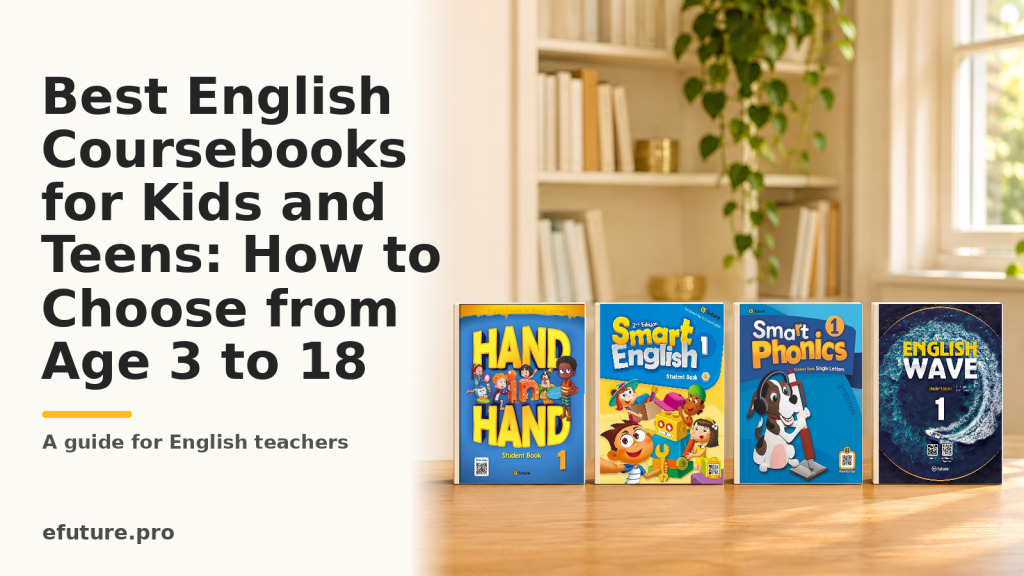
The best English coursebook for children is the one that fits a particular group: the learners’ age, their level, the hours on the timetable and the goal of the course. No single book works for everyone. What does work is a language path from early childhood to the end of secondary school, where each coursebook hands learners on to the next one, and skills books add whatever the group needs most: phonics, reading, grammar or listening. This guide shows how to recognise a good coursebook, how to match it to your learners and how to build an engaging programme with e-future materials that leads children to independent communication in English.
What makes a good English coursebook for children
Teachers have a wide choice today, and publishers’ catalogues can look alike: bright covers, songs, an app, tests. The best English coursebooks for kids stand out in the classroom, not in the catalogue. Check five things.
1. It is easy to teach from. A good coursebook has a predictable unit flow. After two or three weeks, children know what comes after the story, and the teacher spends less time explaining instructions. A Teacher’s Manual with ready lesson procedures does the rest. Each level of Smart English has 12 regular units, 6 review units and 2 test units, and the publisher lists “clear lesson plans” among its features.
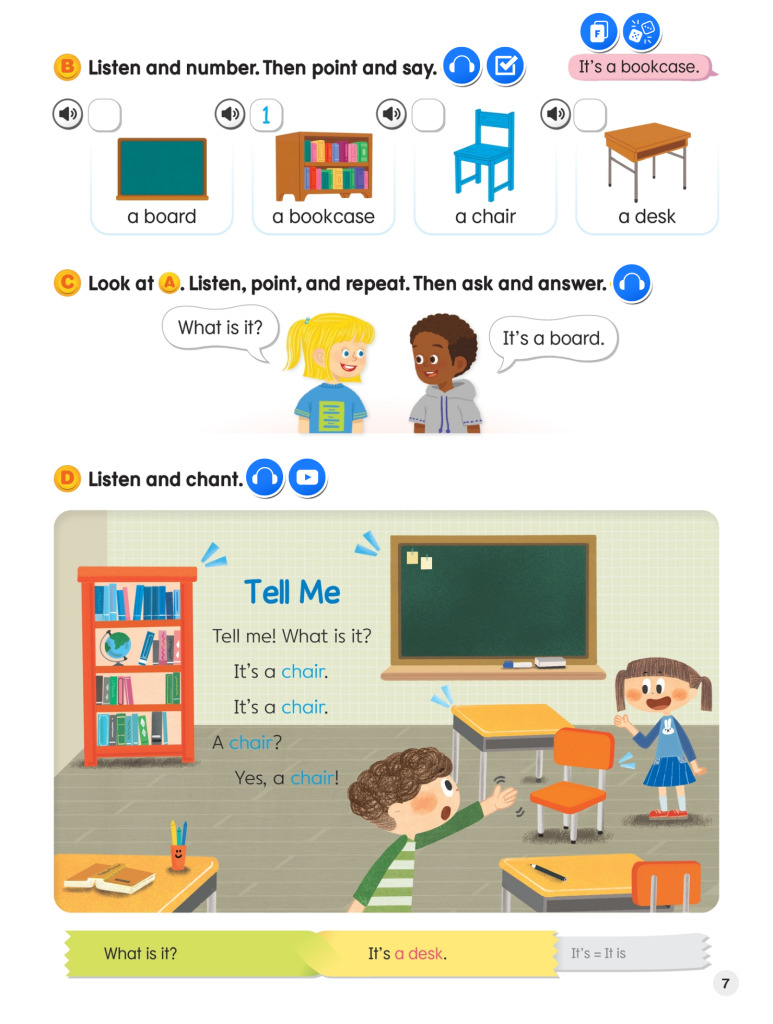
2. It teaches simply. One lesson, one aim: new words in a model sentence, a short practice task, then real use in a game or a conversation. In Let’s Smile 1, the first lesson of the unit “At School” is four words (a board, a bookcase, a chair, a desk), the dialogue What is it? It’s a board. and a short chant, with audio for every task. Children also need to meet language again. Let’s Smile recycles language goals in a spiral, and Hand in Hand is built on systematic recycling of language targets.
3. It is fun. A seven-year-old wants to know what happens to the character on the next page. Stories, comics, songs, chants and games are not extras added to “real learning”. They are the reason a child hears the same sentence ten times without getting bored. In the preschool course Little Hands, that role belongs to Chip, the mascot, which teachers can also have in class as a hand puppet.
4. It fits the learners’ age and level. A six-year-old and a twelve-year-old may both be at A1, yet they need different books. Topics, the amount of text on a page, the style of illustration and the type of task all change with age. A twelve-year-old beginner will quickly lose interest in a book designed for preschoolers.
5. It leads to independent communication. This is the deciding test. Look at how each unit ends. Does the learner say or write something about themselves: their family, favourite food, last weekend? If the last task is still a gap fill, the book teaches learners to recognise English rather than use it.
A language path from 3 to 18: which coursebook at which stage
Instead of searching for one best coursebook, plan a path: from first songs at age three to B2 at the end of secondary school. Here is that path with e-future series. Ages follow the age categories on efuture.pro, and CEFR levels follow the product descriptions.
| Age | Stage | Core coursebook | Level | Typical additions |
|---|---|---|---|---|
| 2–5 | nursery, preschool | Little Hands: Nursery (age 2), 1 (age 3), 2 (age 4), 3 (age 5) | first steps | songs, Phonics Book inside the Student Book |
| 6 | pre-primary | Starter level of Smart English, Let’s Smile or Hand in Hand | Pre A1 | phonics, flashcards |
| 7–9 | lower primary | Hand in Hand, Let’s Smile or Smart English, levels 1–3 | Pre A1 | phonics, My First Grammar, Magic Speaking, Smart Reading |
| 10–12 | middle and upper primary | the same series, levels 4–6; in language schools also English Wave 1–2 | A1–A2 | My Next Grammar, Smart Listening, Discovery, 1200 Words for Tests |
| 13–14 | lower secondary | English Wave 2–3 | A2–B1 | My Next Grammar 3, Hands on History, graded readers |
| 15–18 | upper secondary | English Wave 3–6 | A2–B2 | MetaLibrary, official exam sample papers |
A few numbers help with planning. Hand in Hand, Let’s Smile and Smart English are seven-level courses (Starter plus levels 1–6) for children aged 6–12. Hand in Hand 1 is Pre A1 and Hand in Hand 6 reaches A2. Let’s Smile Starter begins at Pre A1 for six-year-olds, and Let’s Smile 6 ends at A1–A2. English Wave has six levels from A1 to B2: Book 1 is A1, 2 is A2, 3 is A2–B1, 4 is B1, 5 is B1–B2 and 6 is B2.
In language schools, English Wave already works from around age ten. Ten-year-olds use English Wave 1 and spend the year consolidating the whole of A1. Eleven- and twelve-year-olds move on to English Wave 2, thirteen-year-olds to English Wave 3, and the later books follow. This is what language schools do in practice, not a fixed rule: the right moment depends on the group’s level and on whether teenage topics already appeal to them.
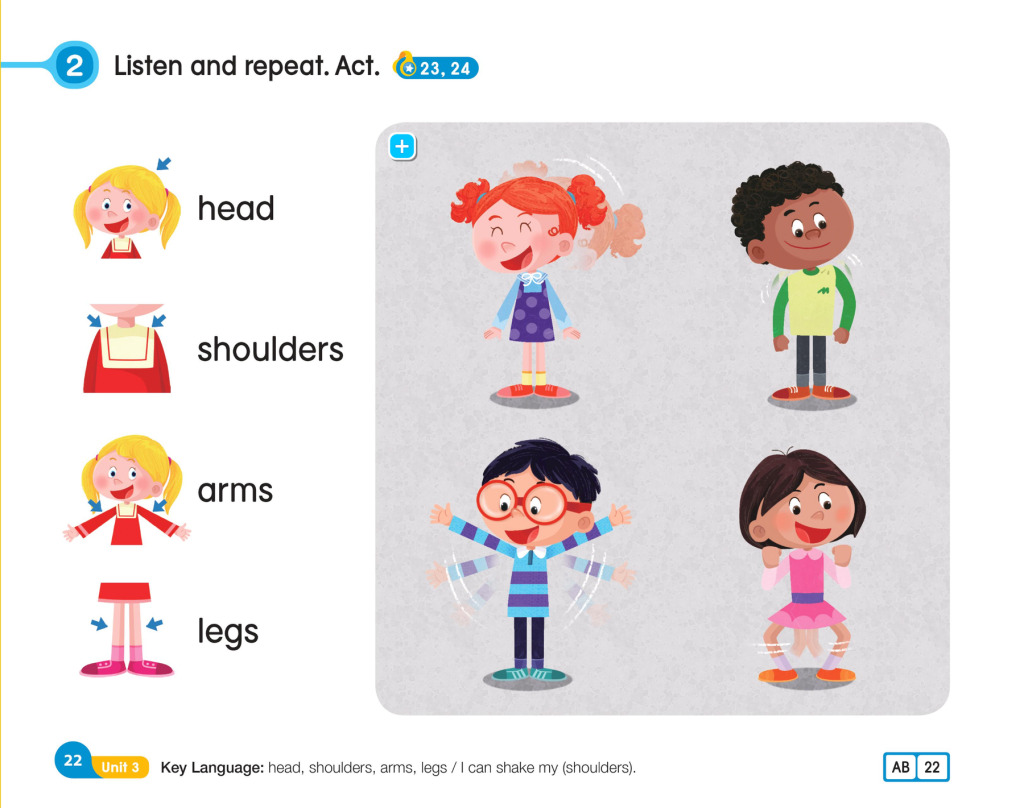
When you compare pages across the path, look at three things: how much text there is on a page, who is speaking (a character or the learner) and how the lesson ends. Younger levels are built on pictures, songs and movement. In Little Hands 2, in the unit “My Body”, four-year-olds repeat head, shoulders, arms, legs and act the words out (I can shake my shoulders). English Wave brings longer texts, “School Connection” pages and a project at the end of every unit. For the youngest learners, see our guide Choosing preschool English books: a practical checklist for your class.
Matching the coursebook to the group or the child
Decide in this order: level first, then age and interests, and finally the course goal and the number of lessons per week. School year or grade is only a starting point. In a class of ten-year-olds, one child may have had English since preschool and another may be starting now, perhaps with a different home language.
The free e-future placement test helps with the first decision. It is designed for primary learners (grades 1–6). Its levels follow school grades but can be chosen flexibly. The test has 30 to 40 tasks and usually takes 20–35 minutes, with no time limit. At the end, learners get a PDF report with an overall score, separate results for listening, grammar, vocabulary, reading, writing and speaking, and a list of recommended coursebooks, readers and comics. Download the report straight away, as results are not stored on the site. A printable version comes with a teacher’s guide, answer key, transcript and audio. If a score is close to zero, the publisher suggests the test one level lower; close to 100%, one level higher.
There is no placement test for preschoolers. For them, the publisher suggests Little Hands, the first levels of School Phonics and Smart Phonics, and the online library.
Three situations come up again and again:
- A mixed-level class. Choose the core coursebook for the majority and balance the differences with skills books: less confident learners read an easier reader, stronger ones get a longer text or a bigger role in the project.
- A new learner mid-year. Use the test, talk to the child for five minutes, then decide whether they join the group straight away or spend a few weeks catching up with a skills book.
- A group that “knows everything” but does not speak. These learners recognise words but do not build sentences. Do not jump to a higher level. Add a speaking-focused book and tasks in which learners talk about themselves.
Before ordering books for a whole school, teach one trial unit and watch what children can do on their own. We describe how to collect that kind of evidence during the year in Formative assessment in English lessons: a practical guide.
Cambridge exams or communication: serving both goals
Cambridge English Qualifications for children have three levels: Pre A1 Starters, A1 Movers and A2 Flyers. They are followed by A2 Key for Schools, B1 Preliminary for Schools and B2 First for Schools. All are linked to the CEFR, the international standard that describes language ability on a six-point scale from A1 to C2. Cambridge English describes its young learner exams as clear milestones to reach step by step. That is a useful way to see them: an exam is a milestone on the path, not the path itself.
A good English coursebook prepares learners for an exam without turning the course into a set of practice tests. With e-future series it looks like this:
- Hand in Hand includes a YLE test preparation package, and its vocabulary and grammar follow CEFR and YLE levels.
- Let’s Smile includes YLE preparation material, and Smart English was designed around CEFR and YLE language goals.
- 1200 Words for Tests is nine books: Starters 1–3, Movers 1–3 and Flyers 1–3. Key words come from the official Cambridge vocabulary lists, and the series includes Reading & Writing test booklets modelled on the exam.
- Smart Listening includes YLE preparation elements.
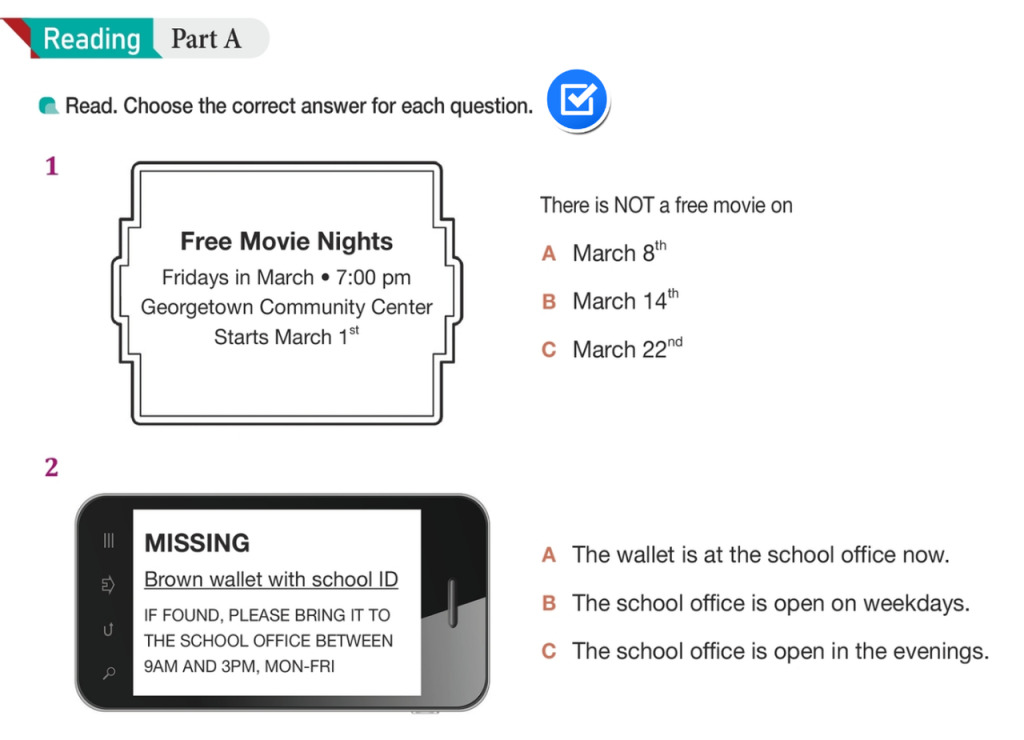
At A2–B2, e-future does not publish a separate exam series. English Wave covers the same levels (Book 2 is A2, Book 4 is B1, Book 6 is B2) and has Review and Test Prep sections. In English Wave 1, Test Prep 1 comes only after six units and has Listening and Reading parts: short notices and messages with A, B, C answers, in a format close to A2 Key. Six units of communication come first, then one block in exam format. It is part of the coursebook, not a Cambridge exam book. Learners practise the format of a specific exam with official Cambridge sample papers.
How do you keep communication at the centre? Try a simple rule: every exam-style task gets a partner task in which learners speak or write about themselves. If they matched pictures to descriptions of animals in a test task, they then describe, in pairs, an animal they would like to have. For most of the year, exam format takes at most one lesson in four. It gets more time only in the last 6–8 weeks before the exam. For details, see Starters, Movers and Flyers: levels and resources for teachers and Cambridge English exams for children: benefits and learner readiness.
Language skills: listening, reading, writing, speaking
Children listen first, then speak, then read and finally write. A good course develops all four skills together, with a different emphasis at each age. Grammar and vocabulary are tools: they help learners understand a recording and say what they want to say.
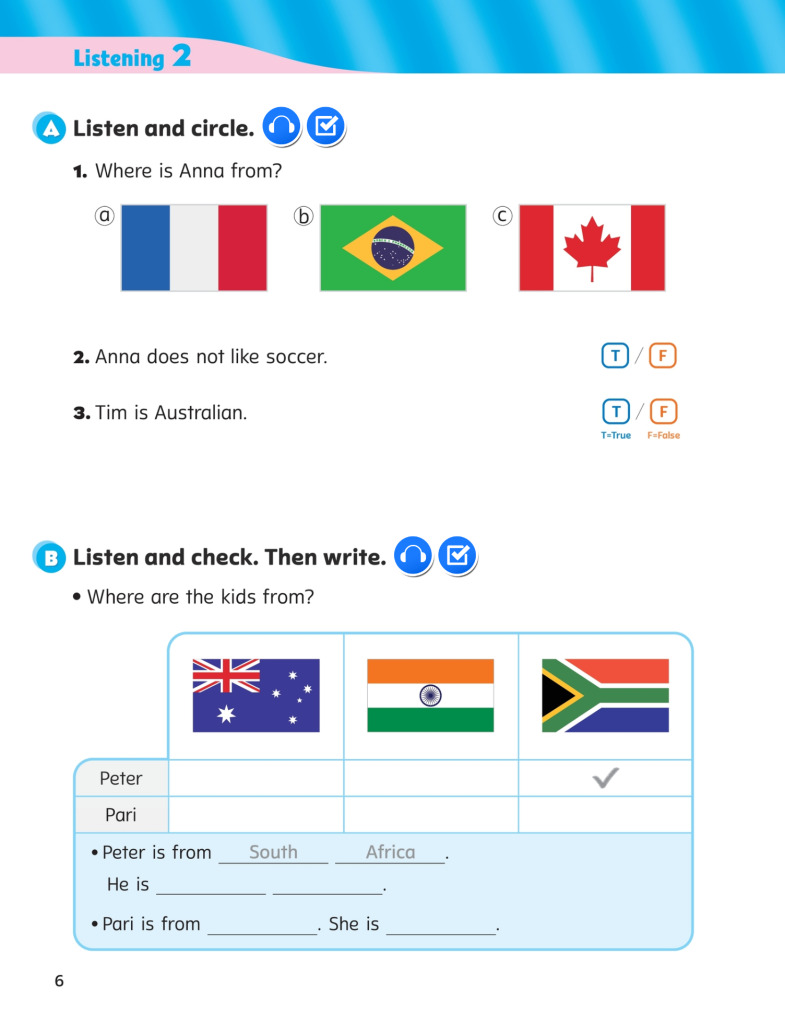
Listening. In children’s courses, listening is part of every lesson: a story, a song, a dialogue. When a group understands the teacher but gets lost in recordings, a dedicated series helps. Smart Listening has nine books (1.1 to 3.3): level 1 is Pre A1, level 2 is A1 and level 3 is A2. Recordings use both British and American accents. In Smart Listening 2-1, a unit starts with listening and circling and ends with Listen and check. Then write: learners listen, check and write He is from… / She is from…. Listening moves straight into writing.
Speaking. Young learners often understand far more than they can say. Fixed sentence patterns help them start. Magic Speaking has three levels (for ages 7, 8 and 9) with 40 lessons in each book. Every unit has four lessons: two present key sentence patterns, the third adds a useful expression and the fourth brings it all together in a comic with characters from the Magic Adventures series.
Reading. With the youngest learners, reading starts with phonics, the link between sounds and letters (how phonics works). Short texts come next. Smart Reading has six levels from Pre A1 to A2, two texts per topic and more non-fiction at each level. Discovery uses real photos and informational texts at Pre A1–B1. Alongside this, children read for pleasure: we cover extensive reading and choosing graded readers children want to keep reading in separate guides.
Writing. At first, writing means spelling known words. In Smart Phonics, after the story children write words that follow the sound pattern of the unit. Later come sentences about themselves and, with teenagers, short texts. English Wave teaches reading and writing step by step.
Grammar and vocabulary. My First Grammar is for children aged 7–9 and combines written, oral and personalised practice. My Next Grammar continues from age ten. 1200 Words for Tests organises YLE vocabulary. For ideas on teaching grammar that children enjoy, read How to make your students fall in love with grammar.
Teacher materials: what you get beyond the student book
The student book is only part of the package. Whether a lesson is easy to teach depends on what the teacher gets.
- Teacher’s Manual. For Hand in Hand and Little Hands it includes the Teacher’s E-Kit Hybrid CD. With the Teacher’s Manual for Hand in Hand, Let’s Smile or Smart English, teachers get access to downloadable, printable resources and the eSmartClass platform, and students get free access to the mobile app.
- eSmartClass. The student book and workbook are combined into one interactive e-book, and you switch between them with one click. From the page you can play audio or video, start a memory game or reveal the correct answers. During the lesson, a dice, a timer and a note tool also come in handy. You can set up a class, assign books, track learners’ progress and study time, and generate certificates when a book is completed. Most books have online activities. Access is free for teachers who have bought the printed books or teacher’s guides of the series.
- Flashcards. Smart English has picture flashcards. Phonics series, Let’s Smile and Smart English also include cut-out cards with a picture and a word (teaching with flashcards).
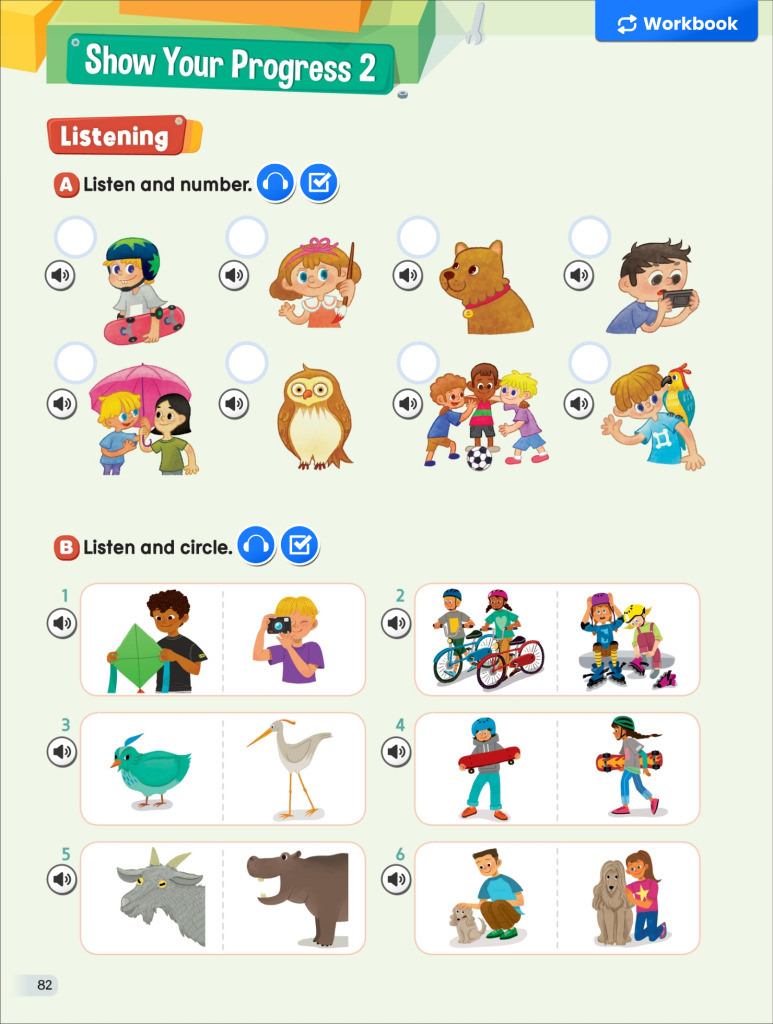
- Progress checks. The two test units in each Smart English level are “Show Your Progress” pages. In eSmartClass you play the recordings from them, reveal answers and jump to the matching Workbook page with one click.
- Tests. Hand in Hand has a placement test and end-of-unit, end-of-semester and end-of-year tests. Smart Reading has placement, unit, periodic and final tests. Smart Listening resources include MP3 files, word lists, tests, a syllabus and lesson plans.
- Contact with families. Little Hands has a letter to parents for every unit. In eSmartClass you can create parent accounts and send messages about schedule changes, homework and tests.
In practice, this means fewer evenings spent on worksheets. You prepare the lesson in one place and spend the time you save talking with your learners.
Apps, AI and extra online practice
An app will not replace a teacher, but it gives each child something every lesson is short of: time for individual practice and feedback on pronunciation. Here is what e-future series offer, based on the product descriptions.
- A free mobile app for learners with Little Hands, Hand in Hand, Let’s Smile and Smart English (e-future mobile apps).
- AI Andi in Smart English. In “Listen and Repeat”, learners repeat sentences and AI Andi rates the fluency and accuracy of each word. In “Role-play”, the child records one character’s lines, listens to the whole conversation with their own voice and compares the result with the average of other learners.
- An AI app for Smart Phonics. In the third edition of Smart Phonics, the app with AI Andi includes class audio, animations, games and flashcards.
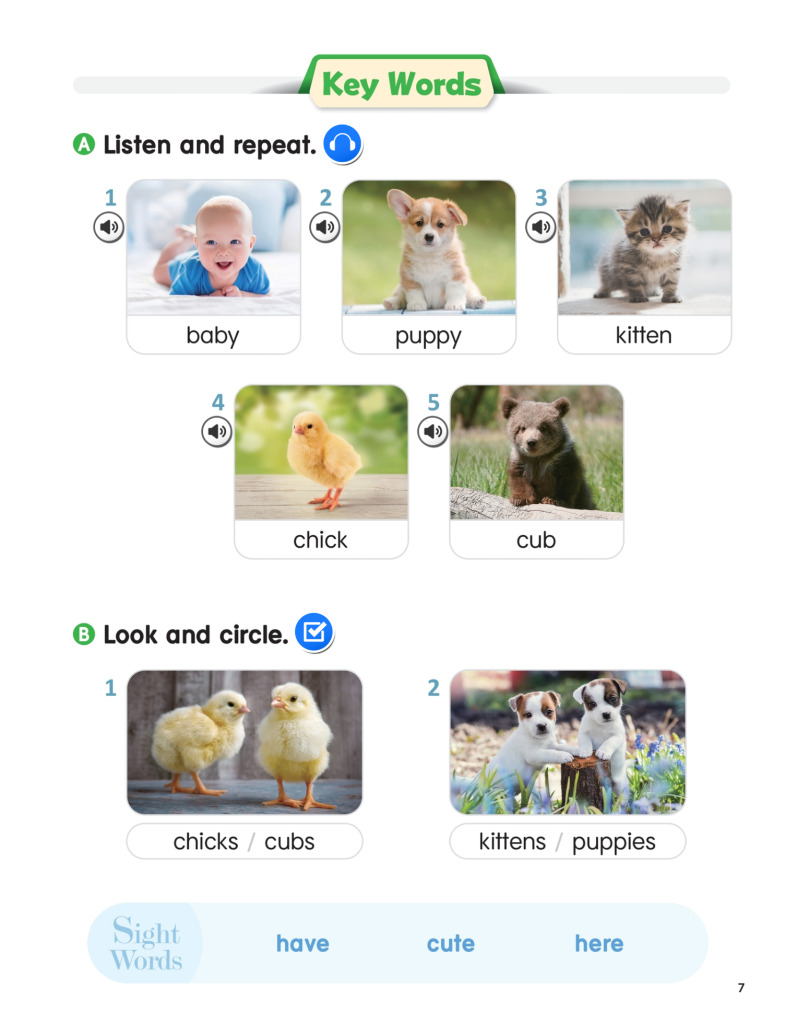
- Reading Fluency Builder in Discovery. This AI-based tool helps learners read more fluently. It covers sentence practice, shadow reading (reading along with a recording) and pronunciation assessment. The Discovery e-book itself supports home practice: on the Key Words page every word has its own recording, with high-frequency Sight Words at the bottom.
- MetaLibrary. An online library of 1,204 readers at Pre A1–B2, with missions, rewards, reading aloud, pronunciation feedback and conversations with story characters. Teachers assign missions and see quiz results. The minimum order is 10 students. The publisher notes that talking with a character does not replace the teacher. e-Library has the same catalogue without missions and conversations.
- Online activities in eSmartClass check understanding of the material, and the teacher sees learners’ results and mistakes.
How does this fit into a week? Ten to fifteen minutes of app practice at home, two or three times a week, works well, always after the lesson in which the material was introduced. AI handles pronunciation and fluency practice; in class, the teacher turns those sentences into real conversation.
Beyond language: collaboration, projects, CLIL
CLIL (Content and Language Integrated Learning) means learning content from other subjects, such as science or maths, through a foreign language. Children use English to find something out, not just to complete an exercise. In a good coursebook, CLIL and projects are a regular part of the course, not an occasional extra.
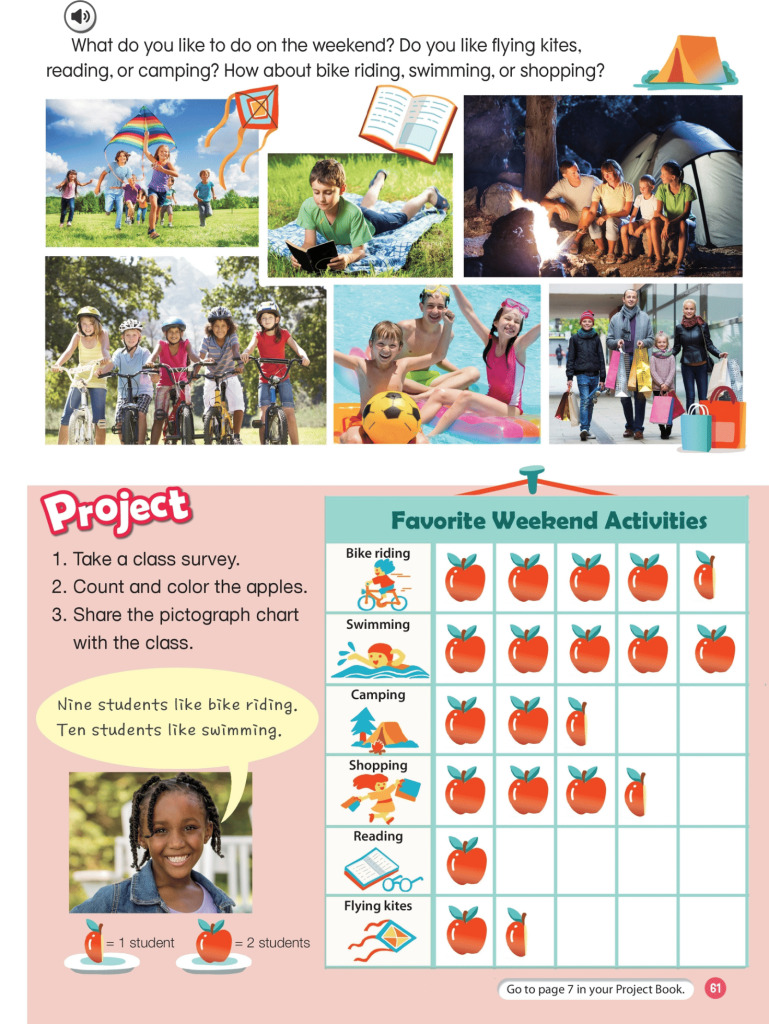
- Hand in Hand has six CLIL lessons in every level (“School Link”) in maths, science and social studies, a project for every unit in the Project Book, and content that builds cultural awareness. In Hand in Hand 3, the maths School Link lesson is a class survey of favourite weekend activities: children collect answers, draw a pictograph and present the results. The publisher describes the aim of the series as helping learners become confident English speakers and global citizens.
- Let’s Smile has twelve CLIL lessons, six World Link lessons connected to unit topics and art projects.
- Little Hands combines language with art, music and play, develops communication and motor skills, and adapts CLIL content to preschool age.
- English Wave has CLIL topics from science, history, maths and art, and “School Connection” pages. Each unit ends with a project: a mini-market simulation, working with rainfall data or a sun-safety poster. The series also builds critical thinking.
- Discovery develops logical thinking at levels 5–6 through “Discuss & Discover” tasks, and Hands on History lets teenagers read in English about ancient civilisations, the Middle Ages, the Age of Discovery and the Age of Imperialism.
A project builds collaboration only when everyone has a job. For the English Wave mini-market, split the group into shop assistants, customers and an order-taker. Give each role three sentence frames (Can I help you? How much is…? I’d like…) and one success criterion: “the customer bought three items without switching to their home language”. Then swap roles. Learners practise language, planning and teamwork at the same time. The Hand in Hand 3 survey works the same way: it ends with learners presenting the results, and presenting is one more chance to speak.
Not just one coursebook: how to build a skills-based programme with e-future
One coursebook does not have to be the whole programme. You can build your own skills-based programme: a core coursebook runs the course, and one or two skills series strengthen what the group needs most. Children get variety, you can see a specific skill grow, lessons become more interesting for everyone, and it is easier to show families what their children can do.
The programme works when you keep three rules:
- One communicative goal per unit. For example: “I can describe my room.” The skills series serves that goal. This week we read about homes, listen to someone describe a room and practise there is / there are.
- Every series has a fixed slot in the week. Children know that Friday is reading day, and you do not have to plan everything from scratch each week.
- The week ends with independent output. A pair conversation, a short description, a recording. Phonics, grammar or reading should all lead to the learner saying something on their own.
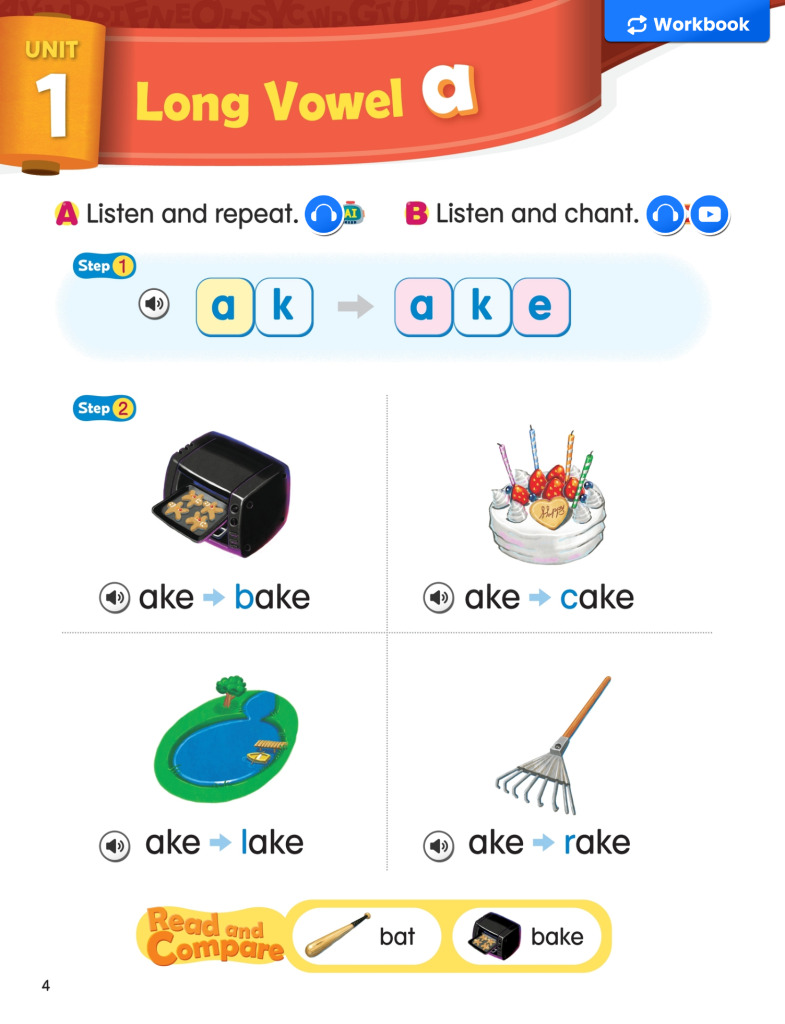
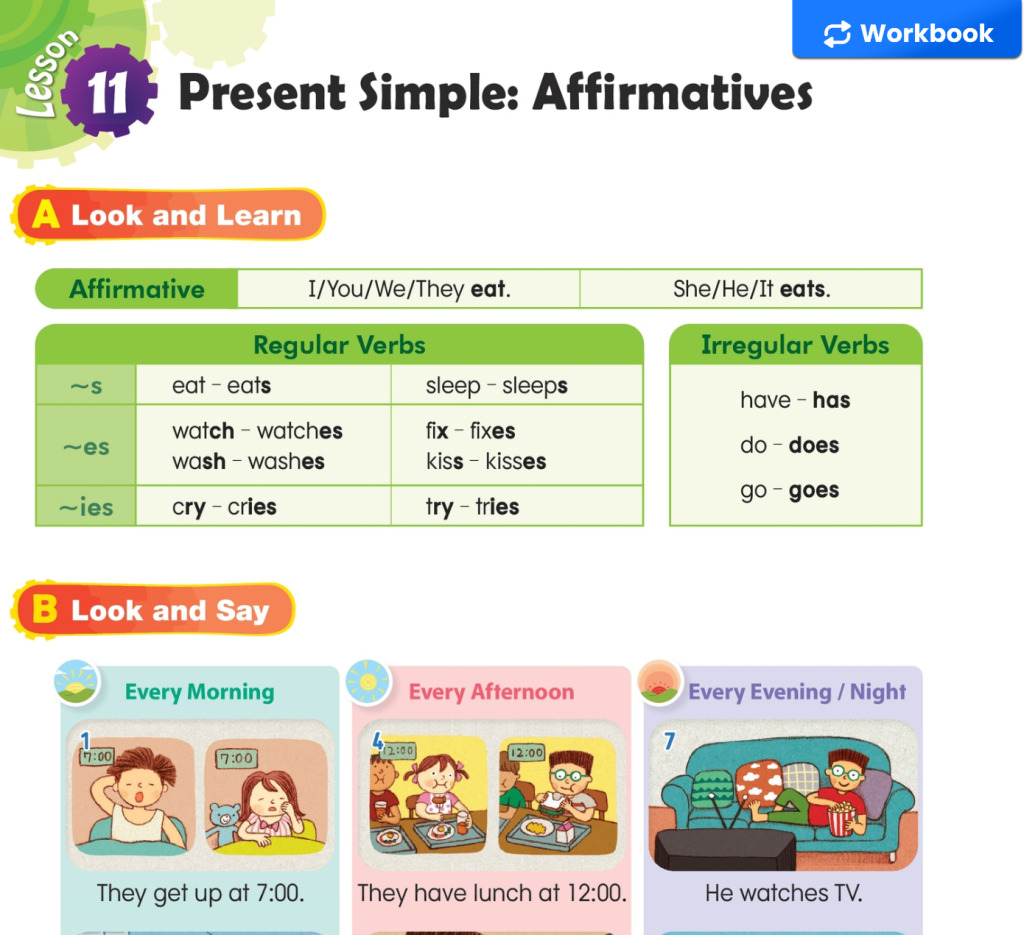
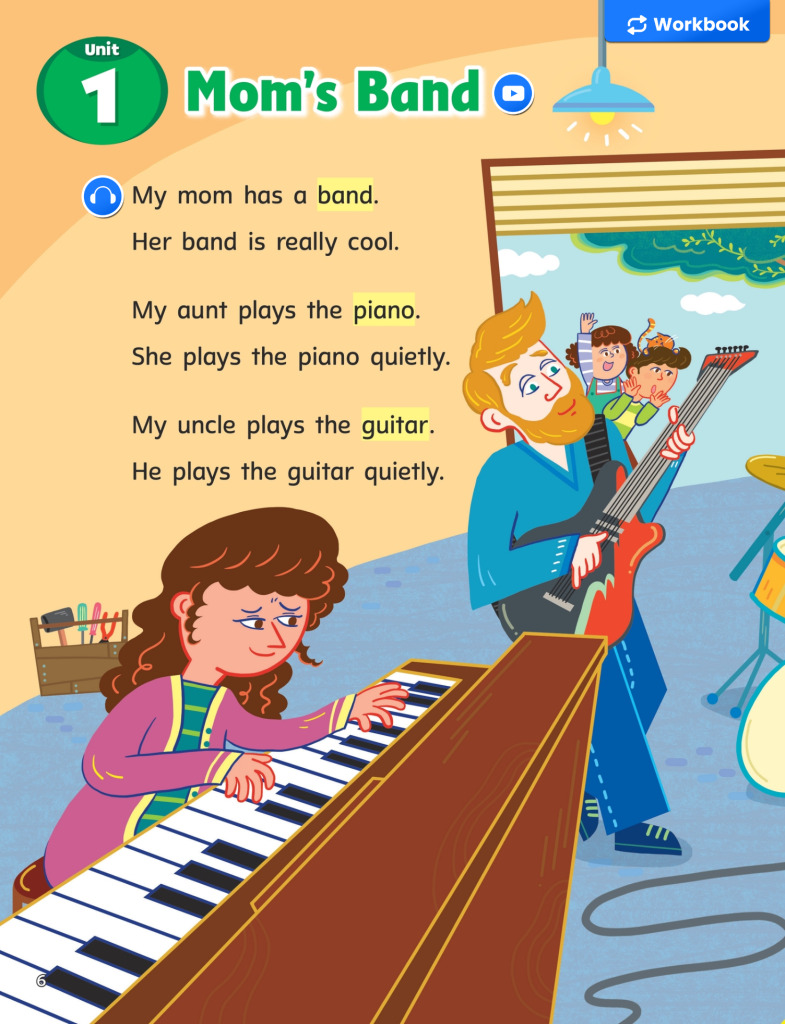
The skills books themselves are built this way. In My First Grammar 2, the Present Simple lesson starts with a “Look and Learn” table of -s, -es, -ies endings, but “Look and Say” follows immediately: children talk about daily routines (They get up at 7:00. He watches TV.). Smart Phonics 3 teaches long vowels through word pairs (bat – bake), and the story in the same unit gives learners a reason to read those words. Smart Reading pairs two short texts on one topic, so there is something to talk about after reading. A skills series does not replace the core coursebook. It gives the group more time for the skill it needs.
Here are three sample set-ups. They are methodological suggestions to adapt, not an official recommendation from the publisher. The minutes assume a typical timetable and are easy to rescale.
Set-up 1: preschool and pre-primary (ages 5–6), two 30-minute sessions
| Session | Material | Time | What children do |
|---|---|---|---|
| 1 | Little Hands 3: story, song, unit words | 30 min | listen, point, sing, answer with a word or a phrase |
| 2 | Little Hands 3: game, art activity, Phonics Book | 20 min | use words in play, recognise letter sounds |
| 2 | picture-and-word flashcards | 10 min | name, guess, ask for a card: Can I have…? |
Over the year: Little Hands 3 carries the whole course in the first term. From the second term, in a group of six-year-olds, the phonics slot can move to Smart Phonics 1 (single letters and their sounds). Goal for the end of the year: the child greets, introduces themselves, says what they want and recognises the sounds of the first letters.
Set-up 2: ages 7–9, three 45-minute lessons
| Lesson | Material | Time | Aim |
|---|---|---|---|
| 1 | Hand in Hand 1–3 (or Let’s Smile, Smart English): new unit material | 45 min | words and structures in a story, song, dialogue |
| 2 | core coursebook: practice and game | 25 min | pair work |
| 2 | Smart Phonics | 20 min | sound–letter links, reading simple words |
| 3 | My First Grammar (from the second term or the second year) | 20 min | one structure the unit needs |
| 3 | Magic Speaking or a Magic Adventures comic | 25 min | conversation and reading for pleasure |
Over the year: a Hand in Hand project at the end of each unit. If the group is taking Starters, 1200 Words for Tests Starters takes over lesson 3 for the last six weeks before the exam. Goal: learners ask and answer about themselves and friends, read a short illustrated text and write a simple sentence.
Set-up 3: ages 10–12 and language schools, three or four 45-minute lessons
| Lesson | Material | Time | Aim |
|---|---|---|---|
| 1–2 | Hand in Hand 4–6 or English Wave 1–2 | 2 × 45 min | the full unit: vocabulary, reading, grammar, listening, speaking |
| 3 | My Next Grammar 1–2 | 25 min | the unit structure, controlled practice, a sentence about me |
| 3 | Smart Listening | 20 min | listening with a task, note-taking |
| 4 or home | Smart Reading or Discovery with Reading Fluency Builder | 45 min or 3 × 15 min | reading for meaning, fluency |
| home | a MetaLibrary mission | 15 min a week | free-choice reading, talking about the book |
Over the year: a project at the end of each unit and, before Movers or Flyers, the matching 1200 Words for Tests book. Goal: learners hold a short conversation on a familiar topic, talk about last weekend and write a few sentences about themselves.
Teenagers (ages 13–18)
English Wave becomes the backbone, because every unit covers vocabulary, reading, grammar, listening, speaking and writing. Add-ons follow the group’s gaps: My Next Grammar 3 (A2) for learners who still mix up basic tenses, Hands on History for those who enjoy history, MetaLibrary for reading up to B2, and official Cambridge sample papers before A2 Key, B1 Preliminary or B2 First.
How to check that the programme works
Every 6–8 weeks, run one task without the book: two minutes of pair conversation on the last unit’s topic and five sentences written independently. Note how many learners speak without help. This tells you more than a gap-fill score, because it measures the goal of the whole programme: independent communication.
If you want to build a programme like this for a whole school, the e-future partner school programme includes help with choosing series, paths and materials for each group. A model without a core coursebook, built only on skills series, is described in English teaching materials: what to choose and where to look.
How to choose the best English coursebook: a checklist
Before you order, go through eight questions:
- Do I know the group’s level from a test and a conversation, not just from their grade?
- Do the topics and illustrations suit my learners’ age?
- Is the unit flow predictable, and can I teach from the Teacher’s Manual without hours of preparation?
- Does every unit end with learners speaking or writing on their own?
- Does language come back in later units (reviews, recycling)?
- Do I have audio, an e-book, flashcards and tests, and do learners have an app for home practice?
- Do I know which series and level come next year, without repeating a level?
- If the group has an exam goal: does the course reach the right CEFR level, and do we practise the exam format with official materials?
Five “yes” answers give you a good starting point. A skills series can fill the gaps.
Frequently asked questions
Which English coursebook should I choose for a seven-year-old?
For seven-year-olds, e-future offers level 1 of Hand in Hand, Let’s Smile and Smart English, all at Pre A1. Hand in Hand has the most CLIL and project work plus YLE preparation, Let’s Smile builds on stories, songs and games, and Smart English uses comics and everyday expressions with an AI app. If the child already learned English in preschool, start with the placement test.
Is one coursebook enough for a whole year?
With two or three lessons a week, a good core coursebook is enough if it has reviews and projects. Add a skills series when you see a specific gap: children do not read, do not follow recordings or mix up structures.
When can learners start English Wave?
In language schools, English Wave already works from around age ten, with English Wave 1 used to consolidate the whole of A1. The move depends on the group’s level and on whether teenage topics appeal to them.
Do I need a separate book for Cambridge exams?
At Starters, Movers and Flyers, Hand in Hand and Let’s Smile include YLE preparation, and 1200 Words for Tests organises vocabulary from the Cambridge lists. For A2 Key, B1 Preliminary and B2 First, practise the exam format with official Cambridge sample papers and build the language with the core course.
Can an AI app replace a lesson?
No. AI Andi in Smart English and Reading Fluency Builder in Discovery give children extra practice and pronunciation feedback. Conversation, games, projects and the teacher’s response stay in the classroom.
Do I pay separately for eSmartClass?
Access to eSmartClass is free for teachers and tutors who have bought the printed books or teacher’s guides of a series. You request access from e-future by phone or email.
Sources
- Cambridge English, Young learners (Pre A1 Starters, A1 Movers, A2 Flyers): exam levels for children and their link to the CEFR.
- Cambridge English, Qualifications for schools: A2 Key for Schools, B1 Preliminary for Schools, B2 First for Schools.
- Cambridge English, International language standards (CEFR): the six-point scale from A1 to C2.
- e-future materials: course books, placement test, eSmartClass, MetaLibrary.